
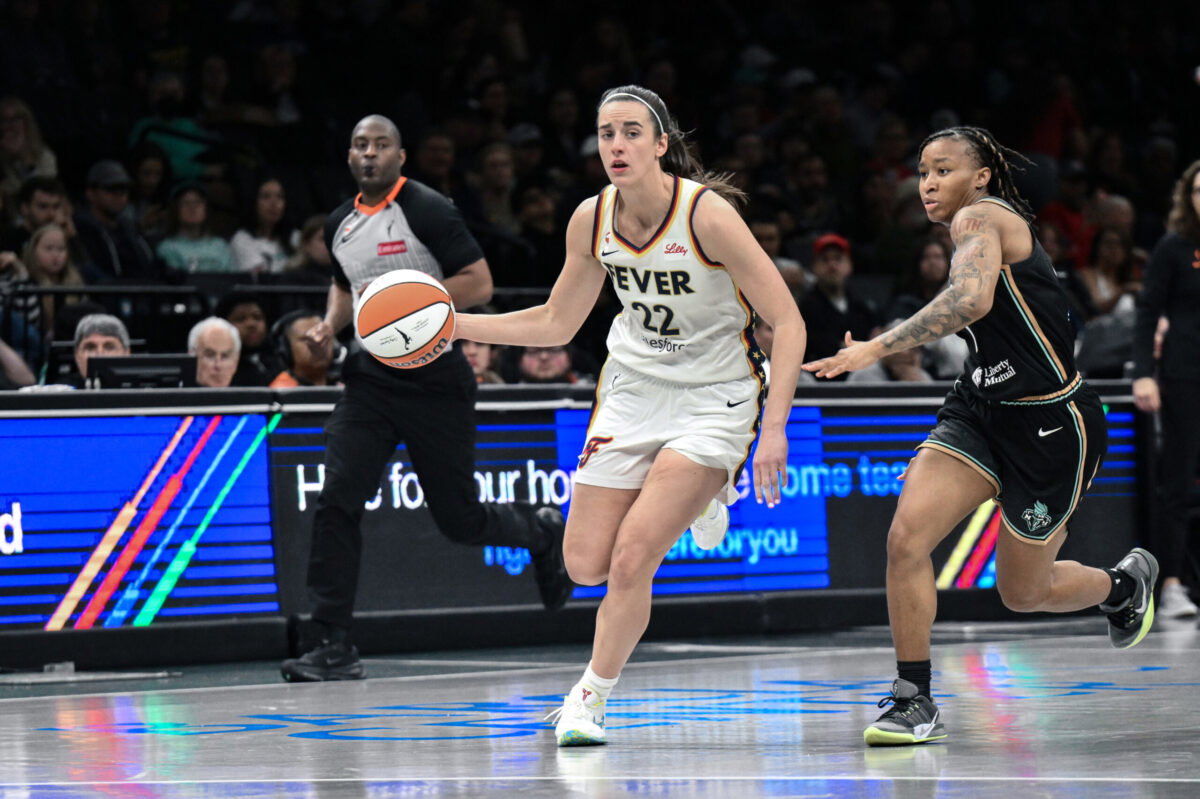
Defending Caitlin Clark can attract fierce backlash from the opposition. And a WNBA journalist found that out the hard way when she defended her against a basketball page that highlighted and criticized Clark’s defensive output across the Fever’s preseason games.
Watch What’s Trending Now!
On Friday, Noa Dalzell tweeted: “This isn’t even the best example. But it sucks that one of the biggest women’s basketball accounts on Twitter constantly throws shots at one player.” What followed was a wave of criticism directed at her, not necessarily for being wrong, but for simply backing Clark.

Hold up, I hope you've been busy the last 48 hours exposing the other pages, posting lowlights of another player. Cause if not, politely STFU, ma'am. We don't want to hear it.🙄

The Indiana Fever have played two preseason games so far in 2026, holding a 1-1 record. Their opener against the New York Liberty ended in a win. However, the second game resulted in an 80-95 loss to the Dallas Wings. Of course, on the offensive end, Clark was a genuine presence across both outings, averaging 14.0 points, 4.0 assists, and 2.5 rebounds per game. Her second game performance drew plenty of admiration.
However, on the defensive side, the numbers were not as impressive. She had 0.5 steals, 0.5 blocks, and 2.5 defensive rebounds per game across both contests. That’s what prompted the criticism from the page in question, which posed whether the star guard could do a better job of keeping opposing guards from getting downhill. And on the surface, it’s not an entirely unreasonable thing to ask.
But the answer isn’t as clean as a simple yes or no. In coach Stephanie White’s offensive system, the team heavily relies on Clark to push the pace. They need her to space the floor and create advantages for everyone around her. That role demands energy conservation. So if Clark is grinding through every screen and chasing ball handlers with the intensity of a defensive specialist, she risks losing the legs needed for those deep transition threes and off-the-dribble pull-ups that make her so uniquely dangerous. Her value, at its core, is in the gravity she creates offensively and how that gravity elevates every teammate on the floor.
Ultimately, the only person best positioned to answer this question is White. If she determines that the Fever’s success requires Clark to invest more on the defensive end, she will ask her to do that. And if she decides that maximizing Clark’s offensive output is the greater priority for this team’s chances, that will guide the approach instead.
It’s a legitimate tactical conversation, but one that probably deserves more nuance than a pointed social media post allows for. But what do you think? Should Clark do more defensively, or is her offensive impact enough to justify the trade-off?
Fans didn’t spare WNBA journalist Noa Dalzell for defending Caitlin Clark
One might wonder what exactly drew the backlash Noa Dalzell received for her defense of Caitlin Clark. Was it because her opinion was factually wrong? Or because the original criticism of Clark’s defensive output was so accurate that defending her was indefensible? Turns out the fans who came for Dalzell weren’t really arguing either of those points.
The core grievance was something different entirely: selectivity. The prevailing sentiment among her critics was that Dalzell would never have shown up with the same energy had the player in question not been Clark. “Now let me scroll your page and see if you have this energy for ANY other woman in the league that spit on them,” one fan wrote pointedly. Another was equally direct: “Shut up, stop having selective outrage! Keep that same energy for all those other pages! Grow up.”
And in what is perhaps the most predictable turn the discourse could have taken, it didn’t take long for Angel Reese to enter the conversation. Fans drew the comparison swiftly, arguing that Dalzell had not shown up with similar conviction when Reese faced criticism or targeted commentary over the years. “Teach your girl how to squabble. Not sure I ever saw you standing up for Angel with the vitriol that has been thrown her way the last three years,” one fan said.
The calls for consistency even extended beyond Reese. They also brought other players into the argument to reinforce the same point. “If you can ignore Azzi and Angel getting clipped, then you can ignore this,” one fan said. Another fan, who also captured the broader message, wrote: “Hold up, I hope you’ve been busy the last 48 hours exposing the other pages, posting lowlights of another player. Cause if not, politely STFU, ma’am. We don’t want to hear it.” The expectation was clear: if you’re not willing to call it out every time, for every player, then staying silent is the more honest option.
But then, whether Dalzell has genuinely been selective in her coverage over her two to three years as a WNBA journalist is a question that’s difficult to answer definitively without a thorough audit of her work. However, regardless of where the truth lies, she has found herself in a no-win situation that public figures in sports media frequently stumble into.