
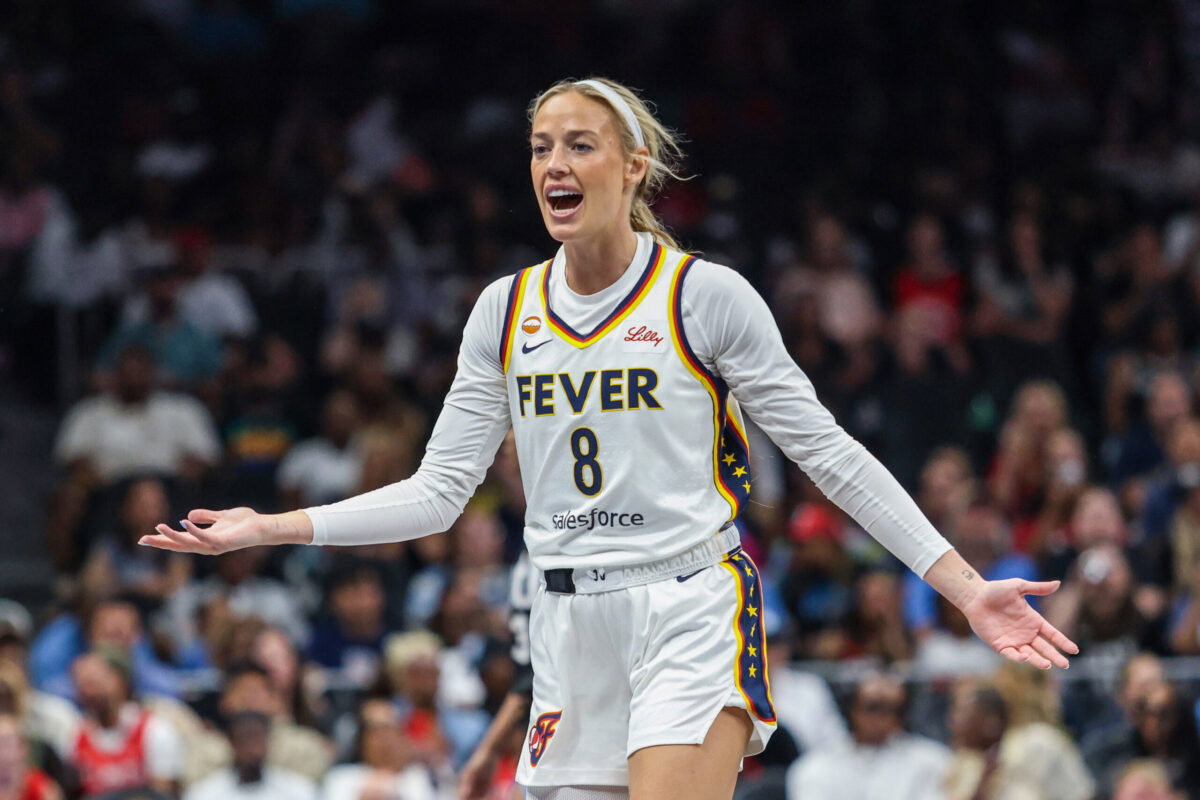
Sophie Cunningham did not hold back when asked about online hate in the WNBA. However, her answer has sparked a much bigger conversation than she likely expected. The Indiana Fever guard’s blunt take drew a rare public rebuke from Martin Luther King Jr. Center, which weighed in directly on the league’s handling of racist and homophobic abuse toward players.
Watch What’s Trending Now!
“Dear @WNBA: Bigoted, homophobic, and racist attacks on social media and otherwise are not ‘outside noise’ or something the Black and LGBTQ players in your league should have to increase their ‘mental toughness’ to endure,” the post read in response to Cunningham’s assessment. “You can and should address the issue with intentionality, strategy, and courage.”
The comments came during Cunningham’s practice media availability ahead of Indiana’s matchup with Las Vegas. This was in the aftermath of Alyssa Thomas’ one-game suspension for making contact with Caitlin Clark’s throat during a June 24 game. Thomas had since gone public about the death threats and racial slurs she received afterward. Asked about the fallout, Cunningham gave a starkly different read than the rest of the league.
“You can put out statements as much as you want. But at the end of the day, you’re in the entertainment business,” she said as per Yahoo Sports. “That’s where mental toughness comes in. If you’re going to live by praise, you’re going to die by the hate.”
“I think it’s on the individual person to have mental toughness. Some people can deal with it, some people can’t.”
That framing put Cunningham at odds with how most of the league responded to Thomas. Stephanie White and Caitlin Clark had both already condemned the abuse directly. But, Cunningham’s assessment reveals a gap: treating hate as a mental toughness issue rather than a league failure. That’s what drew the Martin Luther King Jr. Center’s attention.
The distinction the Center is drawing matters, because not all criticism aimed at WNBA players look the same. Clark has taken heat over her defense all season. Angel Reese hears it over her shooting. That’s the ordinary friction of being a public athlete, and it’s not what Thomas described.
What Thomas was different in kind, not just degree. She named racial slurs and death threats specifically. That’s the sort of targeted hate that does not fall under normal fan criticism no matter how it gets framed.
And the MLK Center isn’t the only entity finding a problem with Sophie Cunningham’s statement. NBC Sports analyst Natalie Esquire has also reacted to the same, drawing astonishment at Cunningham’s comments.
NBC Sports’ Natalie Esquire Reacts to Sophie Cunningham’s Comments on Online Hate
Two-time Sports Emmy Award and NBC Sports analyst Natalie Esquire recently shared her two cents on Sophie Cunningham’s assessment of online hate. She doubled down on explaining the distinction between constructive criticism and excessive trolling and media remarks.
“Mental toughness for racism?” Esquire wrote in an X post. “This is why specifying the kind of hate is important. B/c saying your game s***s and calling you the N word aren’t quite the same thing.”
Esquire’s point cuts to what’s actually at stake here. Telling a player to toughen up against criticism of her jump shot is one. But telling her to toughen up against racial slurs and death threats is an entirely different conversation. Conflating the two is what Esquire and the MLK Center are pushing back against.
Cunningham’s comments may reflect a real and unglamorous truth about life as a public athlete. But the reaction from voices like the MLK Center makes it clear that the league’s response to targeted hate needs more than a shrug and a nod to individual resilience. The WNBA’s “No Space For Hate” campaign exists for exactly this reason, and moments like this one are the test of whether it holds up.