
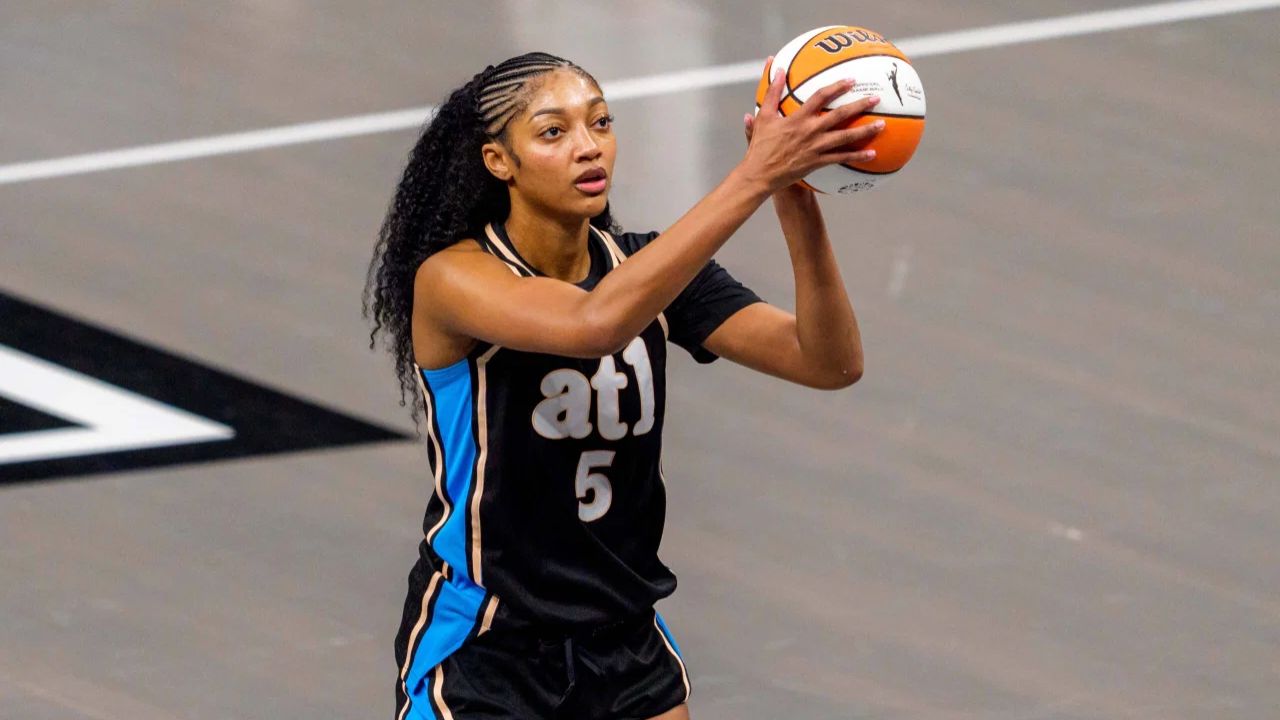
Angel Reese’s 21st career double-double against Phoenix Mercury might have left her fans impressed, but not everyone’s buying the stat-line hype. The Atlanta Dream star closed the game with 14 points, 10 rebounds, 4 assists and 1 block. Seemingly an invaluable contribution to the Dream’s 96-82 win vs Mercury. However, a closer look reveals clear gaps in her game. And WNBA analyst Ben Daniel did not shy away from putting Reese’s Wednesday night performance further under the microscope.
Watch What’s Trending Now!
It started with Ben Daniel questioning the attendance for the Dream’s clash against the Mercury. “Angel Reese has taken the WNBA back to the stone age by herself,” he said, before claiming the actual crowd was closer to 1,200. But that wasn’t the case.
As per ESPN, the announced attendance for Wednesday night’s game was 3,575. While that number might not seem particularly impressive at first glance, it’s worth remembering that the Gateway Center Arena, where the Dream play most of their home games, seats only around 5,000 fans.
In fact, fan demand had grown so much that before the season even began, the Dream announced they would move five home games to State Farm Arena, home of the Atlanta Hawks, which can accommodate nearly 17,000 fans.
And that decision has paid off. The Dream are averaging 6,496.5 fans per home game this season, according to Across the Timeline. While that remains the second-lowest figure in the league, it was still enough for the franchise to surpass last year’s total home attendance in just 15 games.
Hardly the “Stone Age” picture Daniel painted!
But attendance wasn’t really Daniel’s biggest issue. Instead, he turned his attention to what he saw as recurring shortcomings in Angel Reese’s offensive game.
“Good grief. Terrible. Terrible… DeWanna Bonner not even playing defense [on Reese]… They know Angel Reese selfish player… She’s not passing.” The comments came from Daniel as he reacted to the Dream forward’s missed layup, followed by a missed shot after grabbing her own rebound, two missed 3s and another missed shot from inside the arc.
“The scouting report on Angel Reese is out. The defense literally doesn’t guard her when she’s more than 6 feet from the basket,” Fox News reporter Dan Zaksheske wrote on X while sharing highlights from the Wednesday night WNBA clash.
Do the numbers support that criticism? At first glance, Reese’s career-high 16 points per game this season, combined with her elite rebounding, paint the picture of a highly productive offensive player. But a deeper look at the numbers tells a different story.
The Atlanta Dream forward is shooting 43.7 percent from the field with an effective field goal percentage of just 44.3 percent. That is a bottom-tier mark for a frontcourt player who almost lives near the rim.
Even worse, Reese’s two-point shooting percentage is 46.9. A 6ft 4 forward converting under half her shots inside the arc becomes a genuine concern. Especially when other bigs at her position like Jessica Shepard and Jonquel Jones live in the range of upper 50s and 60s.
And when it comes to the three-point experiment, Reese has failed for the most part of it. She has gone just 5-of-36 from three this season despite attempting a career-high 1.2 threes per game.
Now, even if these evident metrics were to leave any room for doubt around her offensive woes, Reese’s true shooting percentage reveals volumes.
Even with the added value of drawing frequent fouls, Reese’s true shooting percentage sits at just 51.4 percent. Take away the foul-drawing and the scoring efficiency collapses. And the concerns don’t end there.
Reese has also been used as a facilitator at times, an experiment Tyler Marsh leaned into last season and one Karl Smesko has also used at times this season. While there have been encouraging flashes, the role has also exposed another weakness. Reese is averaging 3.3 turnovers per game, the fourth-most in the WNBA this season, according to Fox Sports.
However, the single most damning number is Reese’s 0.6 offensive win shares in 29 games, against her 1.9 defensive win shares. Clearly, the majority of her value comes from defense and rebounding.
The offensive shortcomings are evident, but so is Reese’s track record of improving year after year. If she can make similar strides offensively, many of the criticisms surrounding her game may not last much longer.
Last season, after just six games, Reese was already facing intense criticism over her shooting struggles. Of her 61 field-goal attempts, 44 came from the restricted area. Yet despite getting so many point-blank looks at the basket, she was converting just 31.8% of them, according to CBS Sports.
While she led the league with 7.3 attempts per game from that zone, her efficiency ranked last among the top 10 players attempting at least five shots there. Yet, as she has repeatedly shown throughout her career, Reese found a way to improve.
Her shooting in the restricted area improved from just 37.5% to an eye-popping 56.5%. Reese also boosted her overall field-goal percentage from 39.1% in her rookie season to 45.8% last year. That’s become a recurring theme throughout her career: when her game is questioned, Reese has found ways to answer.
Take this season, for example. Against the Phoenix Mercury, she became the fastest player ever to record 70 career double-doubles, reaching the milestone in just 93 games, 25 fewer than the previous record set by Tina Charles.
Criticism has followed Angel Reese throughout her basketball journey, and that’s unlikely to change anytime soon. While her offensive game still has room for improvement, her strengths as a rebounder and defender already make her an invaluable part of an Atlanta Dream team that sits fourth in the WNBA standings with a 19-11 record and is well-positioned for another playoff run.
If she continues improving the way she has throughout her career, the Dream could very well emerge as genuine title contenders. And should that happen, don’t be surprised if Reese’s name starts appearing in MVP conversations alongside the league’s very best, just as her coach believes she can.