
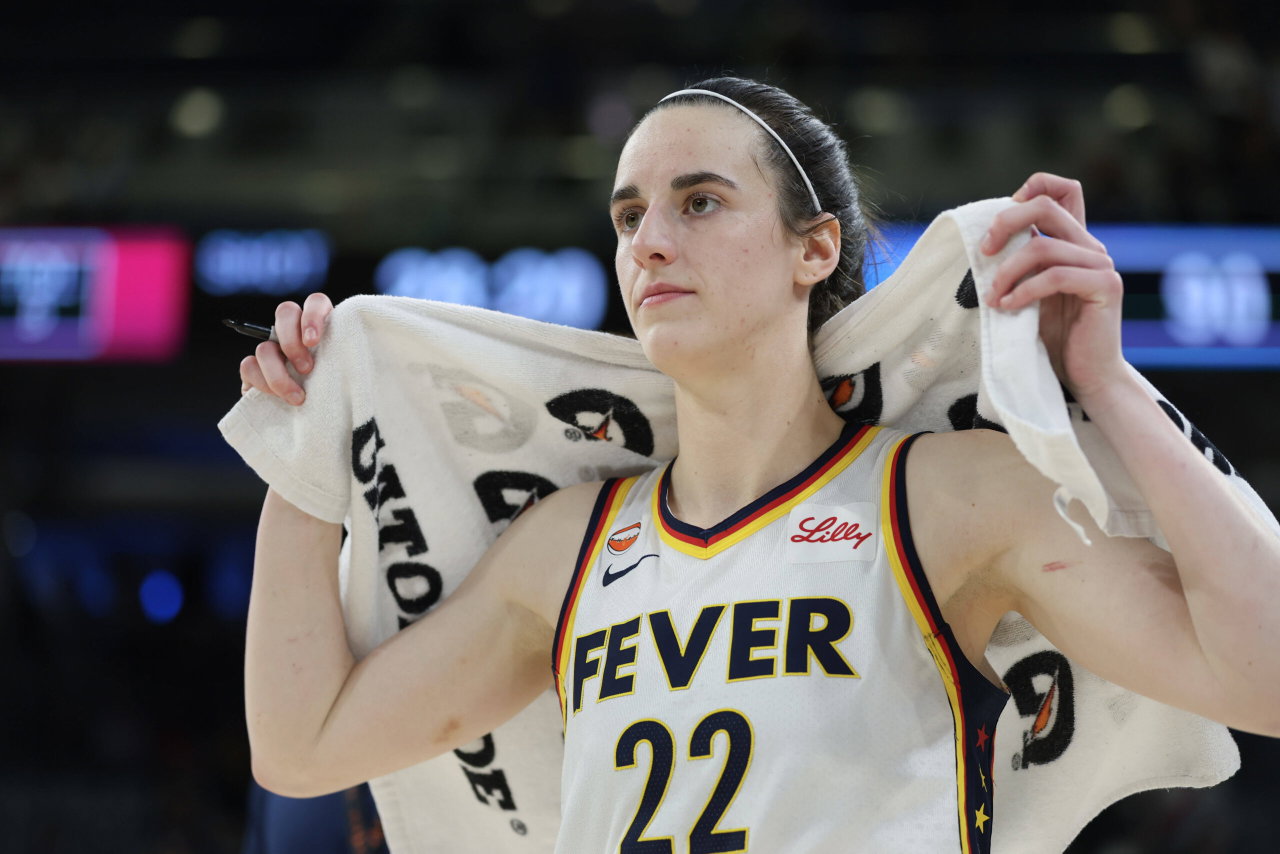
From broken TV ratings and dwindling turnout, the WNBA’s story skyrocketed two years ago, and the center of the new phenomenon was the 22-year-old star from Des Moines, Iowa. Caitlin Clark changed the calculus of the league when the Indiana Fever drafted her from the Iowa Hawkeyes. While the league benefited, the biggest beneficiary of Clark’s stardom was the Fever.
Watch What’s Trending Now!
Three years, two first-round and a semifinal exit later, Clark is yet to taste major success, and questions about her future, although inconsequential, have found space in the larger conversation about the team. According to Christine Brennan, despite mediocre success, she expected Clark to remain in Indiana because she had developed a personal relationship with the city.
“She loves Indiana. She loves the Midwest… they love her there,” said Brennan, the author of On Her Game: Caitlin Clark and the Revolution in Women’s Sports, on Linda Cohn’s show on YouTube. “She loves them there. She’s got a home. Her boyfriend is there…I think she wants to stay there.”
Clark’s arrival was matched with record attendance for the Fever. Fans’ love is hardly a question. Moreover, her boyfriend, Connor McCaffery, works as the player development assistant for the Noblesville Boom, the NBA G League team affiliated with the Indiana Pacers. Clark remains the captain of her own ship, but according to Brennan, the magnitude of Clark’s power goes beyond Indiana.
“[Clark] controls her fate…She’s bigger than the league,” the USA Today columnist said. “She’s so popular that…she doesn’t have to play basketball again, and she could still get major speaking gigs for 10 years, 15 years.”
While Brennan’s claim seems hyperbolic, Clark’s unprecedented effect can’t be denied. She arrived at the scene possessing a unique deep shooting quality, previously dominated by her male counterparts. She was charismatic because she changed coaches’ strategy, and she could see a pass that no one did. But Clark’s effect was more than her on-court magic. Her cultural impact matched Stephen Curry, if not beyond that.
“When you see the numbers, the Indiana Fever desperately want Caitlin Clark to stay and want her to be happy because if Caitlin Clark leaves, the economy of downtown Indianapolis would take a huge hit and everything about the Fever would change,” Beennan added further.
In 2023, the Fever were valued at just $90 million. Three years later, they are worth $560 million. It’s not hard to see what Clark has done to the team. During the 2023 season, the Fever were 10th among 12 teams with 5,699 average attendance, per Across The Timeline.
Clark arrived a year later; they shot to the top of the league. Their average attendance almost tripled to 16,083. Since then, the Fever have been among the top three teams in attendance. Clark’s absence and its impact give a true picture of her impact, and it is reflected in this year’s postseason.
Caitlin Clark’s early playoff exit gives a reality check to WNBA
The WNBA is taking a hard hit in viewership with the Indiana Fever’s early exit from the playoffs. The Fever-Aces series drew numbers in the millions, and as the league started the semifinals without the Fever, the viewership has significantly plummeted.
Game 1 of the Fever-Aces series drew 2.11 million viewers on ABC. To put it into perspective, it was the network’s largest playoff number since 2000, and the third-largest across any. Game 2, which took place in Indiana, touched 1.42 million on Prime Video. While the number might seem smaller than Game 1, it is worth noting that it was despite the MLB playoffs. Days later, Game 3 of the series went further, reaching 2.25 million on USA Network, and peaked at 2.7 million.
However, since the Fever exited the postseason, the league is struggling to even touch a million in viewership. The Liberty were ahead of the Fever in attendance during the regular season. However, their Game 1 of the semifinal against Angel Reese and the Atlanta Dream reached just 654,000.
The Valkyries, which led the league in attendance during the regular season, saw even worse viewership. Their Game 1 of the semifinal against the Aces reached only 500,000.
The deja vu of Clarkonomics
WNBA’s viewership during and after Clark follows a similar trend. Her presence skyrockets the viewership, and once the Fever crash out, viewership crashes down. In her rookie year, the WNBA experienced the first impact of Clarkonomics.
The Aug. 18 game of the 2024 season between the Fever and the Seattle Storm reached 2.2 million in viewership, the largest ever for the WNBA on ESPN. In 2024, the first-round series, the networks drew 944,000 viewers on average, and Game 1 of the Fever-Connecticut Sun drew 1.7 million.
The numbers plunged when the Fever exited after the first round. The decline is evident, and the inhibitor behind those numbers is too. Caitlin Clark is the WNBA’s biggest driving force. But is she bigger than the league itself, like Brennan said? Perhaps not.