
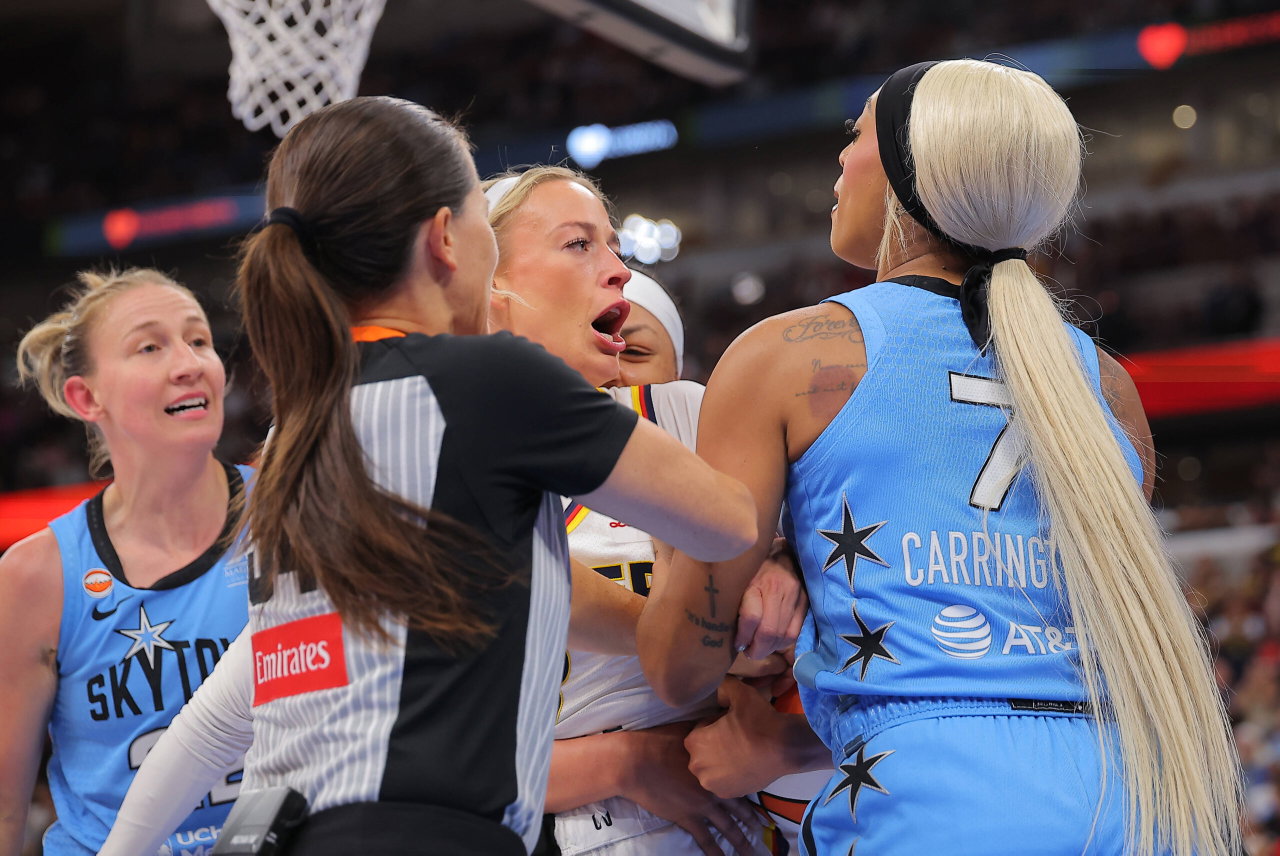
At some point, covering the WNBA became a lot more than just basketball. Every week seems to bring a new controversy. A hard foul, a dispute over officiating, political and racial issues that spawn fresh debates, often spilling outside the WNBA community. For sports caster Elle Duncan, the seemingly nonstop onslaught of controversies in 2026 reached a troubling point.
Watch What’s Trending Now!
“Right now, the WNBA is the most toxic space to cover, and that’s incredibly frustrating and sad,” Duncan said on the Friday, August 14 edition of WHYY’s Sports In America podcast.
“I know everybody that I work with is exhausted by this space right now, and I think the players are included. But I do think that it’s not just the media to blame, just the league to blame, or just the players. I think, collectively, we’ve got to put our heads together and figure out how we right this ship.”
That is a striking assessment from someone who has spent years covering sports, including women’s basketball, from one of the most prominent seats in sports media. But it also raises a bigger question: Has the WNBA’s remarkable rise created a culture where the controversy is becoming bigger than the game itself? As it appears, it is quite difficult to argue against Duncan’s verdict.
The WNBA right now has never had more attention, more star power, and more national exposure. In fact, the 2026 WNBA season kicked off with a historic moment that saw the league reach a landmark CBA agreement. Yet somewhere amid that growth, the conversation around growth was overshadowed by controversy.
Officiating disputes, foul calls, and heated moments have always been part of sports. However, the difference, as it appears to be with the WNBA, is that these controversies have been seemingly never-ending, becoming the main discourse all season long and relegating the basketball gameplay, which is supposed to be at the center of it all, to the sidelines.
The establishment of the special officiating task force caused foul calls to increase, and instead of streamlining play, every missed call created more friction between officials and players and generated huge debate among fans.
One notable example came from Chicago Sky guard Natasha Cloud, who criticized the refereeing after a highly physical game against the Minnesota Lynx. That game saw her fellow Chicago Sky teammate Rickea Jackson suffer an ACL injury that has now ruled her out for the remainder of the 2026 season.
“The ultimate job is to control and protect the players in this game. And I think that this group today failed to do so. They failed to protect Rickea, they failed to control the game,” Cloud said.
“The points of emphasis is great, but I also think it’s a little b——-. They need to let us play, but there also needs to be control of the game. I don’t think for the majority of the game tonight these refs had control,” Cloud added.
All that physical play and the scrutiny surrounding officiating culminated in a game where Alyssa Thomas committed a hard foul against Caitlin Clark on June 24. A game where one player had her fist pressed against another player’s neck and no call was made did little to ease the existing concerns. If anything, it appeared to justify the criticism that had already been building.
And it did more than that. It resulted in another line of controversy that dominated the league for weeks.
There were massive debates over whether referees were failing to protect players, claims of a league-wide target against Caitlin Clark, and narratives that the treatment seemed to be a result of the animosity surrounding her. To a large extent, Thomas’ actions in the wake of the incident seemed to reinforce those existing narratives.
At least, if it was genuinely a mistake or error, an apology or even a remorseful response might have helped matters. Instead, what followed was Alyssa Thomas adamantly maintaining that the foul was entirely unintentional, calling it a “complete accident,” while her coach, Nate Tibbetts, took a defensive stance and spent his media availability criticizing the WNBA’s “not thorough” investigation before Thomas’ suspension for her action. These responses did not in any way taper down the already heated conversation. Instead, they appeared to fuel the negative narrative even more.
“I’d like to hit on my disappointment in the suspension process by our league and our leaders in the W. This was not a thorough investigation in my opinion,” Tibbetts said.
Thomas, in the aftermath of the whole situation, did claim that it had resulted in unwarranted hate, threats, and abuse directed at her and her teammates. And as expected, that shifted the entire conversation from what could have been a routine basketball disciplinary review into a massive, culture-wide debate regarding player safety, discrimination, and extreme online backlash. Her comments even forced the WNBA to issue a formal statement vehemently condemning the hate and coordinating with team security.
And while all that was going on, the situation escalated to the highest levels of the United States government when a group of congressional lawmakers intervened. A group of 11 Republican members of Congress, led by Texas Representative August Pfluger and including representatives from Indiana and Iowa, penned an official letter directly to WNBA Commissioner Cathy Engelbert.
And, of course, that again led to another round of debate, with critics and sports commentators widely slamming the political intervention and accusing the politicians of weaponizing Clark as a symbol of cultural grievance to score political points. In fact, by this point, Clark herself was already beyond exhausted.
“I think for myself, like I just try to navigate it the best I can. It gets exhausting. It gets frustrating. Yeah, it was a hard foul… it was then reviewed. Great, we move on. It’s basketball. When I walk out of the locker room, I shouldn’t be not fearful of what the conversation is going to be, but you know, you just like it’s emotionally exhausting. It’s draining,” Clark said in an interview with ESPN’s Malika Andrews ahead of the All-Star Weekend in July.
“It makes your shoulders tense because, you know, people don’t want to talk about the basketball. They just want to stir it up and make it something else,” Clark added.
Now, while all that seemed to be dying out, with Clark getting back on the court after two weeks away with injury and the discussions around the league being replaced by the All-Star Weekend games as they should, another round of controversy seemed to just receive the baton from the existing discourse that has not even quietened down completely.
The controversy shifted to political culture wars when Sophie Cunningham gave a wide-ranging interview to ESPN, expressing her opposition to transgender athletes in women’s sports, saying, “I want to protect young girls in a locker room, or young girls in sport who shouldn’t have to go against biological men.” The backlash, reactions, and conversations surrounding that have now gone on for about four weeks, and it is not looking like it is stopping anytime soon.
The controversy has seen opposing players and coaches take stands against Cunningham’s position. Notably, Minnesota Lynx coach Cheryl Reeve wore a “Trans kids belong” shirt during a game against the Fever, while Cunningham faced heavy booing from crowds during away games. A part of the fan base has vocally supported the Fever guard as well.
Of course, all these developments that have resulted from the controversy have been food for the media and have continually dominated the discourse around the league. And honestly, it seems tiring at the moment even for Sophie Cunningham herself, who appeared to have sparked the controversy in the first place.
“I think the WNBA media, all we ever do is cover everything except basketball. And it’s like, what are we doing? … For me, I want to get back to basketball. It’s always been about basketball,” Cunningham said.
That frustration, as rightly expressed and justified as it was, has done nothing to quiet the conversation. On Sunday night, August 16, WNBA security in Atlanta even faced backlash for allegedly forcing fans to cover up their “XX-XY” shirts, which were in support of Cunningham’s stance. The controversy reached such a boiling point that moderators of the main WNBA subreddit officially banned any mention of Cunningham’s name in an attempt to control toxic online vitriol.
Beyond all the debates and arguments, the most dramatic turn that all these conversations have taken is the decision by former NBA players Enes Kanter Freedom and Royce White to identify as women and declare for the WNBA’s 2027 draft. The rationale behind their declarations has been that since the league cannot decisively clarify who a woman is, despite stating that only women are eligible to play in the league, they might as well identify as women and test the boundaries of the league’s eligibility rules.
Enes Kanter Freedom on Tuesday even came out with an announcement that eight more men from the NBA G League and abroad will be declaring for the draft as well. The league, however, has since denounced these applications as “bad-faith efforts” to demean and marginalize others, noting that no immediate eligibility crisis exists.
But then, amidst all these controversies, what exactly is within the WNBA’s very own control? Because all that the media, fans, and other entities with an interest in the league have been reporting or talking about has actually happened. It does not seem logical to simply suggest that these conversations should magically cease. These conversations will continue to happen for as long as the actions on and off the court keep triggering them.
And so perhaps the responsibility lies first with the league, its leadership, coaches, and players to keep everything centered on basketball. The WNBA cannot necessarily control which incident becomes the center of a debate or how outside entities choose to involve themselves. But it can control what happens within its own walls and on its own basketball courts.
Perhaps that is where the conversation needs to begin. Before the discussions surrounding the controversies, politics, officiating, player safety, and everything else can quieten down, there first has to be fewer things within the league itself continually triggering those conversations.
So while it seems like the WNBA has begun ‘losing it’s way’ as it struggles to contain the discourse, it may not be too late. While ex-NBA stars like Enes Kanter Freedom and Royce White have suggested that they’ll continue to push for eligibility, the solution could be a more concrete stance. However, for now, the WNBA has stated it needs more time to give that concrete answer.
“We also plan to convene additional discussions and offer listening sessions for any team leaders who would like to participate. Your perspectives and feedback are invaluable, and I appreciate those who have already reached out to share their thoughts,” Engelbert said after the Anti-Hate Task Force’s August 12 meeting.
Whether the WNBA will be able to ‘right the ship’ like Duncan suggested depends on how deliberate they are with their policies.