
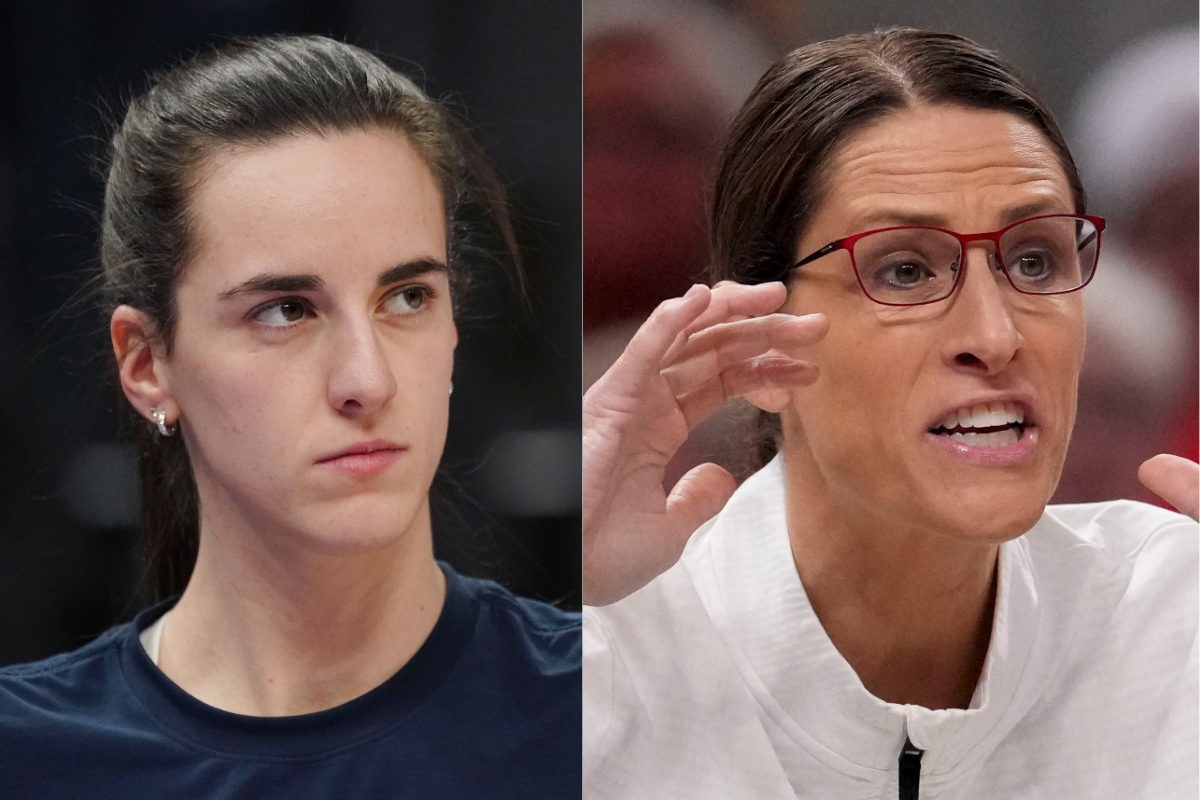
Just days before Stephanie White became the latest villain in the Caitlin Clark discourse, Clark was trying to stop another controversy entirely. The Indiana Fever star had been ruled out with back stiffness, a routine precaution for a player who battled multiple injuries during her rookie season. Instead of accepting the explanation, portions of the internet immediately began constructing alternative theories.
Watch What’s Trending Now!
Some claimed she had been secretly punished for “going rogue” on offense. Others suggested there had been tension behind the scenes between Clark and the Fever coaching staff. Clark eventually addressed the speculation herself.
“I actually went back and looked, because of all these narratives that are going crazy online, about when I told my mom I wasn’t gonna play the game: 4:47. You guys found out at 5:20. So one of the most important people in my life found out 40 minutes before you guys.”
Yet the conspiracy theories never truly disappeared. That is precisely why Seerat Sohi believes the discussion surrounding Clark has evolved beyond basketball.
“The words that are actually coming out of her mouth just seem to be really irrelevant to a lot of people who are pushing the most sort of loony conspiracy theories,” Sohi said. “Media at that sort of level just needs heroes and villains, and the nuances of individual people just get blunted out by that.”
Those comments gained renewed attention after Clark’s heated sideline exchange with Fever head coach Stephanie White during Indiana’s 100-84 loss to the Portland Fire. The clip quickly went viral, spawning criticism of White and reigniting accusations that the coach was mishandling the league’s biggest star.
But a closer look at the controversy suggests White may have become the latest target in a narrative that was already building long before the Portland game ever tipped off.

Could Caitlin Clark put an end to the conspiracies if she wanted to? @seeratsohi Watch The Play-By-Play LIVE every MWF!
The viral timeout exchange did not create the backlash against White. It merely accelerated it.
When White was hired in November 2024, the reaction was overwhelmingly positive. She was viewed as one of the league’s brightest basketball minds and the ideal coach to maximize a roster built around Clark and Aliyah Boston. Clark herself had praised White long before the hiring, calling her a “great basketball mind” and someone who had always supported her game.
Over time, however, skepticism evolved into a pattern. What started as minor criticism of White’s comments about player salaries soon expanded into debates about Clark’s off-ball role, substitution patterns, defensive schemes, and overall offensive philosophy. By late May, the backlash had developed its own timeline. First came criticism of White’s contract-related comments.
Then came complaints about her efforts to diversify Clark’s role beyond constant on-ball creation. A precautionary rest day later triggered theories that Clark was being punished for “going rogue” offensively. By the time the Portland game arrived, many fans were already viewing every White decision through the lens of conflict rather than basketball.
By May 2026, some content creators were openly asking whether White was “destroying” Clark’s game. Others argued that Indiana’s offense worked better without the former Iowa star. The Portland loss then poured gasoline on an already smoldering fire. The reaction quickly escalated beyond basketball analysis.
One viral fan post claimed White viewed Clark as “an enemy.” Another accused the coaching staff of “deprogramming” Clark and stripping away the instincts that made her a superstar. Others argued White’s offense worked better without Clark and even suggested the Fever should trade the face of the franchise altogether. The speculation eventually escalated to a point where false reports claiming White had already been fired began circulating online.
Those claims reached a point where Indiana beat reporters were forced to publicly refute rumors circulating online. The growing tension also prompted basketball commentator Mick Talk Hoops to make a dramatic prediction.
“I’m going to be honest. I think the days are numbered for either Stephanie White and Caitlin Clark.”
The statement generated significant attention, but the actual basketball reality tells a very different story. Through the opening weeks of the season, Indiana owns the highest-scoring offense in the WNBA at 92.9 points per game. The Fever rank fourth in defensive rating, third in net rating at plus-6.5, and second in pace despite their 4-4 record.
If White were truly holding Clark back, the numbers would likely reflect it. Instead, Clark is averaging 23.8 points and a league-leading 9.0 assists per game while operating within one of the league’s most productive offenses. The criticism may be real, but the statistical evidence for systemic dysfunction remains surprisingly thin.
Those numbers hardly reflect a franchise in crisis. In fact, they suggest a team navigating normal early-season growing pains rather than a coach-player relationship on the verge of collapse.
Caitlin Clark continues telling a very different story
Perhaps the strongest evidence supporting Sohi’s argument is Clark’s own history. Again and again, major controversies have emerged around her career. And again and again, Clark has responded by lowering the temperature. When Chennedy Carter’s controversial hip-check became one of the defining moments of her rookie season, Clark refused to fuel the outrage.
“No. I mean, basketball’s competitive. I get it. Sometimes your emotions get the best of you.” She said. “There’s no grudges. There’s nothing like that.”
When she was left off the 2024 Olympic roster, Clark rejected narratives of disrespect and victimhood.
“Honestly no disappointment. Like I think it just gives something to work for.”
Even the highly publicized Angel Reese discourse followed the same pattern. While fans and commentators attempted to frame the relationship through rivalry, race, and resentment, Clark consistently emphasized respect and admiration instead.
The Portland controversy followed the exact same pattern. Instead of criticizing White’s substitutions, defensive schemes, or offensive system, Clark accepted responsibility for her own performance.
“Officiating wasn’t our problem tonight.”
Perhaps the strongest evidence supporting Sohi’s argument came before the White controversy ever happened. Clark publicly detailed the timeline behind her precautionary rest day, explained exactly why she sat out, and personally pushed back against online speculation. Yet within days, another conspiracy replaced it. The target changed. The pattern did not.
The comments were consistent with how she has handled criticism throughout both her college and professional career. Whether playing for Lisa Bluder at Iowa, Christie Sides during her rookie WNBA season, or White in Indiana, Clark has consistently redirected attention toward team execution and personal accountability rather than public blame.
That history becomes even more important when examining the actual relationship between Clark and White. There is little public evidence supporting the notion of a fractured partnership.
Clark praised White before she was ever hired. Long before White arrived in Indiana, Clark described her as “a really great basketball mind” and credited her for being supportive of her game. White, meanwhile, was hired specifically to build around a young core led by Clark and Aliyah Boston. The public record shows years of mutual respect. The conspiracy theories largely rely on interpretations of isolated moments rather than documented friction.
White has repeatedly highlighted Clark’s competitiveness, leadership, and impact on the sport. Following the Portland game, White explained that Clark’s foul trouble forced difficult rotation decisions and described the situation as standard game management rather than personal conflict.
History suggests this kind of reaction is hardly unique. In 2015, LeBron James appeared to shove Cavaliers coach David Blatt during a game, creating weeks of speculation about a fractured relationship. Both later explained that James was attempting to prevent Blatt from drawing a technical foul.
Michael Jordan initially resisted aspects of the triangle offense before winning six championships under Phil Jackson. Kobe Bryant and Jackson spent years being portrayed as incompatible personalities despite capturing five titles together. In each case, brief public moments became evidence for narratives that were often far more dramatic than reality.
That is ultimately what makes Sohi’s observation so compelling. Clark has repeatedly attempted to correct narratives surrounding injuries, opponents, teammates, coaches, and league decisions. Sometimes her comments calm the conversation. Rarely do they stop it entirely.
The irony of the Stephanie White controversy is that Clark has already done exactly what critics often ask of her. She has defended teammates, supported coaches, accepted responsibility for losses, and pushed back against conspiracy theories when they arise.
Yet the narratives continue anyway. Which may be the strongest evidence that Sohi was right from the beginning.
Clark has repeatedly defended opponents, teammates, coaches, and even league decision-makers. She has rejected outrage over Chennedy Carter, downplayed Olympic snub narratives, pushed back on rest-day conspiracies, and taken responsibility after losses. Yet the debates continue anyway.
As Sohi observed, the modern sports content economy thrives on heroes and villains. What the algorithm cannot afford is for Clark to be normal. That may be why her attempts to calm controversies so often fail. She explained her rest day. She defended Chennedy Carter. She downplayed the Olympic snub. She took responsibility after Portland. Yet each time, the debate simply found a new target.
Stephanie White may be the villain of the week. If history is any indication, she probably won’t be the last.