
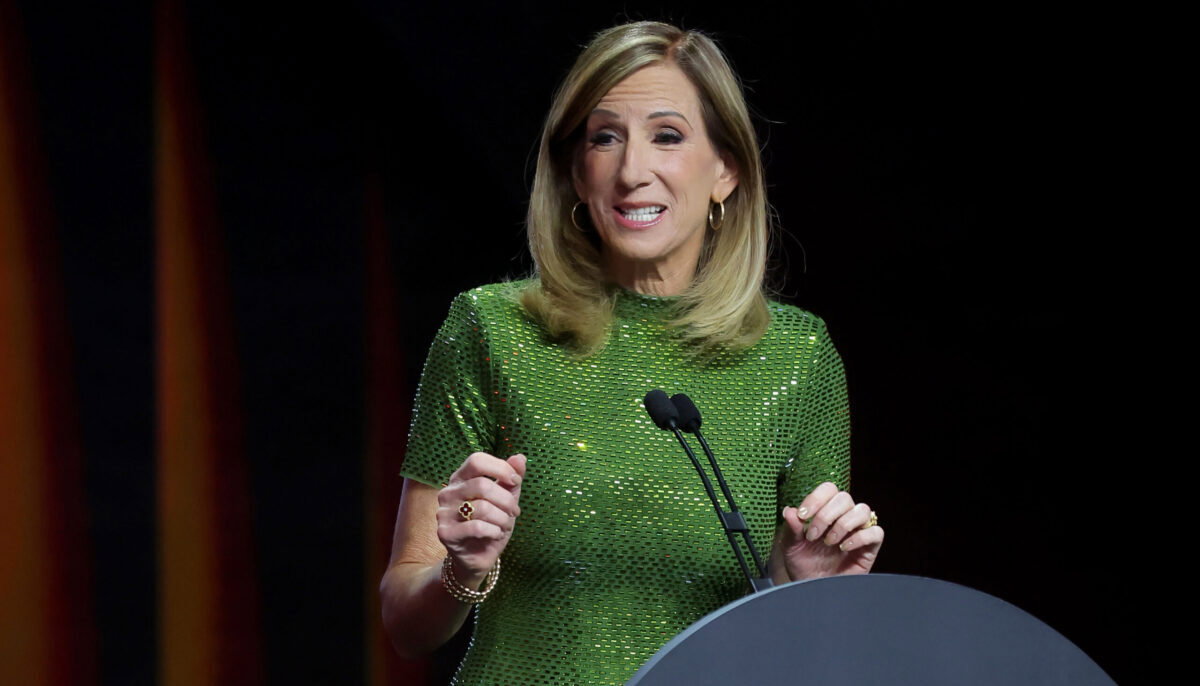
Cathy Engelbert is grabbing the WNBA’s lightning-quick rise by the scruff of its neck. The league once only imagined being in the spotlight. Now it’s filling stadiums and handing out millions in salaries while signing billion-plus-dollar media deals. With the increased attention, the league is expanding its product to 50 games per team. It feels like just yesterday when they were playing 32 games a season. At first glance, a rise in games seems like a completely positive development. But Annie Costabile and Sabreena Merchant have pointed out some major drawbacks for the next generation that arrives on the big stage.
Watch What’s Trending Now!
“Let’s say training camp starts on April 1st and the draft happens, what, like April 13th or something like it did last year?” Merchant said on the ‘No Offseason’ Podcast. “The earliest you could appear to training camp would be two weeks after it starts, which makes your transition that much harder to learn the systems and learn the concepts. It doesn’t seem like an ideal method of starting a WNBA season to me.”
The league has been dealing with this logistical sandwich for its extension. In their CBA negotiations, the league reportedly suggested an NBA-style combine for the league before the draft. But the scheduling concerns made it almost impossible to do so. However, it’s unconfirmed why it did not make it in the final CBA.
Even without a combine, it has always been a very quick transition for the WNBA pipeline.
“So you basically go home for one day and pack up your whole life and then move to a new city, the city that you get drafted to,” Caitlin Clark said in 2024. Kelsey Plum called it ‘sink or swim,’ while A’ja Wilson termed it as ‘insane.’
It is a major step up for college athletes, both mentally and physically. Now they are going up against legends who are stronger, smarter, and more experienced. Their stature drops from being a star at their program to being a rookie. Instead of leading the team, they have to switch to learning. This quick turnaround does not help their adaptation. The players’ plight often gets the spotlight. But this increase will stretch the front office staff as well.
“The draft is typically a week after that (Final Four),” Costabile said. “Under this standard, that would mean rookies are showing up late to training camp. But it would also mean that WNBA staffs, which are already shorter or limited in comparison to NBA staffs, would be pulling double duty.
“They would be preparing for training camp, getting training camp underway, and also scouting. One of the most opportune moments to scout is obviously the tournament, with the Final Four ultimately being the first weekend in April.”
The WNBA facilities and staff count are rising, but they’re nowhere near the NBA. For example, the Pacers have clearly listed multiple scouting roles on the NBA side. That includes a Senior VP of Pro Scouting, a Manager of G-League & International Scouting, a Director of College Scouting, and several scouts.
On the Fever side, it lists only one scout and one Advanced Scouting & Video Coordinator. With this roster crunch, each team’s front office will be stretched, and the better-prepared team will get an advantage. Note that the data on Toronto Tempo and the Portland Fire is not available yet.
With this increase in workload coming, the teams could stack up even more till the offseason arrives. The new CBA already requires teams to meet certain staffing levels, including “access to additional physicians, athletic trainers, strength and conditioning coaches, physical and massage therapists, and nutritionists.”
The league also has an arms race when it comes to facilities. Now, the teams are competing in other aspects as well. For now, expansion is bringing everything the WNBA wanted: more games, more money, and more attention. But as Merchant and Costabile point out, growth comes with growing pains, and the teams that adapt fastest may gain the first real advantage.