
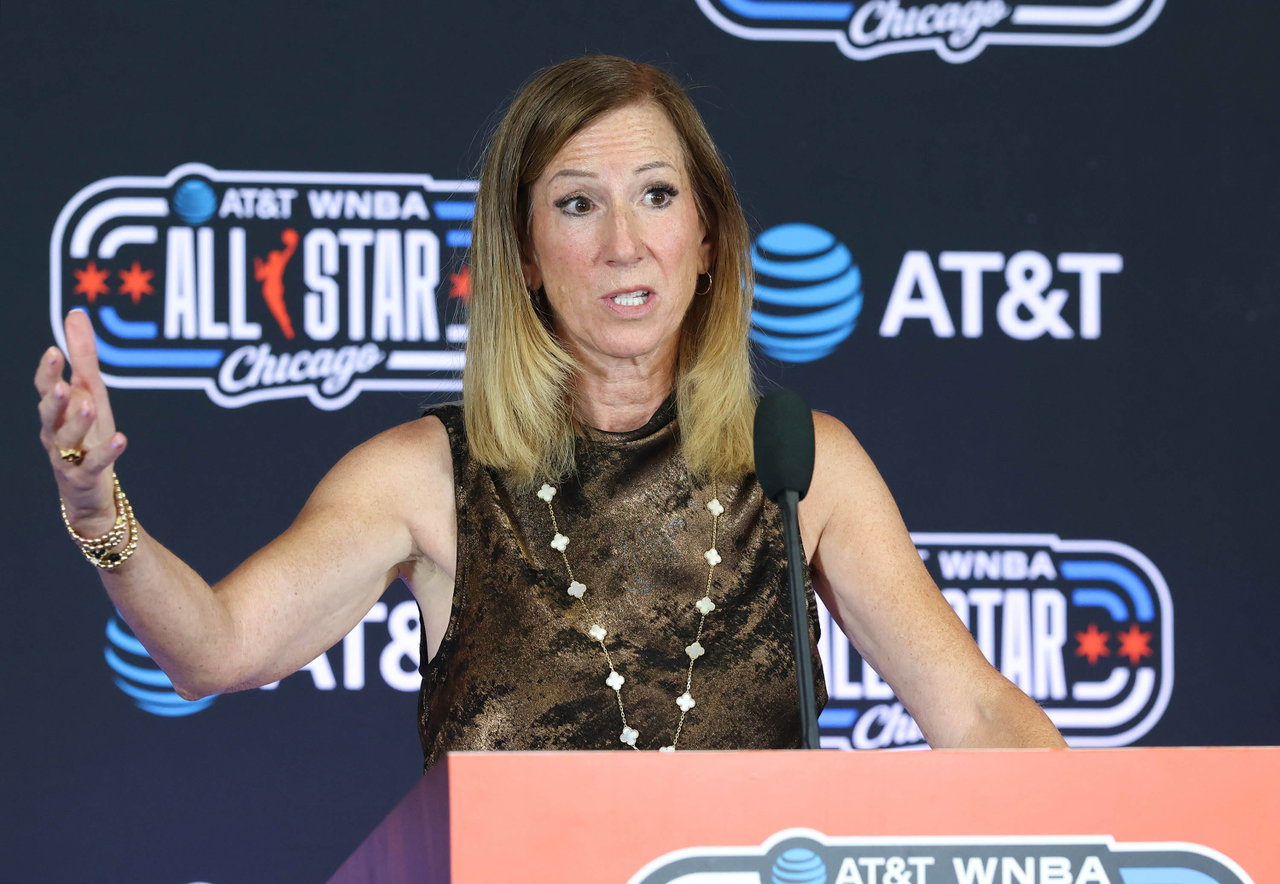
On Friday, WNBA commissioner Cathy Engelbert announced her retirement from the league, effective at the end of this year. So naturally, questions about what she has done during her tenure will be raised. But her work in the league is not black and white. Engelbert’s tenure as commissioner has been defined by two very different realities. She took over a league that was still fighting for relevance in 2019, only to leave it after years of unprecedented growth.
Watch What’s Trending Now!
So looking back at Engelbert’s early years, WNBA analyst Sabreena Merchant pointed to the “existential moment” for the league.
“It was kind of an existential moment for the WNBA, and her working with the (Players Association) to have that 2020 season was critical just to keep the WNBA on television – in people’s minds,” Merchant said in a September 4 episode of No Offseason. “They didn’t really get a big amount of revenue out of that deal because there were no fans, obviously. They had a limited TV contract because it was only 22 games for the season as opposed to the 30-plus that they were having in previous years. But it was important just to have the WNBA in the national consciousness.”
“Then you think about the 2020 season…there was a lot that created a platform for the WNBA in that season. And it doesn’t really happen if they’re not playing during that time, which again was like up in the air because it was very hard for sports to get back on after the pandemic. And her ability to combine with the PA to make that happen, I think, was a huge part of it.”
“Then you get into the 2021 season, which is also like a limited-attendance year. A lot of arenas are not letting fans back in. And I think it’s kind of still like this very again existential point for the WNBA, where they don’t know what is going to happen, how it’s going to rebound out of this really terrible time for the country and sports as a whole,” she added.
Just a season after Cathy Engelbert became the commissioner of the league, she helped negotiate a groundbreaking Collective Bargaining Agreement that increased player salaries and added cash compensation. But everything quickly spiraled as the league was faced with the COVID-19 pandemic at a time when the WNBA was still fighting for relevance.
But still, Engelbert worked with the WNBPA to pull off a 22-game season in 2020 in an isolation bubble at the IMG Academy in Bradenton, Florida. Though that season generated limited revenue due to having no fans and fewer games, the league was kept in the public eye and the brand stayed alive when its future was anything but certain.
However, that was only the beginning of the difficult decisions Cathy Engelbert had to make as the league tried to move forward. And it was her next major financial move that Merchant finds much harder to rationalize.
In 2022, Engelbert helped lead a $75 million capital raise by selling a 16% equity stake in the WNBA.
“And that’s like the situation when the raise happens, right? So I understand, in hindsight, it looks terrible. Even in the time, it looked really weird because so many of the investors were current owners,” Merchant further added. “So, if they were willing to put the money in as part of the capital raise, couldn’t there have been some other agreement whereby they could have given money for maybe not a stake but like just the general growth of the league, or a better negotiation there because 16% is just so much of the league to give up, especially when the WNBA is already half owned by the NBA.”
Coming off the pandemic and two seasons that had severely disrupted the league’s normal business, the WNBA was desperately in need of fresh capital. So in February 2022, the $75 million raised was the largest investment round in women’s sports at the time, with the money earmarked for brand elevation, marketing, globalization, and infrastructure.
The problem, however, was how much ownership the league gave up to secure it.
Before the capital raise, NBA owners collectively controlled 50% of the WNBA, with the league’s team owners controlling the other 50%. But after the sale, that collective stake fell to 42%.
“I understand where the business was to get Cathy to that point. But it’s just hard to rationalize it with the group of investors that came in not being able to get a better deal because they were already part of your league, and then all of the things that were supposed to come out of this, like the digital transformation of the WNBA. I cannot complain enough about WNBA ID and the WNBA stats page, and why these things aren’t better, because they used to be so good,” Merchant said.
But Cathy Engelbert’s tenure cannot be viewed through a black-and-white lens. Although the journey had its fair share of wrinkles, under her guidance, the WNBA survived one of the most uncertain periods in its history, expanded its footprint, secured major investments and media rights, and entered a new era of player compensation, with players now eligible for a supermax salary of $1.4 million.