
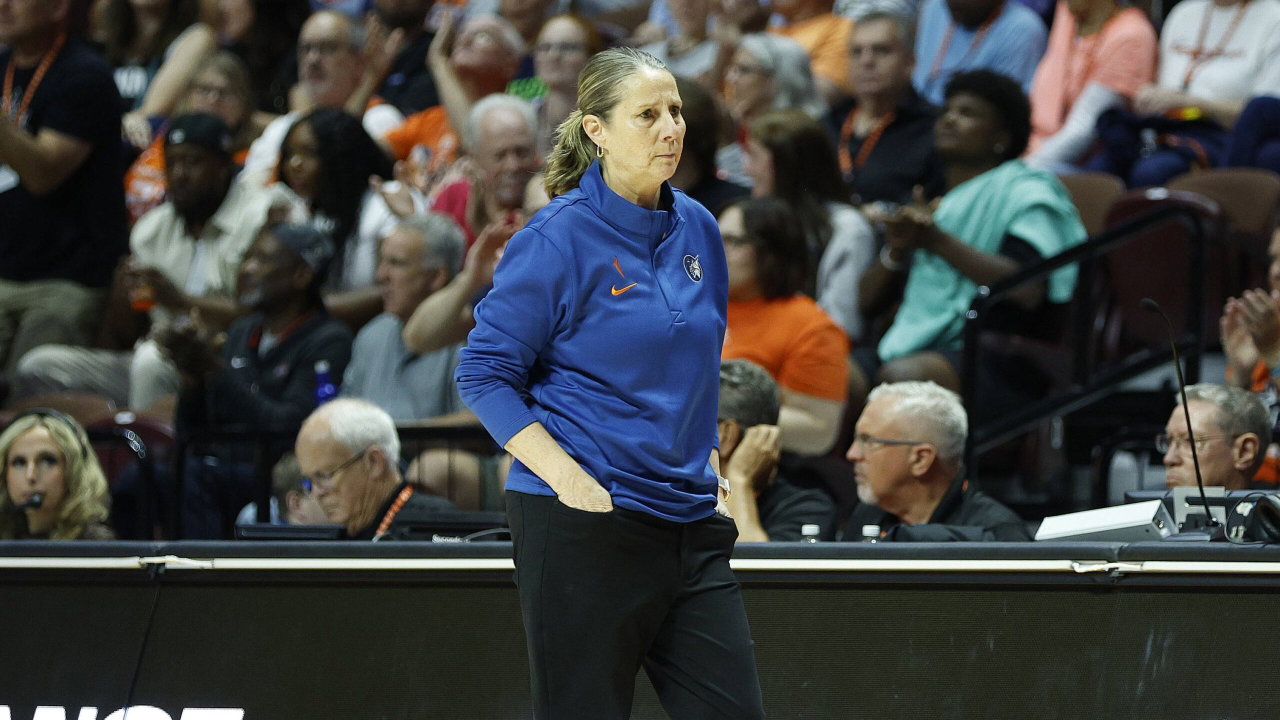
One year after the Minnesota Lynx left Barclays Center believing a championship had slipped away from them, Cheryl Reeve returned to the same building with a very different problem. The 2024 WNBA Finals had ended with Minnesota losing Game 5 in overtime, 67-62, after a late foul call allowed Breanna Stewart to tie the game at the free-throw line. Nearly two years later, there was no five-game battle or last-second drama waiting for Reeve. There was a playoff sweep.
Watch What’s Trending Now!
The timing made it even harder to process. Just one day earlier, Reeve had accepted her fifth WNBA Coach of the Year award after leading Minnesota to a league-best 33-11 record. Rookie point guard Olivia Miles had also been named the unanimous Rookie of the Year. Then, on September 29, the Lynx were back in Brooklyn fighting to keep their season alive. New York had other plans.
But the biggest revelation came after the game, when Reeve offered an unusually direct explanation for why the team that had looked so good for 44 regular-season games could not find an answer when the playoffs arrived.
“There are sometimes when you have that team and that would be the case, you should feel that way… I have not felt like we’ve had that team over these three years, and so what we’re doing is sort of maybe exceeding expectations in the regular season, and then when it comes playoffs, maybe we don’t quite have the right group to be effective.”
The No. 1 Seed Never Got Comfortable
That was not simply a coach explaining one bad night. Reeve was talking about a problem she believes has followed Minnesota for three years. And after the Lynx became the first No. 1 seed in WNBA history to be swept by a No. 8 seed, that admission suddenly carries much more weight.
New York made the mismatch impossible to ignore.
The Liberty entered the playoffs as the No. 8 seed with a 26-18 record, seven wins behind Minnesota. On paper, the matchup looked like a major opportunity for the Lynx to move on. Instead, New York won both games and finished the series with a 32-point advantage.
Game 1 already showed where the series could go. New York won 91-75 in Minneapolis, with Breanna Stewart putting up 34 points, 12 rebounds and six assists while shooting 11-of-18 from the field. The Liberty also shot 50.8% overall and 52% from three.
Minnesota never found a comfortable offensive rhythm. Olivia Miles, who had been one of the biggest reasons for the Lynx’s regular-season success, finished her playoff debut with 11 points on 3-of-12 shooting, one assist and three turnovers.
Then came Game 2.
Minnesota fell behind 9-1 almost immediately and entered halftime down 49-37. Jonquel Jones controlled the paint early, scoring 14 of her 21 points before halftime. When Minnesota tried to make a push in the third quarter, New York had an answer.
The Liberty eventually won 87-71.
And that is where the series stopped looking like a random upset.
Miles Had No Room to Breathe
The numbers tell an even clearer story. New York shot 46.4% from the field compared with Minnesota’s 38.2%, won the rebounding battle 36-29 and held a 44-28 advantage in points in the paint. Jones finished with 21 points and 13 rebounds, including six offensive boards, while Stewart added 21 points and two blocks.
That physical difference mattered.
Minnesota had been built to win games through ball movement, shooting and the playmaking of Miles. During the regular season, the Lynx ranked third in offensive rating, fourth in true shooting percentage at 57.9% and second in three-point shooting at 38.2%. They averaged more than 20 assists per game, with Miles averaging 19.8 points and 6.0 assists.
But playoff basketball gives an opponent time to study the same team again and again.
New York went after Miles.
During the regular season, Miles averaged 7.9 attempts at the rim per game and converted 56.7% of those shots. Against the Liberty, that number fell to 3.5 attempts, while her finishing rate at the rim dropped to 14.3%.
Jonquel Jones could sit deeper in the paint. Breanna Stewart could help around screens. The driving lanes that had helped Miles create offense all season became much harder to find.
Across the two games, Miles finished with just 16 points on 20 shots, along with two assists and five turnovers.
And Miles was not the only Lynx player who noticed the problem.
“I think their size really bothered us. We didn’t really know what coverage worked best. We were switching, we were hedging, we were playing drop, trying to throw a lot of things at them. Their size really is imposing,” Miles said.
That was a tough lesson for a rookie who had just helped lead Minnesota to the best record in the league.
But the bigger question was why New York’s size could cause so much trouble for a team that had spent the entire regular season winning games.
The Numbers Were Hiding the Cracks
Minnesota’s regular-season numbers were not fake. The Lynx really were one of the league’s best teams. But there were weaknesses hiding underneath that record.
Minnesota ranked last in the WNBA in free-throw rate at 0.245 and 11th out of 12 teams in opponent offensive rebounding rate, allowing opponents to grab 32.3% of their missed shots.
Against New York, those weaknesses became much harder to hide.
The Liberty had the size to attack the paint and the strength to create second chances. Minnesota, meanwhile, often had Napheesa Collier playing center at 6-foot-1, with 6-foot-2 Natasha Howard alongside her. New York could counter with the 6-foot-5 Jones and 6-foot-4 Stewart.
The result was a 44-28 advantage in points in the paint and a 36-29 rebounding edge for New York in Game 2.
Collier finished that game with 14 points and seven rebounds before fouling out. Courtney Williams led Minnesota with 18 points, but the Lynx never found enough consistent offense to turn the game around.
“We wanted to go on a run, but they had answers for everything,” Williams said.
That sentence may explain the series better than the final score.
Minnesota had answers for almost everyone during the regular season. Against New York, the Liberty kept asking different questions.
And that is exactly why Reeve’s “wrong team” comment matters.
New York Was the Wrong Team for a Reason
“We became a great regular-season team this year, and we ran into the wrong team. I thought the playoffs would be hard for our team, regardless of who we were playing in the first round. We probably needed a little better matchup to do some of the things that we did all season long, but that’s not how it works.”
Reeve’s words point directly back to what happened on the court.
New York did not simply beat Minnesota because it was the higher-quality team on paper. The Liberty had the exact combination of size, interior strength and defensive options that made Minnesota’s preferred style much harder to execute.
The Lynx’s offense had relied heavily on Miles creating advantages off the dribble and getting the ball moving once defenses collapsed. But against New York, those driving lanes were crowded.
Minnesota also had trouble creating second chances. New York’s size allowed the Liberty to win the offensive glass, while Minnesota’s smaller lineup had to spend more possessions defending around the rim.
That made the margin for error even smaller.
When the Lynx did manage to cut the deficit in Game 2, New York did not panic. The Liberty answered with an 8-0 run and eventually pushed the lead to 19 in the fourth quarter.
The No. 8 seed was not hanging on.
It was pulling away.
Three Years, Three Very Different Exits
This is also why the 2026 loss cannot simply be placed next to the previous two playoff exits without context.
In 2024, Minnesota went 30-10, earned the No. 2 seed and reached the WNBA Finals. The Lynx took New York to Game 5 before losing 67-62 in overtime.
That was a heartbreaking ending, but Minnesota had reached the final series and pushed the eventual champion to the limit.
Then came 2025.
The Lynx finished first in the league at 32-8 before losing 3-1 to the Phoenix Mercury in the semifinals. Collier was dealing with bilateral ankle injuries during that postseason and later underwent double ankle surgery.
Those were two very different reasons for Minnesota’s season ending.
In 2024, the Lynx were one possession away from a championship.
In 2025, their star’s health became a major factor.
In 2026, the No. 1 seed was swept in the opening round.
That difference matters because Reeve did not describe 2026 as another version of the same disappointment. She went further. She said she had not felt Minnesota had “that team” over the past three years.
And the players were not pretending they had an easy answer either.
“I don’t know. I feel like if we knew the answer to that, we would be translating it over. That’s something that obviously we have to figure out,” Collier said.
Now the person responsible for finding that answer has to make some difficult choices.
Reeve Knows Who Has to Fix It
Reeve is not only the head coach. She is also Minnesota’s president of basketball operations.
That makes her postgame comments more significant.
She is not simply asking someone else to fix a roster that could not solve New York. She is part of the group responsible for deciding what comes next.
And Reeve accepted that responsibility herself.
“I can’t foresee the future, but I know we have some work to do. I have to help us, I have to get us the appropriate help to do it, make the hard decisions… I couldn’t get us there in this series. It’s on me. I have to help them win in the playoffs. That’s on me, both as an executive and as the coach. I’ll find a way to do that.”
That puts a different meaning on the phrase “hard decisions.”
The Lynx do not need to prove that they can win regular-season games. They just won 33 of them. They do not need another Coach of the Year award to prove that Reeve can build a team that works over 44 games.
The question is whether she can build one that survives a playoff series when an opponent has time to take away its best options.
And that question could begin with the biggest decision of all.
The Offseason Question Is Bigger Than One Series
Napheesa Collier is now an unrestricted free agent after completing her supermax contract, and Minnesota cannot use the core designation on her.
If Collier returns, the Lynx keep their biggest star while still needing to address the size and rebounding problems exposed by New York.
If Collier leaves, Minnesota could face a much larger roster reset around Miles.
The Lynx also hold the No. 15 and No. 45 picks in the 2027 WNBA Draft. But the research around the class suggests the most sought-after interior prospects could be gone before Minnesota makes its first selection.
So the problem Reeve described may not be something one move can solve.
Minnesota has to decide how much of the team that won 33 games should remain intact and how much needs to change.
That is the uncomfortable part of what happened in Brooklyn.
The Lynx spent 44 games proving they could be the best team in the regular season.
New York spent two games showing them what they still needed to prove.
The Liberty took away Miles’ driving game. They won the paint battle. They controlled the glass. They had answers whenever Minnesota made a push.
And now Reeve has to decide whether those two games revealed a flaw in the roster or simply exposed a matchup that Minnesota could not solve.
Either way, the next version of the Lynx will have to answer the question the 2026 season left behind:
Can Minnesota still be itself when the playoffs take away what it does best?