
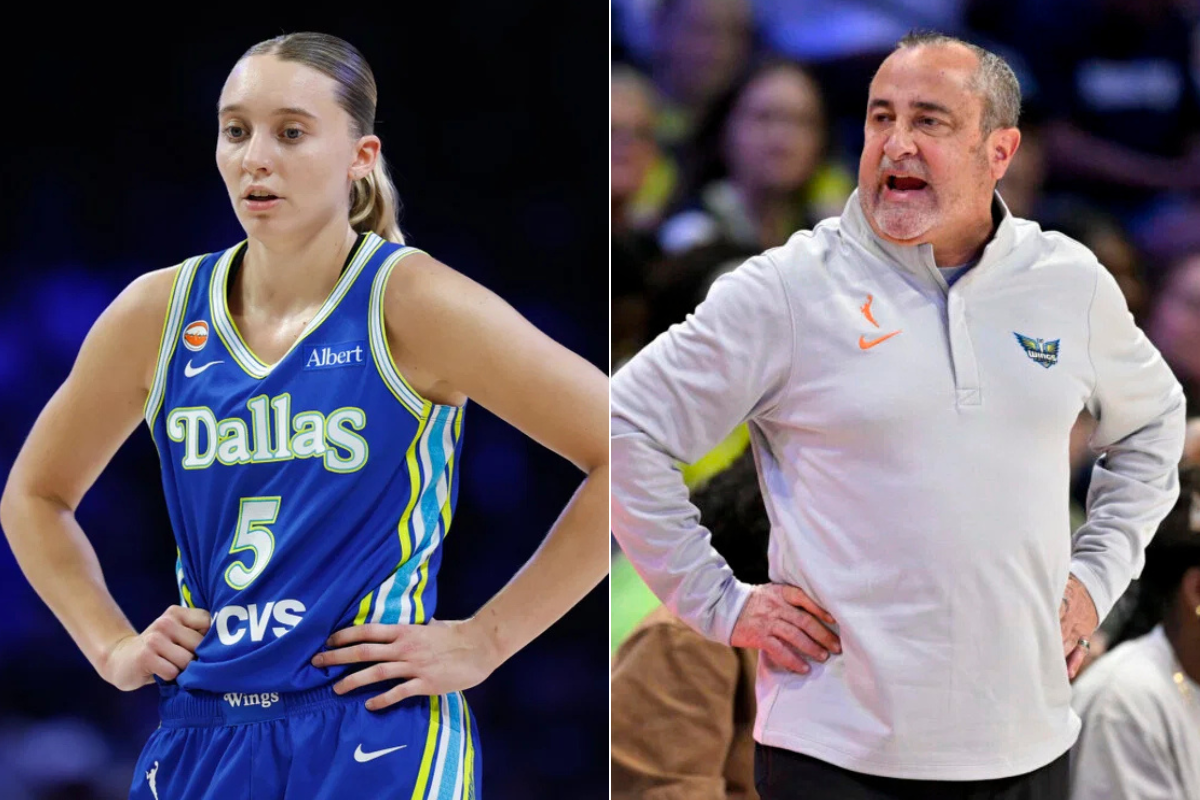
The Atlanta Dream vs. Dallas Wings game had all the makings of a revenge battle. Paige Bueckers and co came into the matchup eager to bounce back after losing to Atlanta earlier this month. But midway through the third quarter, one heated moment completely changed the flow of the game.
Watch What’s Trending Now!
With under two minutes left in the third quarter, the game was still hanging in the balance. The Wings trailed the Dream by just three when Paige Bueckers attacked the rim, and the whistle blew. Believing the call had gone against Atlanta, Bueckers started clapping in celebration, only to suddenly realize the officials had hit her with a technical foul instead.
Yes, you read that right! Bueckers had just been handed a technical foul for clapping. Both Paige and head coach Jose Fernandez immediately turned toward the officials in disbelief and exchanged words while arguing against the decision in real time, but the referees did not budge.

Are we serious brah lmfao
So the tech sent Rhyne Howard of the Atlanta Dream to the free-throw line, where she extended Atlanta’s lead to 58-54 with 1:42 remaining in the quarter.
When coach Fernandez was asked directly about the technical foul incident during his postgame press conference, the Dallas head coach carefully avoided saying too much.
“I’m not going to comment on that because I don’t want to get fined,” he said. In many ways, that entire sequence perfectly summed up the night for the Dallas Wings guard.
The Minnesota native was held to a season-low seven points on 3-of-13 shooting, which also ended her historic streak of 10 straight games with 15 or more points. She finished with a rough minus-25 plus-minus in 31 minutes as the Dream simply never let Bueckers get comfortable.
Rhyne Howard, Jordin Canada, and Atlanta’s perimeter defenders kept pressuring her throughout the game, forcing her into rushed shots and difficult possessions. It was the kind of performance from the reigning Rookie of the Year that many of us simply didn’t expect to see.
We are literally talking about a player who came into the game averaging 20.8 points per game while shooting 57.6% from the field and 57.9% from three. She had become the definition of efficiency this season. But Paige wasn’t the only Dallas star who struggled on the night.
Arike Ogunbowale and Azzi Fudd combined for just nine points, while star acquisition Alanna Smith played only 10 minutes all night, which pretty much tells you everything you need to know about how things went for Jose Fernandez’s side.
Atlanta controlled the tempo right from the start, and by the end of the first quarter, many fans already feared the contest could turn into a blowout. Dallas managed to score just nine points in the opening quarter, while the Dream put up 19.
But Jose Fernandez still had a trick up his sleeve. He brought on Awak Kuier, who completely changed the game for the Wings. Kuier’s perfect 5-for-5 shooting from the field and 2-for-2 shooting from beyond the arc helped Dallas cut the deficit to just five points heading into the fourth quarter.
Three minutes later, they even managed to grab the lead, but the Dream responded with a 23-5 run to close out an 86-69 victory and take a 2-0 lead in the season series against the Wings.
The head coach also knew it was simply one of those nights where nothing seemed to go right for the Wings.
“There are going to be games like this where the ball doesn’t go in the basket. When you shoot 35, 36, 37 percent, you have to do a really good job on the defensive end and rebound,” Fernandez said after the game. “Maybe get to the rim more. We’ve got to put it behind us. When you look at 37, 25, and 50 from the floor, it’s going to be tough to win games that way, but they know it.”
Paige Bueckers and co. will know they still had a chance to win had their starting five not combined to shoot a terrible 10-of-44 (22.7%) from the field. But shooting wasn’t the only issue.
The Wings finished the night with 15 turnovers, and the Dream made them pay by scoring 18 points off those mistakes. Rhyne Howard led Atlanta with 25 points, while Allisha Gray added 16 of her own.
And even though this was a devastating loss, what had everyone’s attention was the technical foul, which was once again tied directly to the growing frustration surrounding officiating across the league.
When the whistle becomes the story
Following growing criticism last season surrounding inconsistent officiating and escalating physicality, especially after several high-profile situations involving stars like Caitlin Clark, the league entered this year emphasizing freedom of movement and stricter officiating standards through a newly formed officiating task force.
But according to many players and fans, that emphasis has now created the opposite problem.
Foul calls across the league have noticeably increased this season, with games often slowing down because of constant whistles and marginal contact calls. To put things in perspective, during a game between the LA Sparks and Toronto Tempo on May 17th, the officials called 59 fouls. That’s almost 15 fouls every quarter and 1.5 fouls every minute.
However, at the same time, there is also another side to the debate. While some players still believe the WNBA remains too physical, others argue officials no longer allow defenders to play with any real physicality at all.
Even Azzi Fudd, the Dallas Wings rookie, admitted she still doesn’t understand how fouls are being called at the professional level after her preseason debut.
“Honestly, I feel more confused,” she said. “I thought you could be physical in the W, and anytime you touch someone, it’s a foul.”
This is exactly why Paige Bueckers’ tech got such massive attention around the league. Because for some fans, it represented referees over-policing emotion during a heated game, while for others, it was simply another example of how difficult it has become to understand where the league now draws the line between competitiveness, physicality, and unsportsmanlike conduct.