
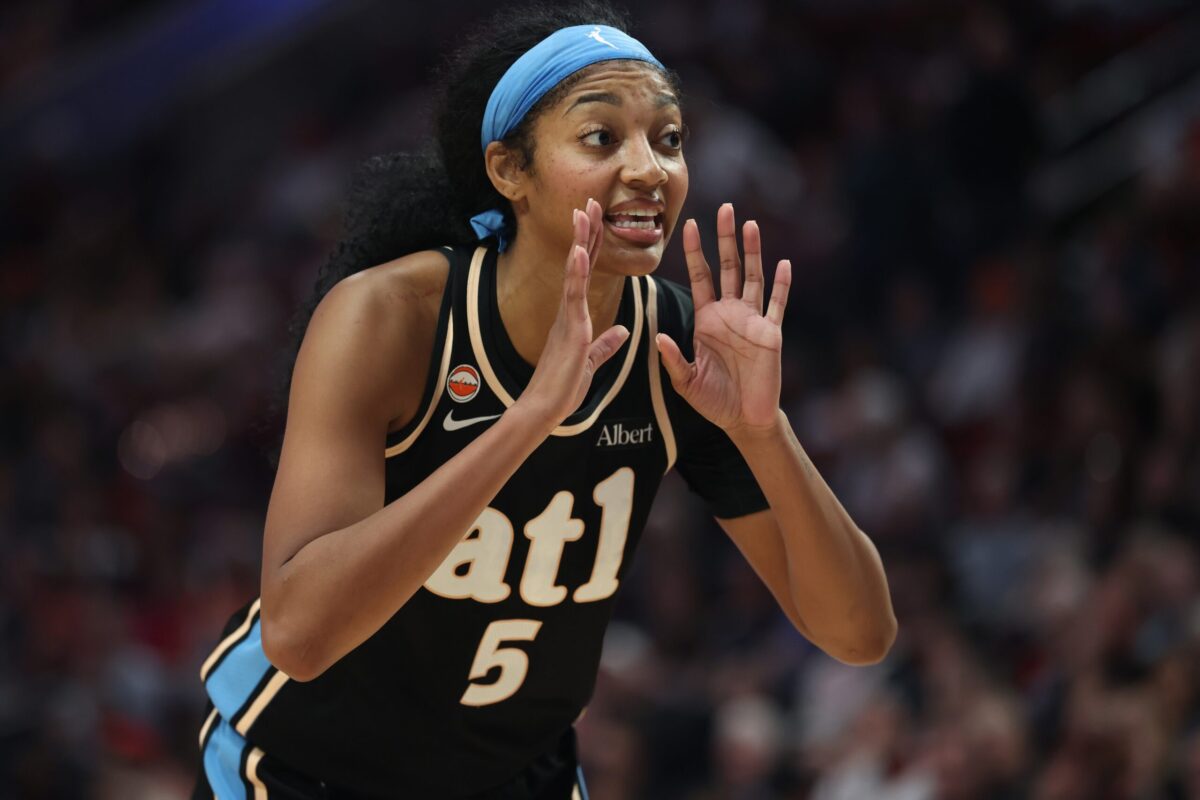
Angel Reese helped the Atlanta Dream secure back-to-back victories over the Indiana Fever last week. Yet despite averaging a double-double across the two wins, much of the conversation surrounding Reese shifted away from basketball and toward her emotional reaction during a Juneteenth pregame ceremony in Indianapolis.
Watch What’s Trending Now!
Before the Dream’s June 18 matchup against the Fever at Gainbridge Fieldhouse, “Lift Every Voice and Sing” was performed as part of the WNBA’s Juneteenth observance. Reese sang along as Indiana fans directed loud boos toward her during pregame introductions, a reaction that quickly sparked debate across social media.
Two days later, Reese addressed the moment publicly and explained why the song resonated with her. “But my ancestors walked so I could run. It’s not supposed to be easy, but I am very, very grateful for this opportunity to be a Black woman,” Reese said. “When I heard the loud boos in the arena and then heard ‘Lift Every Voice,’ it just made me feel like, this is for the ones that walked for me. Representation is important, and I’ll never stay silent for things I believe in.”

Angel Reese on the clip of her singing “Lift Every voice and Sing” making the rounds during Juneteenth weekend: “My ancestors walked so I could run.” Reese also said that when the heard the boos for her last game and then the song came on, she felt supported.
Reese’s comments did not emerge in a vacuum. Since her LSU days, she has frequently discussed race, representation, and the scrutiny she faces as a Black woman in sports. Following LSU’s national championship victory in 2023, Reese famously pushed back against criticism of her on-court celebrations, saying, “I’m too hood. I’m too ghetto. But when other people do it, y’all say nothing. So this was for the girls that look like me.”
While the initial debate centered on Reese singing the Black National Anthem, a second wave of criticism emerged after her explanation was published. Many critics specifically took issue with her references to ancestry, representation and her broader discussion of the treatment she has experienced throughout her career.
Reese’s Explanation Draws Mixed Reactions
“I like Angel Reese but come on she is doing all this just to be petty and hateful to Caitlin Clark by bringing up this race stuff and ancestor stuff because she doesnt like Caitlin Clark which is pretty sad because they are both great players and should respect each other,” a fan wrote.
“EVERYTHING she says has a negative narrative to it,” stated another.
Several fans interpreted Reese’s comments as an indirect reference to Clark and the Indiana fan base. However, Reese never mentioned Clark by name during her explanation, instead focusing on the boos she heard in the arena, the significance of “Lift Every Voice and Sing,” and the importance of representation.
“Your ancestors could probably make a f****** layup though,” remarked another.
Notably, the performance itself was not a spontaneous protest by Reese. “Lift Every Voice and Sing” was part of a league-approved Juneteenth observance, a practice that has become common across multiple WNBA franchises and other major sporting events in recent years.
“LOL! It’s shocking how confident she is in her breathtaking ignorance. Education of a pre-schooler,” chimed in another.
“It’s always all about her and it’s always ghetto garbage,” summed up another.
Reese has been one of the WNBA’s most polarizing figures since entering the national spotlight at LSU, often finding herself at the center of conversations that extend well beyond basketball. That history likely contributed to the strong reactions that followed both her anthem appearance and her subsequent explanation.
Whether fans agreed with Reese or not, the discussion ultimately evolved beyond the pregame ceremony itself. By the time her comments circulated online, the debate had shifted toward the meaning behind her words, with critics and supporters offering sharply different interpretations of what she intended to convey.