

It has been 40 years, yet soccer fans still haven’t stopped talking about Diego Maradona’s “Hand of God” goal. Still, the Argentina vs England game from four decades ago holds a special place in the hearts and minds of soccer fans. The latest proof is the auction of the Adidas Azteca ball used during that historic match.
Watch What’s Trending Now!
According to reports, the soccer ball used in the quarterfinal sold for $3.35 million at Heritage Auctions last Saturday. While the ball had an estimated value of $10 million, the final price still shows just how much interest surrounded this piece of soccer history.
The bidding had started at $2.5 million. And when you look at the ball’s auction history, that figure becomes even more significant. For decades, the ball belonged to referee Ali Bin Nasser, who sold it through Graham Budd Auctions in 2022 for $2.37 million.
A year later, it was put up for auction again through Goldin Auctions and received a final bid of $2.04 million. However, the sale fell through because the bid did not meet an undisclosed reserve price.
So, now it’s easier to understand why the $3.35 million sale price stands out. But for those who may not know why this particular ball is so important, here’s the story behind it.
Forty years ago, England and Argentina met in a high-pressure World Cup quarterfinal. Around 114,000 fans packed into Estadio Azteca for the match, and they watched an intense but scoreless first half.
Then, six minutes into the second half, every eye was once again on Maradona. He chased a loose ball inside the England penalty area before leaping toward it as the ball deflected into the air. In an instant, the ball was past England goalkeeper Peter Shilton and into the net.
Referee Ali Bin Nasser hadn’t seen what happened. Neither had his linesman. It was a handball, with Maradona using his fist to redirect the ball past Shilton. After the match, Maradona famously referred to the goal as the “Hand of God.”
But that goal was only the beginning.
Four minutes later, Maradona produced another unforgettable moment. He collected the ball inside his own half and embarked on a dazzling 70-meter run, weaving through England’s defense and beating six players before finding the back of the net. Argentina led England 2-0.
The emotion surrounding those two goals can still be felt through Víctor Hugo Morales’ iconic commentary for Radio Argentina. In English, his commentary also rose to fame.
“Maradona has the ball, two mark him, he touches the ball,” the commentary read. “The genius of world football dashes to the right and leaves the third and is going to pass to Burruchaga. It’s still Maradona! Genius! Genius! Genius! Ta-ta-ta-ta-ta-ta-ta. Gooooooooooal! Gooooooooooal! I want to cry! Dear God! Long live football! It’s enough to make you cry; forgive me. Maradona, in an unforgettable run!”
That second goal later earned another piece of history, being voted the “Goal of the Century” by FIFA fans ahead of the 2002 World Cup.
Maradona is no longer here. He passed away six years ago, but soccer fans have never forgotten how Argentina’s 2-1 victory over England helped pave the way for the nation to win the World Cup that year. And now, the Adidas Azteca ball carries another chapter of that unforgettable story.
But the story of the ball would be incomplete without looking at the other side of its history.
The debate around Diego Maradona’s ‘Hand of God’ goal
There was no divine intervention behind Maradona’s “Hand of God” goal. At least, that’s what Peter Shilton has maintained for decades.
“He (Maradona) didn’t out-jump me,” Shilton said in a January 2020 interview with The Guardian, “He cheated…the whole England team suffered because he cheated. He didn’t show any remorse.”
In another similar incident, honesty was prioritized. During Lazio’s 2012 clash with Napoli, Miroslav Klose scored with his hand from a corner. But when Napoli players protested, Klose admitted the handball himself. The referee promptly overturned the goal.
But what did Maradona have to say about it?
In 2005, Maradona admitted on the Argentine television program La Noche del 10 that he had scored the goal with his hand. Several media outlets around the world reported his confession. He also acknowledged it in his autobiography, writing that “it was the hand of Diego.”
Imago
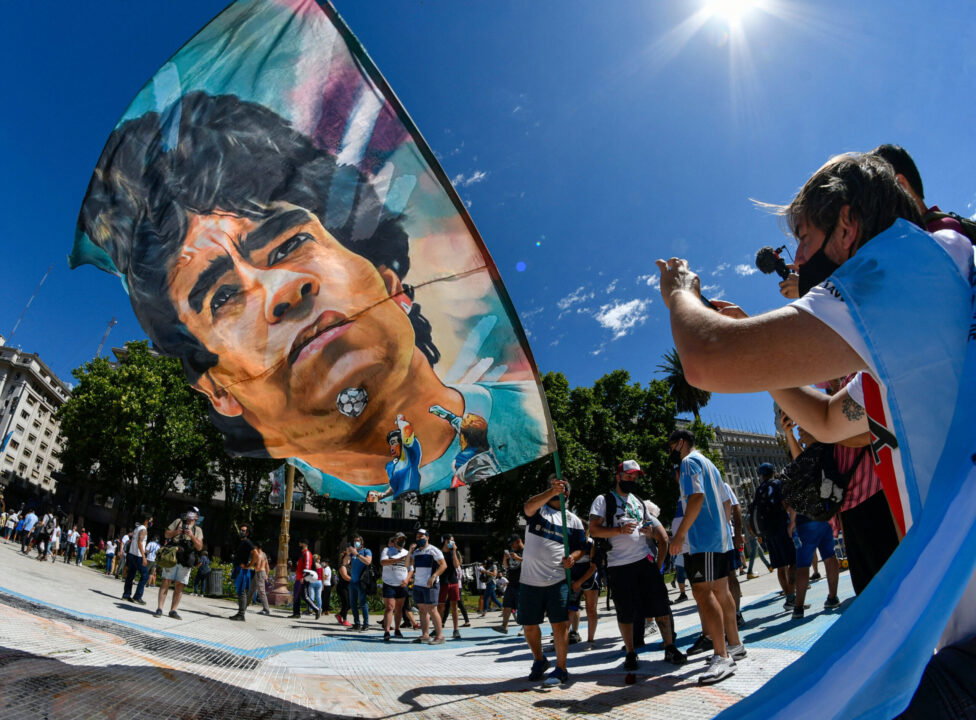
Bilder des Jahres 2020, Entertainment 11 November Entertainment Themen der Woche KW48 Entertainment Bilder des Tages November 27, 2020, Buenos Aires, Argentina: INT Funeral for the late Argentinian soccer player Diego Maradona. November 26, 2020, Casa Rosada, Buenos Aires, Argentina: Fans are seen paying their last tribute to the late Argentinian soccer player, Diego Maradona, who died on Wednesday 25 , 2020 of heart attack aged 60. Credit: /Thenews2. Buenos Aires – ZUMAn293 20201127_znp_n293_049 Copyright: xDeoxAvalosx
Still, Shilton rejected Maradona’s apology, arguing that it came far too late. And that’s the other side of the history carried by the Adidas Azteca ball. It isn’t just a reminder of one of the most famous goals in World Cup history. It also represents one of soccer’s most enduring controversies.