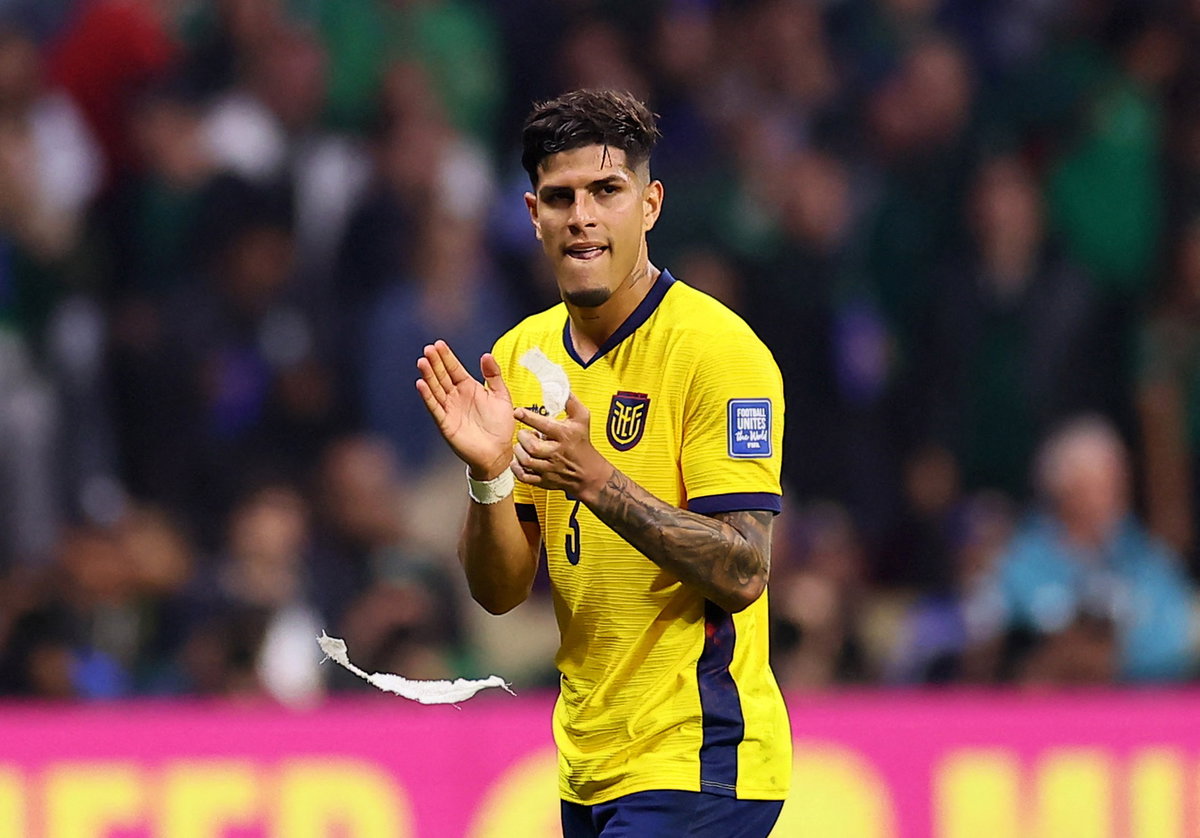
Piero Hincapié became the second player in World Cup history to be sent off for covering his mouth. His actions with Ecuador already trailing 2-0 and staring at a round-of-32 exit baffled a journalist who likened the thought process behind the decision to dark matter in space. Not withholding his words, the journalist slammed Hincapié and Ecuador’s performance.
Watch What’s Trending Now!
“Brainless from Hincapie. Denser than dark matter in space. Ecuador all round have been an embarrassment,” Phil Hay, a lead writer at The Athletic, wrote while covering the match.
Two goals in quick succession from Julian Quinones and Raul Jimenez put Mexico 2-0 up against Ecuador, who struggled to trouble one of the tournament co-hosts throughout the game. With stoppage time winding down, 24-year-old Piero Hincapié covered his mouth while speaking to Mexico’s Santiago Gimenez in what officials deemed a confrontational exchange.
Although the incident initially escaped Slovenian referee Slavko Vinčić’s notice, Gimenez’s complaint prompted a VAR review, after which Vinčić was sent to the pitchside monitor before producing a straight red card. The needless dismissal, with Ecuador already staring at elimination, left Phil Hay baffled by the defender’s decision-making.
Piero Hincapie was sent off for covering his mouth in Mexico-Ecuador after VAR review.
That's the second time this World Cup the new rule has been enforced. pic.twitter.com/YwmGcgWCEN
— ESPN FC (@ESPNFC) July 1, 2026
A special meeting of the International Football Association Board (IFAB) approved two law amendments proposed by FIFA ahead of the World Cup. The laws approved sending off players who covered their mouths while speaking in a confrontational manner with opponents. Red-carding players who leave the pitch protesting the referee’s decisions was also approved.
The push for the amendment gathered momentum after Benfica winger Gianluca Prestianni covered his mouth while speaking to Vinicius Jr. during a Champions League match against Real Madrid earlier this year. Initially accused of racist abuse, Prestianni denied the allegation before UEFA ultimately found him guilty of homophobic conduct and handed him a six-match suspension, with three games suspended. Following its application at the World Cup, the law has informally been nicknamed the “Prestianni Law.”
Pierluigi Collina, FIFA’s head of referees, explained that players would still be permitted to cover their mouths while engaging in “friendly conversations,” while any “confrontational interactions” would be sanctioned. “Any decision to send a player off remains at the discretion of the referee,” with officials instructed to review the footage before reaching a verdict.
Paraguay’s Miguel Almiron became the first player to be sent off for covering his mouth. Almiron confronted Turkiye’s Mert Muldur, who alerted the referee. After the VAR check, the referee showed a red card to Almiron, confirming it was a confrontational interaction. Unlike Ecuador, however, Paraguay held on to win 1-0 despite being reduced to 10 men, before Almiron received a one-match suspension.
England’s Jude Bellingham, however, escaped punishment for covering his mouth and conversing with Ghana’s Jordan Ayew as it was deemed a friendly conversation.
Ecuador booked its place in the round of 32 after a stunning victory over Germany in their final group stage match, reaching the knockout stage for just the second time in their history after their run to the round of 16 in 2006.
But La Tricolor was outplayed against one of the co-hosts, Mexico. Having won Group A with a perfect record, scoring six goals without conceding once, Mexico finally ended a 40-year wait for a World Cup knockout-stage victory.
A clinical performance coupled with Ecuador’s poor final-third play helped Mexico set up a round-of-16 meeting with the winner of the England-DR Congo clash. Ecuador, meanwhile, head home after their campaign ended in disappointment, with Hincapié’s dismissal ensuring he will also serve a one-match suspension in Ecuador’s next competitive fixture.