
Another UFC fighter has found themselves on the receiving end for violating the promotion’s anti-doping policy. No. 13-ranked UFC strawweight Jaqueline Amorim has been handed a six-month suspension after testing positive for the banned substance ostarine in two separate tests conducted in July and August.
Watch What’s Trending Now!
A few days ago, Combat Sports Anti-Doping (CSAD), the agency in charge of testing all UFC athletes, confirmed that Amorim’s tests had returned adverse findings for low levels of ostarine. Following discussions with the Brazilian and her team, CSAD announced that Amorim had accepted a six-month suspension for the doping violation. Now, the UFC has issued a statement explaining the circumstances behind the suspension and the findings of the investigation conducted by CSAD.
“Combat Sports Anti-Doping (CSAD) announced today that Jaqueline Amorim of Fort Lauderdale, Florida, has accepted a six-month period of ineligibility for a violation of the UFC Anti-Doping Policy (UFC ADP),” the UFC’s statement read. “Amorim tested positive for low levels of ostarine, a prohibited non-Specified Substance in the class of Anabolic Agents. Ostarine is prohibited at all times under the UFC ADP and UFC Prohibited List.
“Ostarine was detected in out-of-competition samples collected from Amorim on July 29, 2026, and August 17, 2026, in Fort Lauderdale, Florida. Because the second sample was collected before Amorim was notified of the adverse analytical finding from the first sample, the two findings were combined into a single violation. During CSAD’s investigation, Amorim provided full and complete cooperation as defined under the UFC ADP.”
The UFC’s statement clarified that CSAD collected the two samples after Amorim’s first-round submission victory over Loma at UFC Macau on May 30, 2026. However, the timing of the tests played an important role in determining how the violation would be handled.
Since Jaqueline Amorim had not been notified of the first adverse finding before the second sample was collected in August, CSAD decided to combine the two findings into a single violation rather than treating them as separate offenses.
However, there was another important detail in the UFC’s statement.
Imago
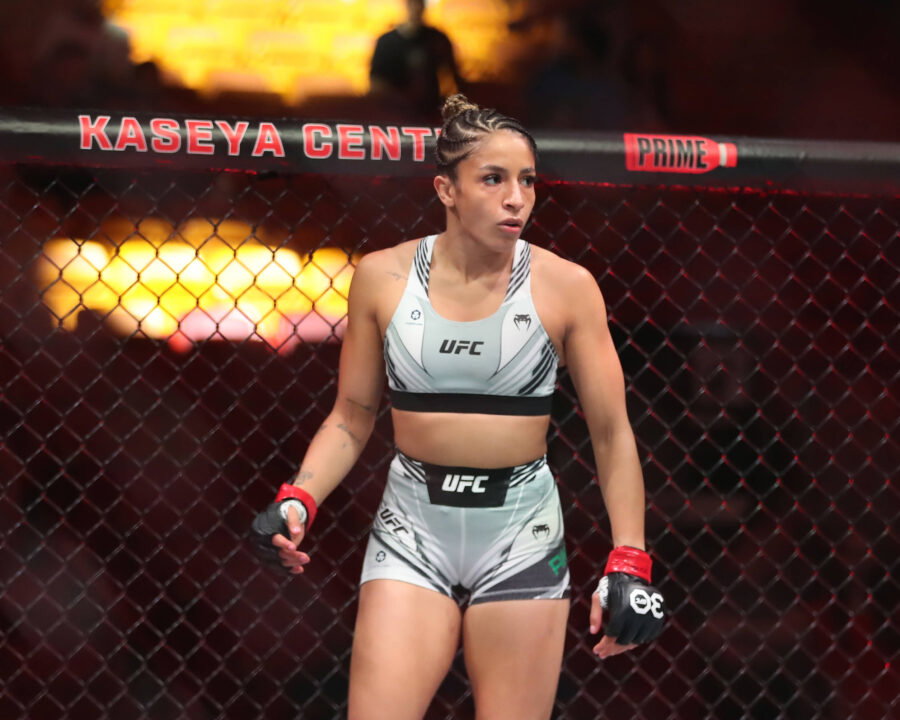
April 8, 2023, Miami, FL, Miami, Florida, United States: MIAMI, FLORIDA – APRIL 8: Jaqueline Amorim prepares to fight Sam Hughes in their women strawweight fight during the UFC 287 event at Kaseya Center on April 8, 2023 in Miami, FL, United States. Miami, FL United States – ZUMAp175 20230408_zsa_p175_004 Copyright: xAlejandroxSalazarx
Despite the positive findings, the investigation concluded that the evidence was consistent with low-level ostarine contamination, which investigators suspect may have originated from her dietary supplements. As such, it suggests the violation wasn’t intentional.
The statement also indicated that the findings did not suggest Amorim had gained any significant performance advantage from the substance. Her testing history and the low levels detected in both samples were determining factors in deciding the terms of her suspension.
“After reviewing the evidence, CSAD determined that the findings were consistent with exposure to low-level ostarine contamination rather than intentional use,” the statement added. “This determination was based on several factors, including Amorim’s testing history, the low levels of ostarine detected in both samples, her use of multiple dietary supplements that had not been third-party tested and certified, and the documented prevalence of ostarine contamination in dietary supplements worldwide.
“The evidence also did not indicate that Amorim’ exposure provided her with any significant performance advantage.”
In other words, the investigation did not establish that Amorim had deliberately used the banned substance to improve her performance. Instead, CSAD determined that the findings were consistent with accidental exposure through contaminated supplements that had not undergone third-party testing and certification.
Following the investigation, Amorim accepted a six-month suspension, which would run retroactively from August 17, 2026, the date of her second sample collection. Her period of ineligibility will end on February 17, 2027.
This means she’ll be eligible to return to competition from March 2027.
For the 31-year-old, this will mean a significant period away from competition. The Brazilian has built an impressive 5-2 record in the UFC, beating credible opponents such as Loma, Polyana Viana, Vanessa Demopoulos, Cory McKenna, and Montserrate Conejo Ruiz. Her two losses came against Sam Hughes and Mizuki.
While Amorim had been enjoying a decent run, this period of inactivity could halt her momentum.
However, Jaqueline Amorim isn’t the only UFC fighter to have faced an anti-doping violation this year. Fellow strawweight Iasmin Lucindo and heavyweight Mohammed Usman have also received suspensions, although their cases involved different circumstances and penalties.
UFC fighters who received doping suspensions in 2026
Besides Jaqueline Amorim, her fellow strawweight fighter Iasmin Lucindo also received a suspension for a doping violation. CSAD suspended her after she tested positive for mesterolone, a prohibited anabolic agent. Similar to Amorim’s case, the authorities could not determine whether the adverse finding in Lucindo’s case resulted from intentional use.
However, a major difference between their suspensions was their duration. Lucindo faced a 9-month suspension following an investigation that lasted from September 24, 2025, to June 2026.
Currently, Lucindo is scheduled to face Nicolle Caliari at UFC 333: Volkanovski vs. Evloev on October 24, 2026. However, not everyone gets off lightly following a doping violation.
Kamaru Usman’s elder brother, Mohammed Usman, also tested positive for highly elevated testosterone levels and the banned peptide BPC-157.
Initially, Usman received a standard 2-year suspension for violating the anti-doping policy. However, the authorities later extended his suspension by 6 months, bringing the total to 2.5 years, for attempting to make false statements to CSAD.
The UFC subsequently parted ways with Mohammed Usman as well.
Fortunately for Amorim, her case resulted in a six-month suspension after CSAD determined that the findings were consistent with low-level ostarine contamination rather than intentional use. She will be eligible to return to competition on February 17, 2027, bringing her period away from the Octagon to an end.