

After five long years, Conor McGregor is all set to make his anticipated return at UFC 329 on July 11 during International Fight Week. He also has a stellar opponent in Max Holloway awaiting him at the T-Mobile Arena. With that, the Irishman has all the ingredients needed to make his comeback a memorable one. However, as the former two-division UFC champion prepares for his first walk to the Octagon since breaking his leg against Dustin Poirier at UFC 264 in 2021, a new controversy has taken shape in the form of an investigative report for The New York Times. As per the report, ‘The Notorious’ was actually the key figure behind UFC’s split from its former anti-doping agency, USADA.
Watch What’s Trending Now!
According to the report by Michael S. Schmidt, “two people with direct knowledge of the matter” have revealed to the NYT that Conor McGregor took “powerful, banned drugs” after his leg injury in 2021. And according to them, he did so with the help and support of renowned sports doctor Neal ElAttrache, who has worked as the head physician for the Dodgers and the Rams as well as many Hollywood actors. According to ElAttrache’s response to The Times, the physician oversaw McGregor’s recovery from the broken bone and later sent him to a specialist for further healing after making it clear to McGregor that he doesn’t prescribe “hormone or steroid-based treatment.”
As per what ElAttrache told the NYT, McGregor then consulted a specialist, after which he wrote a letter supporting the former UFC champion’s application for a “special exemption,” which would have allowed him to use certain performance-enhancing drugs without repercussions. But McGregor’s particular pursuit of that special exemption became the flashpoint that ultimately triggered the split between the UFC and the United States Anti-Doping Agency, whose partnership had begun in 2015.
“Officials overseeing the U.F.C.’s drug testing program believed that in seeking the exemption, McGregor—with the imprimatur of ElAttrache—was trying to exploit a loophole to use banned drugs, the two people said,” The New York Times report noted. “It was the beginning of a split between the U.F.C. and the United States Anti-Doping Agency, known as USADA, the entity that was overseeing the U.F.C.’s drug testing program.”
However, the exemption was never granted by USADA. As a result, the Irishman withdrew from the promotion’s drug testing pool. The outlet also obtained a statement from Conor McGregor’s manager, Audie Attar, who admitted the UFC star underwent a gruesome surgery that required extensive medical attention, but did not directly address the matter of PEDs.
Meanwhile, ElAttrache had expressed doubts about whether McGregor could ever return as the same fighter again and also appeared to advise McGregor to consult with the UFC’s drug-testing partner, which at the time was USADA. Still, the doctor, who recommended the consultations but not the “course of treatment,” mounted a defense of the former UFC champ’s alleged use of PEDs, stating that “banned” drugs aren’t illegal and have been used for various medical purposes.
“You are acting as if ‘banned drugs’ are somehow ‘illegal drugs’ or that they have no legitimate therapeutic use and only have performance enhancement use,” ElAttrache said in his response to The Times. “There are many ‘banned drugs’ on the list, which are necessary to medically treat various conditions that occur in people. That is why a therapeutic use exemption application exists.”
Well, in other sports leagues like Major League Baseball, the Olympics, and the UFC, athletes have previously tried to secure exemptions, referred to as Therapeutic Use Exemptions (TUEs), but anti-doping officials heavily scrutinize such requests before granting them. In the past, USADA has granted retroactive TUEs to former UFC stars like Cris Cyborg and Ian McCall, but both instances were retroactive, not exemptions based on prior request. Despite that, McGregor’s request to use them to heal his broken bone reportedly became a major point of contention with USADA, which in turn created complications regarding his return to the UFC.
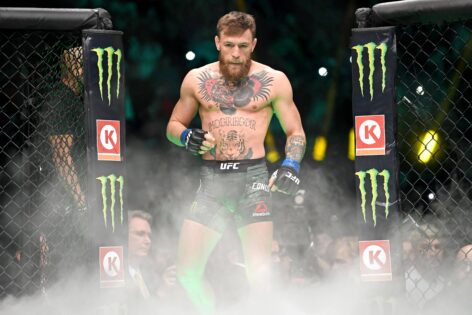
USA Today via Reuters
MMA: UFC 229-Nurmagomedov vs McGregor, Oct 6, 2018 Las Vegas, NV, USA Conor McGregor blue gloves before his fight against Khabib Nurmagomedov red gloves during UFC 229 at T-Mobile Arena. Mandatory Credit: Stephen R. Sylvanie-USA TODAY Sports, 06.10.2018 21:29:13, 11394008, NPStrans, T-Mobile Arena, Khabib Nurmagomedov, MMA, Conor McGregor, wow PUBLICATIONxINxGERxSUIxAUTxONLY Copyright: xStephenxR.xSylvaniex 11394008
In 2022, many noticed on USADA’s website that McGregor hadn’t been tested since breaking his leg at UFC 264. At the same time, ‘The Notorious’ was posting photos of himself looking significantly bigger, which drew criticism from former UFC fighter Anthony Smith, who suspected McGregor’s size had grown because of PEDs.
In response, McGregor called him a “loser” and clarified that he had to take extreme measures to aid his recovery. Along with that, the Irishman further claimed, “Everything was fully disclosed before I began,” though he didn’t reveal who treated him.
Conor McGregor apparently got back into the testing pool in October 2023, which made USADA livid because he entered the testing pool before completing the required six months. As per the report, the agency warned the UFC that the relationship between them would be “over” if the UFC allowed the Irishman to fight again.
“The relationship between USADA and U.F.C. became untenable given the statements made by U.F.C. leaders and others questioning USADA’s principled stance that McGregor not be allowed to fight,” Travis Tygart, chief executive of USADA, said.
Despite this, according to the report, the UFC remained steadfast in their decision to allow McGregor back. This ultimately led to the breakdown of their eight year-partneship. The UFC refuted Tygart’s claim about McGregor being the reason for their fallout. They instead stated that their decision to not renew the contract with USADA at the end of 2023 was because of how poorly the program was being managed.
Regarding McGregor’s condition, UFC CBO Hunter Campbell showed support for the Irishman while bringing up a hypothetical example to illustrate his point.
“For 10 days under the supervision of the best surgeon in the world,” NYT quoted Campbell as saying. “My question is, does he gain any performance-enhancing benefit by the time he returns to competition? If the answer is no, and he doesn’t retain any, and it helped him recover faster, I’m open to that conversation with the best experts in the world. To just blanketly say absolutely not, that’s ignorant.”
Once the UFC had parted ways with USADA and began overseeing their own drug testing program, it presented an opportunity for Conor McGregor to make his return. However, things didn’t go as smoothly.
Conor McGregor faced an 18-month suspension for not following drug testing rules
After the UFC started overseeing its own drug-testing program with the help of Drug Free Sport International (DFSI) and Combat Sports Anti-Doping (CSAD), the Irishman returned to the pool once again. In 2024, he was scheduled to fight Michael Chandler at UFC 304, but another toe injury derailed his comeback even further. However, a year later, it was revealed that McGregor had been hit with another drug-testing-related suspension.
For failing to provide accurate information on his whereabouts, the UFC’s new anti-doping agency could not locate McGregor, and he failed to appear for testing on three separate dates within a 12-month period: June 13, September 19, and September 20, 2024.
As a result, McGregor initially received a 24-month suspension. However, the UFC reduced it to 18 months, citing that he was dealing with an injury, and the suspension ended in March 2026. But during the period, he successfully underwent two anti-doping tests, which he appears to have cleared.
Now that he is all set to make a comeback, McGregor has already been randomly tested 12 times this year, surpassing Merab Dvalishvili, who was tested 14 times in all of 2025, to become the most-tested UFC athlete of 2026.