
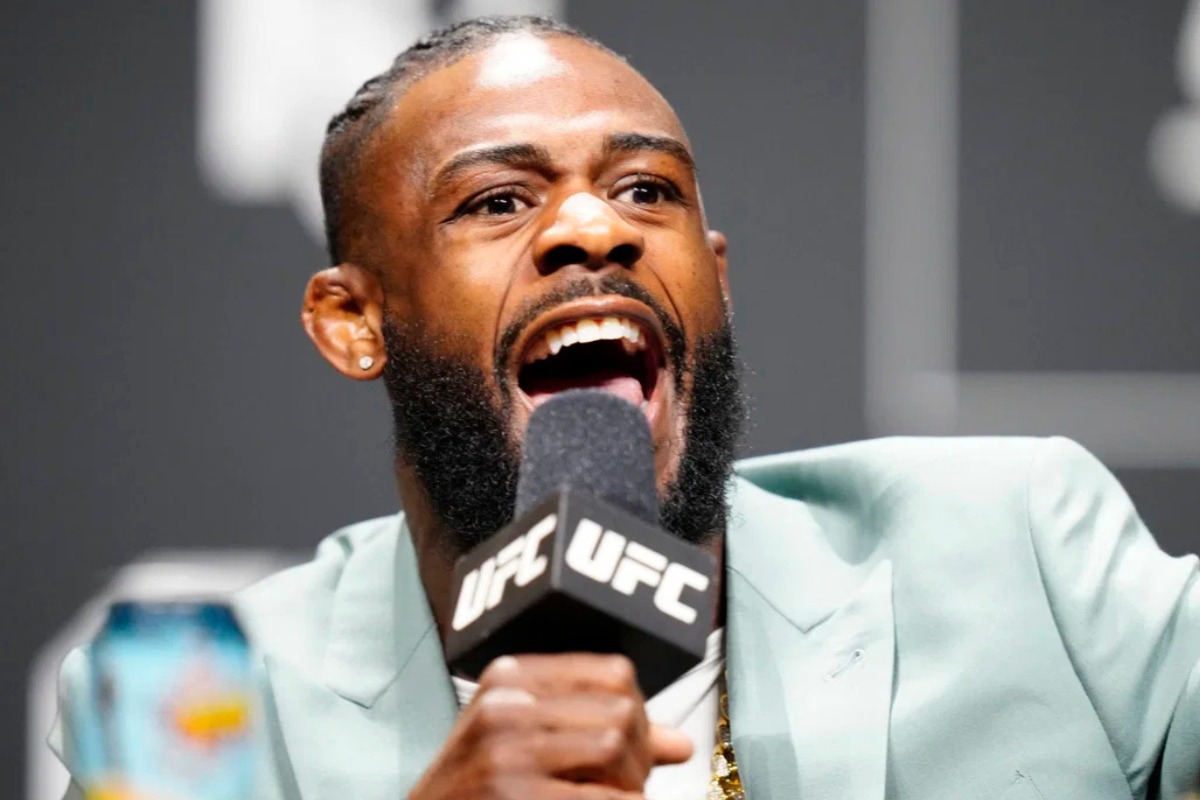
Fresh off a massive featherweight win that has him climbing the title ladder, Aljamain Sterling is turning his attention to a different kind of fight outside the Octagon. ‘The Funk Master’ recently appeared on a live stream with Georgio Poullas and Joshua Van, and he didn’t hold back when the conversation moved to the lucrative world of MMA management.
Watch What’s Trending Now!
The former bantamweight champion, who picked up a decision win over Youssef Zalal at UFC Vegas 116 in April, has finally officially leapfrogged Yair Rodríguez to claim the #4 spot in the 145-pound division. However, while his stock is surely rising as he seeks a title fight with Alexander Volkanovski, Aljamain Sterling made it clear that he believes UFC managers in the game are coasting on easy money when asked by Poullas what exactly they do to earn their keep.
“Oh, they answer the phone, and then they call you, and then they go, ‘Hey, do you want this fight, yes or no?'” Sterling answered. “So obviously, they get a percent on the phone call, And they get paid for all the fights.”

😅 Aljamain Sterling seems not to like UFC managers and their work: "They answer the phone, and then they call you, and then they ask if you want to take this fight." via @georgiopoullas_
The NCAA wrestling standout pushed the point further, questioning why any competent fighter would pay someone a portion of their purse to function as a middleman for a text message they could get themselves.
“Why would you pay another man to answer the phone for you to tell you the same thing that he just did?” Poullas asked. “Why wouldn’t you do it directly?”
However, Joshua Van chimed in with a different opinion, stating the managers also help the fighters get into the promotion. Another person standing outside of the frame also argued that the managers help fighters get the right fights at the right time so they can climb to the top. At this point, the conversation became a little too heated for the live stream, prompting a laughing Sterling to seek a way out.
“I feel like I should excuse myself,” he said.
While Aljamain Sterling isn’t too far off when it comes to arguing what managers do, technically, a manager’s job description mainly includes finding sponsorships, coordinating media, and planning a long-term career. So there’s a certain nuance that the former bantamweight champion is missing here.
But ‘AlJo,’ who has been managed by Tiki Ghosn and has openly admitted to paying a 10% management fee on top of coaching costs and high taxes back in 2022, clearly believes that once a fighter reaches the big stage, some managers do the bare minimum while UFC matchmakers do all of the serious work.
In fact, Aljamain Sterling’s blunt views line up perfectly with a deeper look into the industry.
Aljamain Sterling has previously highlighted the widespread skepticism and the polarizing world of MMA management
A 2020 article by journalist Josh Gross in The New York Times lifted the veil on the highly complicated, often shady relationship between MMA fighters and their representation, revealing that Aljamain Sterling is definitely not alone in his distrust.
An anonymous fighter survey cited in the report revealed a massive divide. While managers normally earn 5% to 25% of a fighter’s fight purse, plus an additional 20% on any sponsorship money, many fighters believe they are treated as simply numbers in a volume business.
One former UFC champion even compared shady managers to firing a shotgun.
“They throw as many pellets as possible and collect percentages off these fighters’ paychecks,” he said.
In fact, when 118 fighters were asked to choose the best manager in the sport, 52 declined to answer, with several competitors simply saying, “They all suck.”
The industry also has a serious poaching problem and a lot of shady behavior. Dan Lambert, founder of well-known MMA gym American Top Team (ATT), claims that smooth-talking managers often wreck fighter relationships by promising far more than they can give.
Things became so bad at ATT that Lambert prohibited outside managers from recruiting inside his gym. He even confessed that he once threatened to toss manager Malki Kawa into a dumpster if he ever saw him near the training facility again.
But perhaps nobody exemplifies how divided people are about MMA management better than Ali Abdelaziz. He manages around 150 fighters, including welterweight champion Islam Makhachev, Kamaru Usman, Justin Gaethje, and Kayla Harrison. And fighters like Gilbert Burns regard him as a dependable “dream maker” and someone they can rely on.
However, for many, the team Dagestan manager remains one of the most controversial men in sports history, with the headlines following him often.
In the end, the quality of the management seems to be completely dependent on a fighter’s current career stage. After all, there are some who are great when it comes to bringing young talents into the UFC, while others are better at getting some meaty sponsorship.
But, as veterans such as Aljamain Sterling continue to question the value of the 10% fee for a simple phone conversation, managers are under pressure to prove that they are genuinely doing the real work behind the scenes.