
Europe is on high alert after scientists discovered that a killer heatwave that started on June 20 has affected it the most, with its climate changing faster than the global average. This is because of “Omega block,” a persistent weather pattern that has trapped stagnant hot air over the continent while pulling up scorching temperatures from North Africa, creating a heat dome. It has disrupted several tennis tournaments, with top players struggling in the heat, prompting Wimbledon to introduce a new rule following the precedent set by the other three Majors.
Watch What’s Trending Now!
Wimbledon has set the heat index threshold at 30.1 degrees Celsius, above which the heat rule is activated. This rule applies to all singles matches, including wheelchair singles. The new policy allows players to take an additional ten-minute break between the second and third sets in women’s singles and between the third and fourth sets in men’s matches. The rule provides that it comes into effect even if one player requests it, with the heat stress monitor used 30 minutes before a match and at fixed intervals at 2 p.m. and 5 p.m.
The heat rule also provides for closing the roof if the temperature exceeds the threshold on Center Court and Court 1, but once it comes into effect in a match, players won’t get the additional break between sets. Wimbledon has the unique rule of not allowing matches to go beyond 11:00 p.m. local time, which affects the heat rule: matches that go beyond the second day do not receive the policy’s benefits if the match has already completed one set (best of three-set match), or two sets (best of five-set match).
The new rule makes sense, given the struggles that players have had in recent days. Grass-court events in Berlin and Eastbourne on the WTA side have seen multiple retirements because of stifling heat, while on the men’s side, Alexander Zverev’s continuous glucose monitor malfunctioned under the conditions, triggering a false health scare for the German player.
The playing conditions will not have much impact, as grass absorbs heat more slowly than hard or clay courts. However, the heat rule will be beneficial, given the weather predictions for London over the next week, with the heat likely to play a role during the qualifying phase as well.
Wimbledon heat rule: How is it different from the other Majors and has it already been used?

Imago
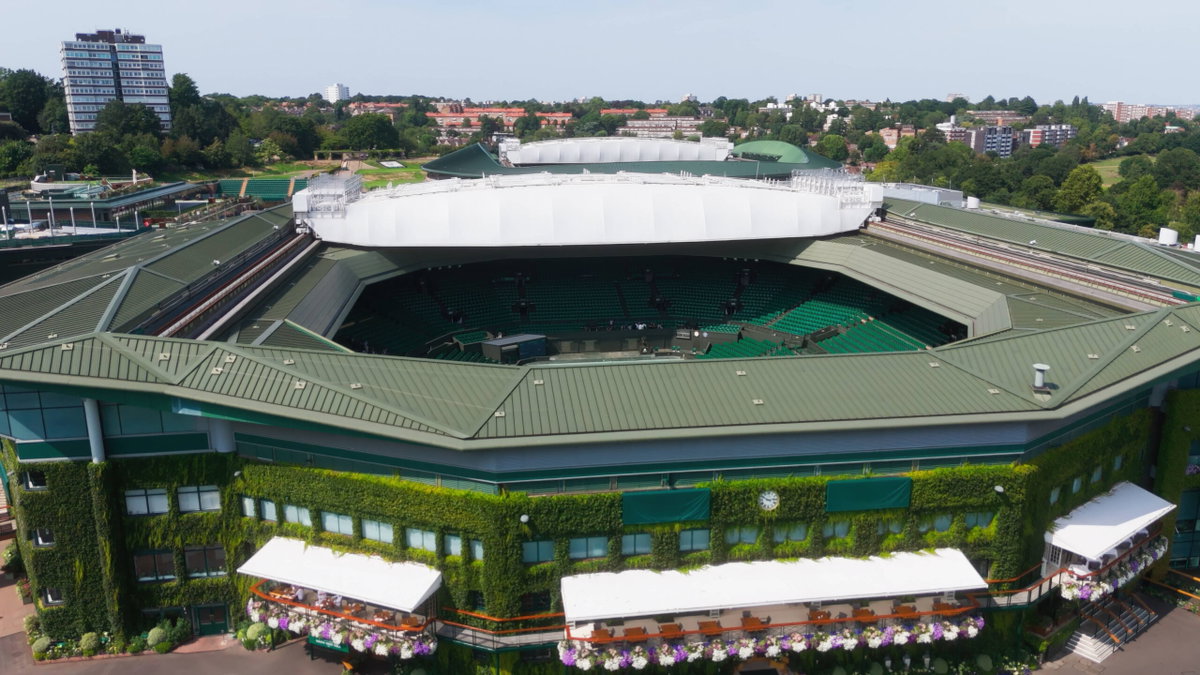
The Prince and Princess of Wales Attend Wimbledon 2025 View from the roof of Centre Court during the prize giving ceremony with HRH The Princess of Wales, Patron of the All England Lawn Tennis Club, after Jannik Sinner ITA defeated Carlos Alcaraz ESP in the final of the Gentlemen s Singles at The Championships 2025. Held at The All England Lawn Tennis Club, Wimbledon. Day 14 Sunday 13/07/2025., Credit:AELTC/Joe Toth / Avalon United Kingdom, Wimbledon PUBLICATIONxNOTxINxUKxFRAxUSA Copyright: xAELTC/JoexTothx/xAvalonx 1021811916
The heat rule regarding the breaks between sets is similar at the Australian Open, French Open, and Wimbledon, as seen this year. But where they differ is the heat index. SW19 and Roland Garros use the WBGT model, whereas Melbourne uses a unique heat index, the Heat Stress Scale (AO-HSS). where they put values between one and five, with the heat threshold being at four for added breaks, whereas a value of five on the heat scale saw outdoor courts suspend all action, and the show courts put their roofs into use. However, the approach is slightly different as temperatures soared over 40 degrees down under, whereas the European heatwave has temperatures hovering around the mid-to-late 30s.
The heat rule has yet to be applied at Wimbledon, even though one qualifying day recorded a temperature of 37 degrees, as the WBGT scale did not register a value above the threshold because of variations in humidity. However, the heat played its part during qualifying. Play had to be halted because the ELC system broke down under an extreme heatwave. The tournament also took the precaution of not allowing children on the court as ball kids, instead using adult volunteers to fulfill those roles.
Temperatures are expected to drop once the tournament ends, as the Met Office has forecast mid-20s for next week with moderate winds, which will be music to the ears of players and the audience.