Why Do Wimbledon Women’s Champions Receive a Plate Instead of a Trophy? The Venus Rosewater Dish: History, Designer, Cost & More

Add us on Google
Why Do Wimbledon Women’s Champions Receive a Plate Instead of a Trophy? The Venus Rosewater Dish: History, Designer, Cost & More
Add us on Google
Imago
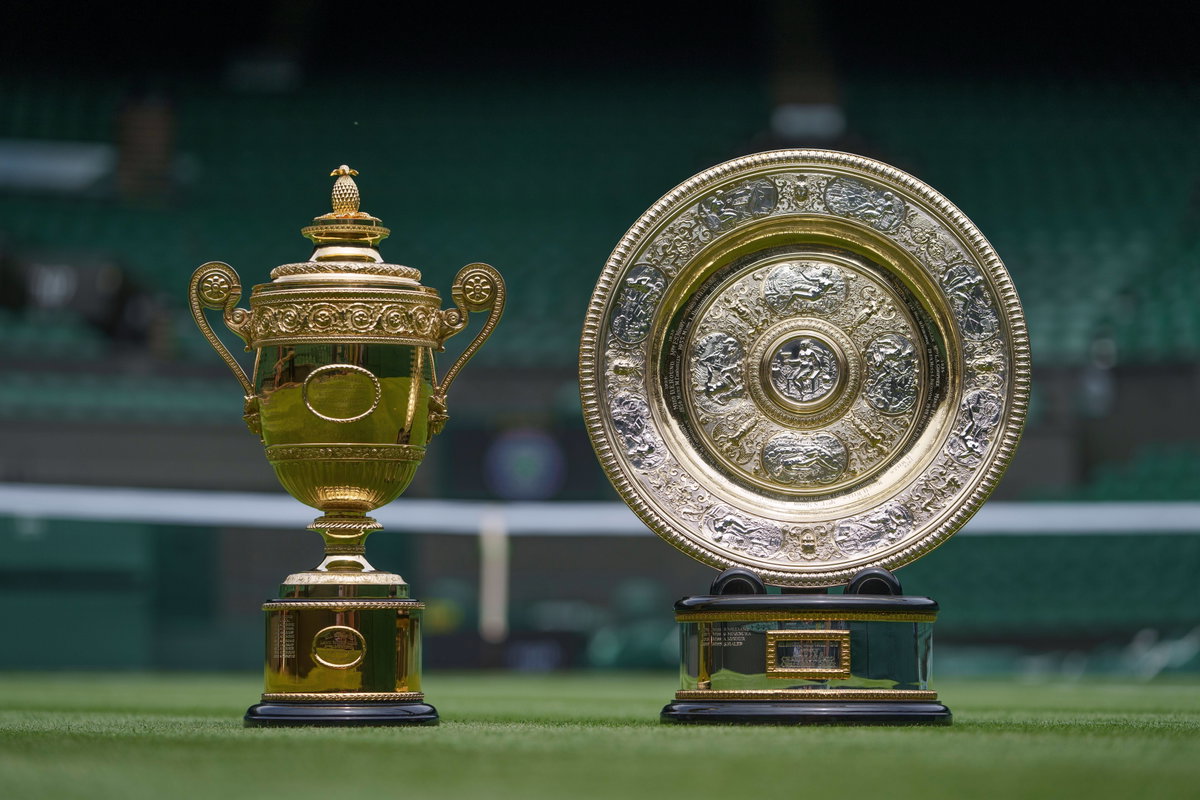
Sport Bilder des Tages Mandatory Credit: Photo by AELTC/Thomas Lovelock/Shutterstock 12171009ab The Gentlemen s Singles Trophy and the Venus Rosewater Dish – the Ladies Singles Trophy, on Centre Court during the presentation to the media ahead of The Championships 2021 Wimbledon Tennis Championships, Preparations, The All England Lawn Tennis and Croquet Club, London, UK – 26 Jun 2021 Editorial Use Only Wimbledon Tennis Championships, Preparations, The All England Lawn Tennis and Croquet Club, London, UK – 26 Jun 2021 Editorial Use Only PUBLICATIONxINxGERxSUIxAUTXHUNxGRExMLTxCYPxROMxBULxUAExKSAxONLY Copyright: xAELTC/ThomasxLovelock/Shutterstockx 12171009ab
Imago
Sport Bilder des Tages Mandatory Credit: Photo by AELTC/Thomas Lovelock/Shutterstock 12171009ab The Gentlemen s Singles Trophy and the Venus Rosewater Dish – the Ladies Singles Trophy, on Centre Court during the presentation to the media ahead of The Championships 2021 Wimbledon Tennis Championships, Preparations, The All England Lawn Tennis and Croquet Club, London, UK – 26 Jun 2021 Editorial Use Only Wimbledon Tennis Championships, Preparations, The All England Lawn Tennis and Croquet Club, London, UK – 26 Jun 2021 Editorial Use Only PUBLICATIONxINxGERxSUIxAUTXHUNxGRExMLTxCYPxROMxBULxUAExKSAxONLY Copyright: xAELTC/ThomasxLovelock/Shutterstockx 12171009ab
At Wimbledon, every champion walks away with a piece of history. But if you look closely at the prize ceremonies, you’ll notice something unusual: the men’s singles champion lifts a traditional gold trophy, while the women’s singles champion receives a large silver dish. For a tournament where both champions have achieved the same legendary feat, the difference naturally raises a question: Why does Wimbledon’s women’s champion get a plate instead of a trophy?
Watch What’s Trending Now!
The answer lies not in the value of the award, but in more than a century of tradition. The iconic silver dish, known as the Venus Rosewater Dish, has its own fascinating story that dates back to the Victorian era. Let’s explore why Wimbledon chose this unique award for its women’s singles champions.
Why do Wimbledon women’s singles champions receive a plate instead of a trophy?
To understand why Wimbledon’s women’s singles champion receives a plate instead of a traditional trophy, we need to travel back to the late 19th century and the traditions of the Victorian era.
The prestigious silver award, known as the Venus Rosewater Dish, was first presented to the women’s singles champion in 1886, two years after Wimbledon introduced the women’s championship in 1884.
The beautifully crafted dish reflects the artistic style of that period, when decorative silverware was often considered a symbol of prestige and achievement. The Victoria & Albert Museum notes that the dish was created by the renowned Birmingham silversmiths Elkington & Co. and was inspired by a Renaissance-style basin, showcasing the Victorian fascination with classical art and elaborate craftsmanship.
In Victorian Britain, ornate silver pieces were commonly used as ceremonial objects, and Wimbledon followed that tradition when creating the women’s championship prize.
More than 130 years later, the world of sport has changed dramatically, but the Venus Rosewater Dish remains a unique part of Wimbledon’s identity. While the men’s champion lifts the famous trophy, the women’s champion continues to raise this historic silver dish — not because it represents a lesser achievement, but because it carries a tradition unlike any other prize in tennis.
What is the Venus Rosewater dish?
The Venus Rosewater Dish has an official name–Ladies’ Singles Trophy. The trophy, aka the plate, is a large circular ceremonial platter measuring 18.75 inches (47.5 cm) in diameter and weighing 2.3 kg.
It is also heavily decorated with intricate mythological carvings. The center of the plate features a classic raised hub depicting Sophrosyne (the personification of temperance and moderation) carrying a lamp and a jug.
Then comes the inner ring, which features four reserves containing the classical Gods representing the four elements: air, water, earth, and fire. It is also adorned with reserves showing the goddess Minerva governing over the Seven Liberal Arts: Astrology, Geometry, Arithmetic, Music, Rhetoric, Dialectic, and Grammar.
Imago
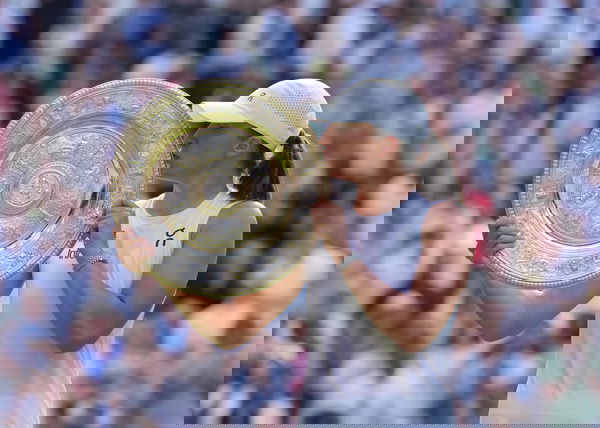
Iga Swiatek of Poland kisses with the Venus Rosewater Dish after winning the Ladies Singles Final on day thirteen of The Championships Wimbledon 2025 at All England Lawn Tennis and Croquet Club on July 12, 2025 in London, England. Photo by MB Media PUBLICATIONxINxGERxSUIxAUTxONLY Copyright: xHiroshixSatox
Who designed the Venus Rosewater Dish?
The intricate award has a fascinating history that goes beyond Wimbledon. The Venus Rosewater Dish was created in 1864 by Birmingham-based silversmiths Elkington & Co. and is made from parcel-gilt sterling silver, meaning parts of the silver surface are decorated with gold accents.
The dish itself is not an original Renaissance creation but a detailed replica of a Renaissance-style basin designed by German artist Caspar Enderlein, who was inspired by the work of French sculptor François Briot. Its elaborate artwork and classical imagery reflect the Victorian era’s fascination with Renaissance design and craftsmanship.
While the award’s origins lie in decorative art, the Venus Rosewater Dish has evolved into something far more than a ceremonial object. Once associated with the tradition of presenting ornate prizes, it is now recognized as one of tennis’ most iconic championship awards — a symbol of excellence, history, and the achievements of Wimbledon’s women’s singles champions.
How much is the Venus Rosewater Dish worth?
The exact monetary value of the Venus Rosewater Dish is difficult to determine because it is not a trophy that can be bought or sold. As a historic Wimbledon artifact, its real value comes from its sporting legacy and more than a century of championship history.
The original dish is made of sterling silver with partial gold gilding, measures 18.75 inches in diameter, and remains part of the All England Club’s trophy collection. While unofficial estimates have placed its value in the million-dollar range, its importance as a priceless piece of tennis history makes a true valuation almost impossible.
Champions do not take the original Venus Rosewater Dish home. Instead, they receive a replica to keep, while the historic presentation trophy remains with Wimbledon. Since 2007, champions have received a three-quarter-size replica of the dish as a personal memento of their victory.
Do Wimbledon women’s champions get to keep the original?
No, Wimbledon women’s singles champions do not get to take the original Venus Rosewater Dish home. The historic silver award remains with the All England Club, while winners receive a replica that they can keep as a personal memento of their triumph.
Since 2007, champions have been presented with a three-quarter-size replica of the dish, measuring 14 inches (36 cm) in diameter. Before that, from 1949 to 2006, winners received a smaller miniature version measuring 8 inches (20 cm). The replica carries the same iconic design as the original and serves as a lasting reminder of their place in Wimbledon history.
The reason the original stays with Wimbledon is simple — there is only one authentic Venus Rosewater Dish, and it is a priceless piece of sporting and artistic heritage. Created in the 19th century and awarded to generations of Wimbledon champions, the original silver salver is preserved as part of the All England Club’s historic collection.
