Imago
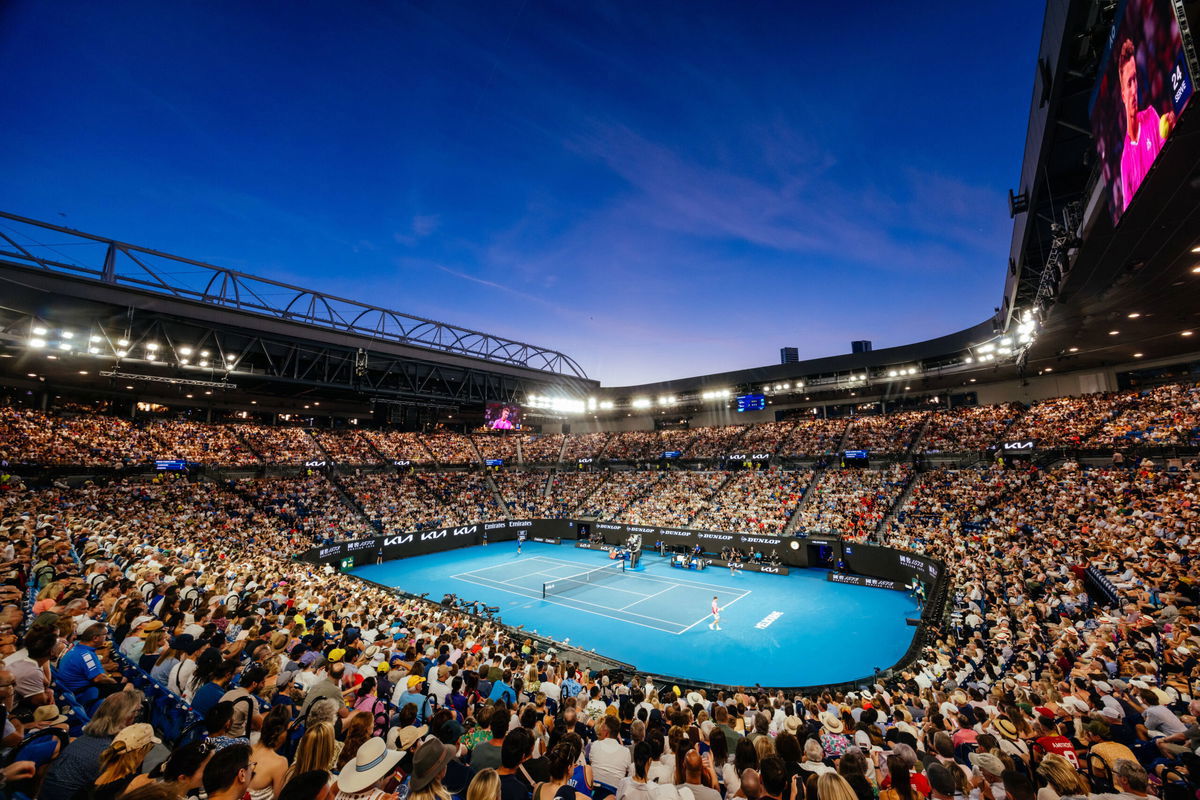
January 19, 2025: MELBOURNE, AUSTRALIA – JANUARY 19: Rod Laver Arena stadium atmosphere as Novak Djokovic of Serbia plays Jiri Lehecka of Czech Republic on day eight of the 2025 Australian Open at Melbourne Park on January 19, 2025 in Melbourne, Australia. – ZUMAp121 20250119_zsp_p121_112 Copyright: xChrisxPutnamx
Imago
January 19, 2025: MELBOURNE, AUSTRALIA – JANUARY 19: Rod Laver Arena stadium atmosphere as Novak Djokovic of Serbia plays Jiri Lehecka of Czech Republic on day eight of the 2025 Australian Open at Melbourne Park on January 19, 2025 in Melbourne, Australia. – ZUMAp121 20250119_zsp_p121_112 Copyright: xChrisxPutnamx
The semifinals at the 2026 Australian Open are heating up. Carlos Alcaraz is chasing his first final and title as he takes on Alexander Zverev, who’s hungry for revenge after last year’s loss. On the other side, Jannik Sinner, the two-time defending champion, faces Novak Djokovic, the king of Melbourne Park with 10 titles.


The atmosphere is electric as these top four seeds light up Rod Laver Arena. The tension builds with each rally, every point carrying weight. As matches grow intense and stretch to five sets, you might wonder how exactly these players get scored. Let’s find out:
Watch What’s Trending Now!
When does a tie-break start, and what happens at 6-6 in the final set?
When a tennis set hits 6-6, the tension spikes and the “standard tiebreak” steps in. It’s a quick sprint to 7 points (win by 2) and the victor seals the set 7-6. Serves rotate after the very first point and then every two points, keeping players on their toes and spectators glued to every swing.
The final set plays by slightly different rules but brings just as much drama. At 6–6, play switches straight to a 10-point tiebreak, still decided by a 2-point margin. This format arrived in 2019 to stop those never-ending thrillers that stretched deep into the night.
Getty
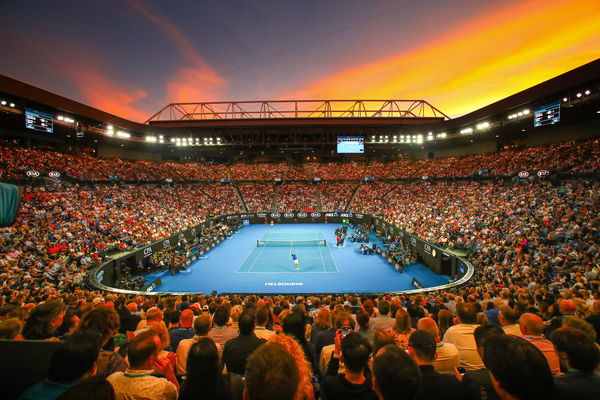
A general view inside Rod Laver Arena at sunset during the Men’s Singles Final match betwen Novak Djokovic of Serbia and Rafael Nadal of Spain during day 14 of the 2019 Australian Open at Melbourne Park on in Melbourne, Australia. (Photo by Scott Barbour/Getty Images)
Since 2022, all Grand Slams have followed this rule for uniformity, whether it’s the third set for women or the fifth for men. The first to 10 with a 2-point edge takes it all, set, match, and glory. If not, it rolls on until someone finally does.
Is the Super Tie Break first to 10 Points? Full scoring breakdown:
At the Australian Open 2026, the decisive super tiebreak raises the stakes. Yes, the first to 10 points with a 2-point cushion takes the win. It kicks in at 6-6 in the final set: the third for women and doubles, the fifth for men. The drama doesn’t end if they’re level at 10 apiece; play rolls on until someone edges ahead by two, whether that’s 11-9 or 15-13.
The player due to serve starts with a single point, then the opponent handles the next two before alternating every pair of serves. They swap ends after the opening point and then every six points, or every four if the weather’s rough. Unlike the usual first-to-seven tiebreak, this super version stretches the tension to 10 points, cutting marathon sets short. And no, there’s no catching your breath, no rest breaks allowed once it begins.
Australian Open tie-break scoring system: Points, serves, and two-point margin
AO uses standard tennis rules with a key variation in the final set. They occur when a set reaches 6-6 games, shifting to a points-based format instead of games.
In the first four sets, players scramble to reach seven points with a two-point cushion, so scores like 7-5 or 8-6 decide it. The first serve kicks off a single point, then changes hands every two. They switch ends after the opening point and again every six, keeping everyone moving and focused.
The final set gets even more intense with a super tie-break to ten points, again needing that two-point gap to seal it. Serving follows the same rhythm, and ends switch after one and every six points or four when the weather turns fierce. Since 2022, every Grand Slam has followed this setup, keeping matches shorter but just as thrilling.
Are the Australian Open tie-break rules different from other Grand Slams?
All four Grand Slams now run on the same format. The Australian Open, French Open, Wimbledon, and US Open all use the standard 7-point tie-break, win by two, in every set except the last. At 6-6 in the final set, whether it’s the third for women and doubles or the fifth for men, a 10-point super tie-break comes into play. It makes the finish sharp, tense, and full of momentum.
This uniform setup was introduced by the Grand Slam Board in 2022, first tested at the French Open that year and later made permanent. Before that, each major followed its own path. Australia led with the 10-pointer in 2019, the US preferred a 7-pointer at 6-6, Wimbledon stretched the thrill to a 7-pointer at 12-12, and the French Open used to keep players grinding until someone finally broke through.
Coverage of the 2026 Australian Open confirms the same procedure is still in action, even through the semifinals. The ITF-approved Grand Slam Rule Book for this season matches every detail across events. Serving alternates seamlessly, with one point first and then every two, while ends switch after 1 and then every 6 points. It feels balanced, predictable, and exactly how big-stage tennis should play out.
