
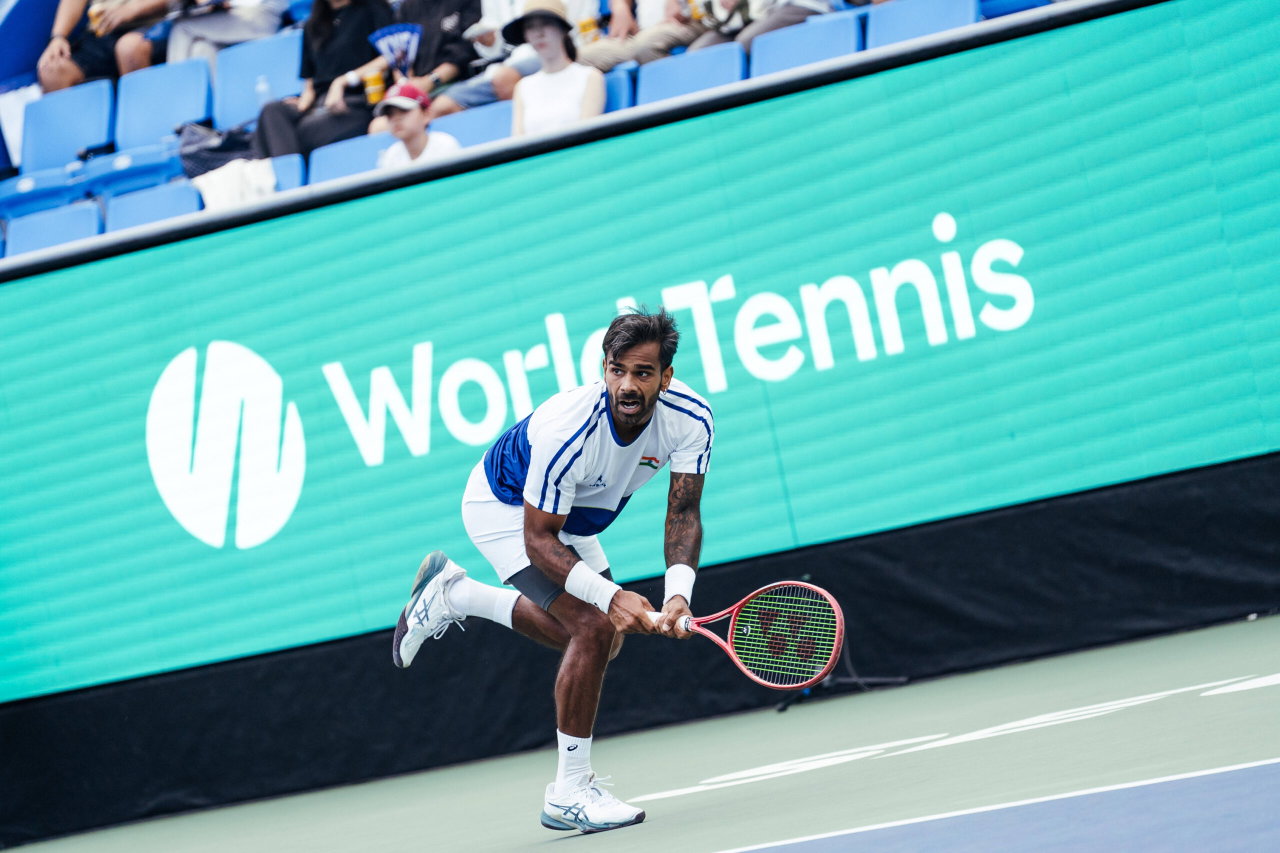
Winning a nearly three-hour tennis match against a home favourite is one thing. Getting carried away after the final point and then having to explain yourself is another. Sumit Nagal experienced both at the Maia ATP Challenger in Portugal, where he fought back from a set down to beat Henrique Rocha in a deciding-set tiebreak.
Watch What’s Trending Now!
The Indian No. 1 had every reason to celebrate a hard-earned victory, but his talking gesture toward the crowd drew boos and became the story after the match. Nagal later took to Instagram to apologize to the spectators and confirmed that he had also spoken to Rocha personally.
“To the crowd in Maia, I want to apologise for the talking gesture I made after the match. It was a heat-of-the-moment reaction, and it wasn’t the right way to respond,” Nagal wrote in an Instagram Story on October 12. He followed it with another message: “I respect everyone who came out to watch, and I appreciate you being there. I’ve also spoken to Henrique and apologised to him personally.” The statements came after his celebration drew boos from the Portuguese spectators. Nagal acknowledged that his reaction crossed a line, even after a victory that demanded nearly three hours of hard work.
Nagal defeated Rocha 3-6, 7-5, 7-6(5) in a match that lasted two hours and 56 minutes. The Portuguese player had chances to close out the contest, but the Indian kept himself alive and eventually edged the deciding tiebreak. Rocha entered the match with momentum after winning the Porto 2 title at the same venue just a week earlier. He was also the second seed at the Maia event and ranked No. 106, with a push toward the ATP Top 100 within reach.
The home crowd naturally backed Rocha, and the atmosphere grew tense as the match reached its conclusion. After sealing the win, Nagal made a talking gesture toward the spectators. The reaction was immediate, with sections of the crowd booing the Indian.
Nagal’s apology addressed both sides of the incident. He acknowledged the people who had come to support their local player and confirmed that he had spoken directly to Rocha. There has been no verified public response from Rocha about the gesture or the apology, so it remains unclear whether he has commented on the incident himself.
For Nagal, the win arrived after a challenging season. Hip and wrist injuries affected his consistency during the first half of 2026, but he showed signs of a revival in June when he won the ATP Challenger 75 title in Trgu Mureș, Romania. That was his seventh career Challenger title and his first since June 2024. He also reached a Challenger semifinal in the Czech Republic in August.
Frances Tiafoe’s Shanghai Meltdown Shows How Quickly Tennis Emotions Can Boil Over
Nagal was not the only player whose emotions became a talking point at the Shanghai Masters. Frances Tiafoe also endured a painful finish after he lost to Alejandro Davidovich Fokina in a deciding-set tiebreak on October 11.
The American seventh seed fell 7-6(4), 4-6, 7-6(6) after he came within a point of victory. Davidovich Fokina saved match point after Tiafoe slipped and fell during the rally, then found a way to win the deciding tiebreak. Tiafoe had also missed five break-point opportunities in the final set, which added to the frustration of a match that lasted nearly three hours.
After the defeat, Tiafoe smashed his racket several times against the side of his chair. The outburst showed just how difficult it was to accept a loss after coming so close to advancing. Yet he still met Davidovich Fokina at the net and hugged his opponent after the match. The Spaniard marked the win by writing “I am back” on the camera lens, as detailed in SportsCape Magazine’s report.
There is a clear difference between the two incidents. Tiafoe directed his anger at his racket after a heartbreaking defeat. Nagal’s gesture was aimed toward spectators who had supported Rocha, which is why it prompted a separate conversation about respect for the crowd. Nagal has since acknowledged that his reaction was inappropriate and apologized.
Both episodes offer a reminder that the final point does not always end the drama in tennis. Sometimes, what a player does in the seconds after a match can become almost as prominent as the result itself.