
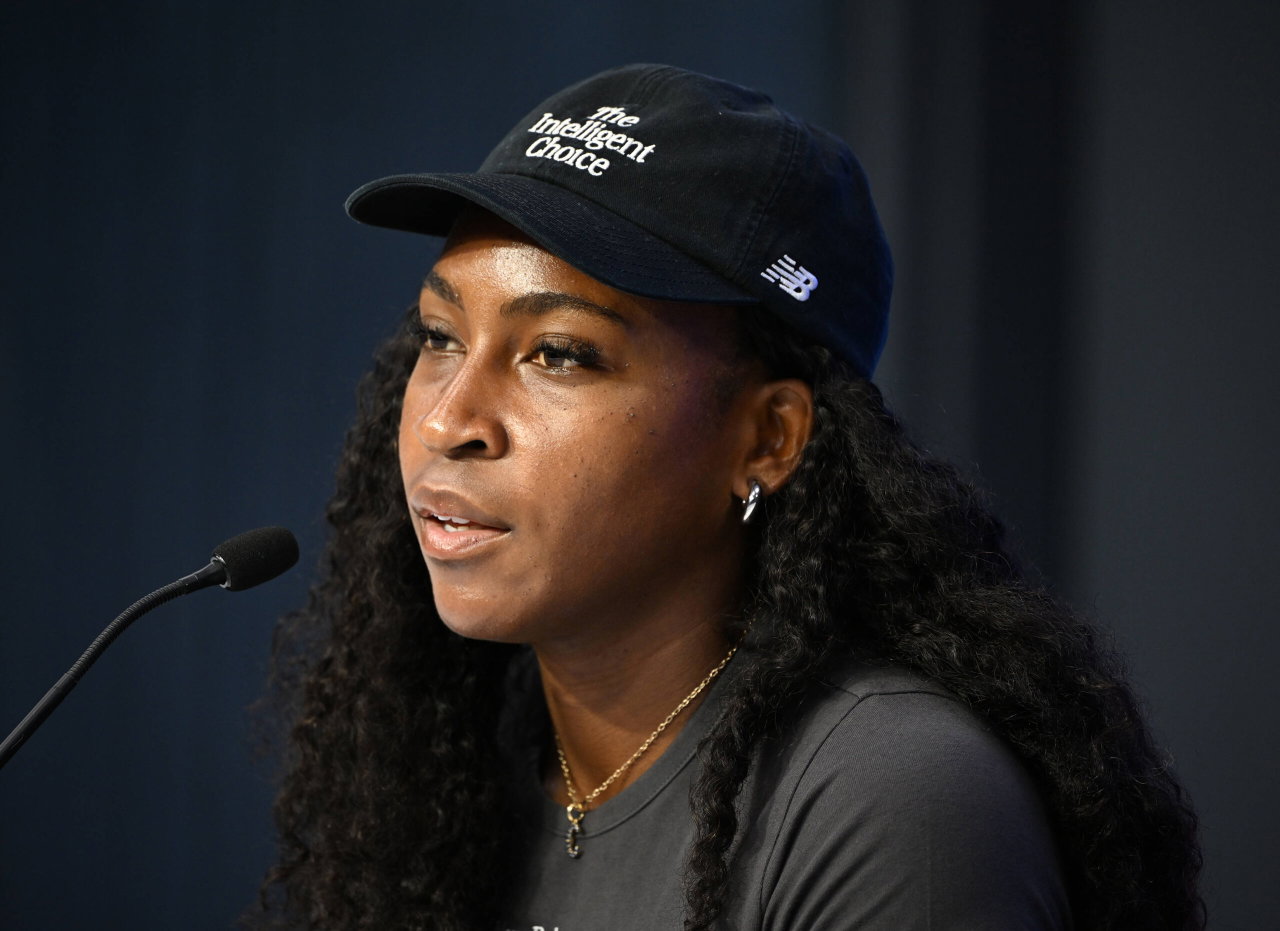
Coco Gauff’s match against Linda Noskova was the American’s 64th of the season, with her 65th scheduled against Marta Kostyuk on Thursday. The match against the Ukrainian might be Gauff’s last of the season, even if she wins, owing to the unusual round-robin format of the WTA Finals. Unlike regular WTA Tour singles tournaments, which follow a knockout format, the season-ending championship features a group stage, with players’ qualification hinging on their match records and, in certain scenarios, set and game percentages. And the World No. 4 isn’t particularly impressed.
Watch What’s Trending Now!
“The scenarios, I know they make sense, but they’re kinda stupid,” Gauff said to Christian’s Court on Tuesday evening. “If I win my match and I still don’t qualify, I’m like, ‘It’s okay, it’s cool.’ I’m looking forward to next year. I can’t say much, but everybody knows that has to change.”
Gauff, a two-time Grand Slam champion, is chasing a second WTA Finals title after winning the event in Riyadh in 2024. This is her fifth straight appearance, and having gone out at the group stage a year ago, she could now exit in the round robin for a second consecutive year.
Gauff’s 6-3, 6-3 loss to Noskova on Tuesday has taken the qualification chances out of the 22-year-old’s control. Even if she wins her final match against Kostyuk, against whom she does have a 4-2 head-to-head record, the American will have to depend on what her compatriot, Jessica Pegula, does in her match against Noskova.
Should Pegula and Gauff both win their matches, it would be a three-way tie between the two Americans and Linda Noskova, all of whom would have a 2-1 win-loss record during the group stages. In such a situation, the percentage of sets won would be considered to determine who would go through. Gauff’s current set record is 2-3, and at best she could reach 4-3 or 4-4, depending on whether she beats Kostyuk in straight sets or in three.
On the other hand, Pegula has a 3-2 set record in the event and can reach up to 5-2 or 5-3, depending on her result against Noskova. This means that even if Pegula wins in three sets against Noskova, her set percentage would be 62.5%, which would be higher than Gauff’s 57.1% should she beat Kostyuk in straight sets. Noskova, who is 4-0 in sets, could not fall below 66.7% in that scenario either, which leaves Gauff third in any three-way tie.
Put simply, a Pegula win ends Gauff’s tournament no matter what she does against Kostyuk. However, should Noskova prevail over Pegula in her match, a win over Kostyuk would be all it takes for Gauff to go through. The Czech does have a 3-1 head-to-head record against Pegula, and Gauff would be hoping that Noskova improves on that record.
If this were before 2003, Gauff would not need to consider so many calculations, as the WTA Finals between 1983 and 2002 were held in the standard knockout format with a 16-player draw, where one loss was enough to send a player packing. The Tour Finals also featured best-of-five-set matches from 1984 till 1998, but only in the final, a format that produced some classic contests, such as Monica Seles defeating Gabriela Sabatini in 1990 and Steffi Graf defeating Martina Hingis in 1996, both in five-set thrillers.
The current setup, though, may not last. The tournament moves to Charlotte, North Carolina, in 2027 for at least three years, and the tour is reportedly weighing format changes. Some sources report that the event will be cut from eight days to five, while Tennis Temple describes a shorter schedule as one of several options, alongside an expanded 16-player draw that would start with a knockout round of 16, much like the pre-2003 setup. Nothing has been confirmed, and it remains to be seen whether the players would back such a move.
Gauff would also remain wary of recent history, in which players have not made it past the group stage despite winning two of their three matches. Back at the 2024 edition, Iga Swiatek missed out on semifinal qualification after falling short of the set percentage criteria, as she was in a three-way tie with Barbora Krejcikova and Gauff herself.
That said, Pegula, 32, has long had her own issues with the format. Ahead of the 2023 Finals in Cancun, when she was 29, ranked fifth in singles and first in doubles, and partnering Gauff in the doubles, Pegula said she had struggled to adapt the year before, when she lost all of her round-robin matches. Players are used to leaving town after a defeat, so staying put and going again was hard. “You lose, you’re still at the same place and you have to play again,” she said, adding that she hoped to prepare better mentally and that the varied matchups still make the format exciting.
Speaking to The Tennis Channel this week, Pegula added:
“It is a little bit of an adjustment. I remember my first finals; I didn’t think it would be that big of a deal. But then you lose a tough match and you’re thinking, ‘I want to get out of here. I don’t want to be here. But then you remind yourself, ‘No, wait. I need to stay, compete and still win.’ Over the last few years, I’ve gotten much better at handling it and knowing how to approach things a little differently.”
She further admitted she was a little irritable in her warm-up after losing to Gauff, and said players have to come back out an hour later to face someone completely different, which calls for a different mindset.
For Gauff, losing that one set against Pegula might be the differentiator, as the American could not convert the match point, despite coming back from a 5-1 deficit. Noskova, meanwhile, appeared far more focused on what lay ahead after beating Gauff, revealing that she hadn’t even realised she had qualified for the semifinals and was already thinking about her next match against Pegula.
Linda Noskova Refuses to Revel in Her Win Over Coco Gauff at the WTA Finals
A straight-sets win over Coco Gauff at the WTA Finals is a significant result for Linda Noskova, given that this is the first time that the Czech player has qualified for the Tour Finals, and the American is a former champion. However, given the year she is having, it is understandable that the World No. 8 holds herself to higher standards.
“I’m glad I got used to the conditions pretty well today,” said Noskova in a post-match interview. “I mean, the sun was obviously very tricky. But also, I would not say that it was one of the best matches I’ve played this year. You know, Coco, she’s a tricky player. Anything can happen. She’s definitely a big fighter. So I had to play since, you know, beginning till the very last match. So I was just focusing on that.”
She further explained her mindset: “First of all, I did not even know I was in the semis, to start with that. Right after the match finished, I was already focusing on how I’m going to play Jessie (Pegula) in two days.”
Noskova is not the first player to highlight the challenges posed by the sunlight at Indian Wells. Even World No. 2 Aryna Sabalenka had spoken about how the sun and shade made serving difficult during her match against Karolina Muchova. Noskova, too, had some serving difficulties in the first set against Gauff, with the American managing to break her serve twice. However, the World No. 4’s own serving woes were considerably more costly, as Noskova broke her four times in the opening set and five times overall.
Once she settled into her rhythm, there was no stopping Noskova, who did not face a single break point in the second set. Mindful of Gauff’s fighting ability, the World No. 8 kept her opponent from mounting any meaningful pressure.