Imago
Hellenic Championship ATP, Tennis Herren 250 – General view during the Hellenic Championship ATP 250 tennis match held in OAKA Stadium in Athens, Greece, 2 November 2025. IMAGO/ONE INCH PRODUCTIONS ATHENS Greece Copyright: xONExINCHxPRODUCTIONSx 6716262
Imago
Hellenic Championship ATP, Tennis Herren 250 – General view during the Hellenic Championship ATP 250 tennis match held in OAKA Stadium in Athens, Greece, 2 November 2025. IMAGO/ONE INCH PRODUCTIONS ATHENS Greece Copyright: xONExINCHxPRODUCTIONSx 6716262
In October 2025, the ATP took its next big leap into Saudi Arabia, teaming up with PIF’s Surj Sports Investment to launch a brand-new Masters 1000 event. It’s the first expansion of that category in the ATP Tour’s 35-year history. The debut is set for 2028, but skepticism is already brewing as players keep voicing concerns about an ever-growing season. And now, another twist is shaking the tennis world.


Reports suggest the organization has reached out to ATP 250 and 500 tournaments, offering hefty sums to buy back their licenses. The motive is to carve out space in the already packed calendar for the Saudi Masters 1000. Negotiations are stirring tension across the Tour. And in the background, whispers grow that the Next Gen Finals could soon find a new home in Prague.
Watch What’s Trending Now!
This transformation isn’t happening overnight, but the gears are turning. Feliciano Lopez lifted the curtain slightly during the recent Ischgl Trophy, an exhibition that gathered several former pros.
“The ATP’s idea is for top players to participate in the Grand Slam tournaments, ten Masters 1000 tournaments, and perhaps a few other 500-level events,” said Lopez, who now oversees the Madrid Masters 1000 and plays a key role in the Davis Cup finals. Lopez confirmed that the Saudi event, featuring a 56-player draw and no mandatory status, is penciled in for 2028. Likely in February after scheduling conflicts with the Australian summer ruled out an early January slot.
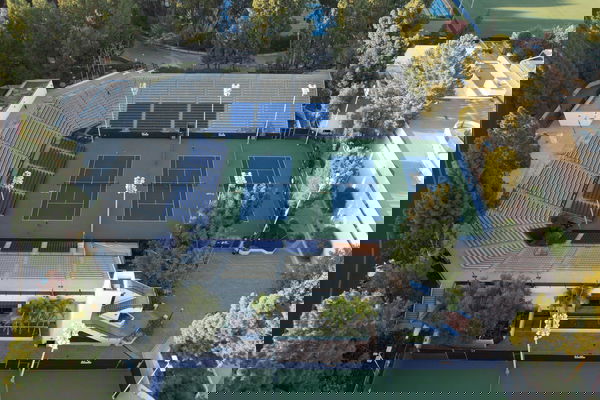
Imago
NCAA, College League, USA Tennis: Los Angeles Tennis Center An aerial view of the Los Angeles Tennis Center on the campus of UCLA, Thursday, Sept. 9, 2021, in Los Angeles. The stadium is the home of the UCLA Bruins men s and women s tennis teams. Los Angeles California United States EDITORIAL USE ONLY Copyright: xImagexofxSportx ImagexofxSportx iosphotos253032
The first visible changes start in 2026. Marseille will move to October and shift to Lyon, freeing up a February slot that still feels crowded. Doha and Dubai stay safe, propped up by strong financial backing and their proximity to Saudi Arabia. But tournaments in Montpellier, Rotterdam, Dallas, Delray Beach, and even South America might be walking a fine line.
The South American swing, already slimmed down to Buenos Aires, Rio, and Santiago, is testing the idea of switching to hard courts just to stay in the game. Gaudenzi’s message couldn’t be clearer: by 2028, February could belong entirely to the Middle East and South America. The rest of the world will have to figure out where it fits in.
Money, once again, is the driving force. SURJ Sport, a Saudi company backed by the PIF, is spearheading a huge plan that includes funding for tournament license buybacks. Swiss outlet Blick reports that the ATP will use those funds to reclaim licenses from several 250s, and maybe even a few 500s.
The playbook is familiar. The ATP compensates organizers, takes over the rights, and lets those events fade away quietly. It’s the same approach used to remove Palermo’s clay event two decades ago and, more recently, to retire Metz, which hosted its final edition in 2024.
The slow removal of the 250 circuit has been happening in plain sight. There were forty-two such tournaments in 2022. Now only thirty remain, a number expected to hold until 2026. During the ATP Finals, chairman Andrea Gaudenzi made it clear that just ten weeks each year will be dedicated to lower-tier events, a subtle but unmistakable sign of cutbacks.
Could all this help answer players’ calls for a shorter season? Only time will tell. Earlier, Danny Townsend, CEO of Surj Sports Investment, spoke of the potential upside of these sweeping changes.
CEO opens up about investing in tennis in Saudi Arabia
On November 25, speaking to The National, SURJ Sports Investment CEO clarified the idea behind Saudi Arabia’s upcoming Masters 1000 tournament.
“When you’re investing in sports IP [intellectual property], you want to invest in assets that have had a history of growth,” Townsend said. “When you look at the Masters 1000 licenses over time, they’ve continued to grow in enterprise value. So first and foremost, as an investment, the return profile was clear that if we could secure one, it would be a good investment.”
The reasoning sits comfortably within a broader global pattern. Across the world, sports organizations are racing to expand into new markets, and tennis is following suit. The sport’s international ambitions are surging, and Saudi Arabia has placed itself right at the center of that movement. A Masters 1000 in the kingdom could mark a pivotal moment, one that introduces top-level tennis to new audiences far beyond its traditional bases in Europe and North America.
For him, the vision extends beyond immediate financial returns. It’s about creating something lasting. “Secondly, when you look at our mandate at SURJ more broadly and how we use our investment assets to drive sustainable growth in the sports sector, having an owned tennis tournament as opposed to a rented one would enable us to do a couple of things,” he explained. His words reveal an emphasis on long-term stability and influence in a rapidly evolving global sports economy.
So now, the Saudi Masters will join a region already energized by tennis’s growing presence, building on existing partnerships and enthusiasm for the game. The momentum suggests not just a new destination on the calendar but a commitment to positioning the Middle East as a serious hub for elite tennis.
The question now is how this bold move will reshape the sport’s reach and rhythm in the years to come. What’s your take on this? Share it in the comments below!