
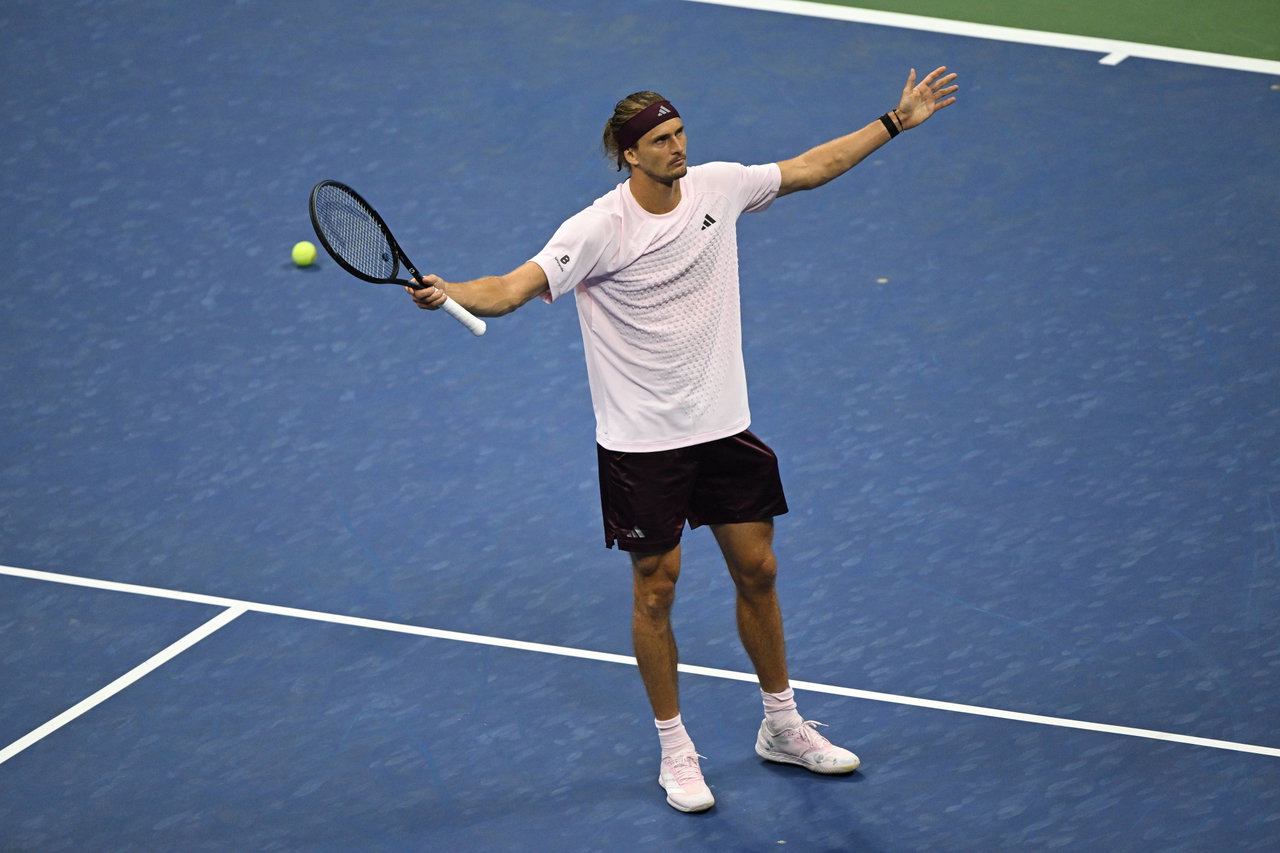
The US Open has been keeping Alexander Zverev up late. So late, in fact, that the German now feels like he has somehow landed in Melbourne.
Watch What’s Trending Now!
After another comfortable win in New York, Zverev offered a sly summary of his recent routine. The top seed had little trouble against Botic van de Zandschulp on Wednesday, cruising to a 6-2, 7-5, 6-1 victory inside Arthur Ashe Stadium. More importantly, the win sent Zverev back into the US Open semifinals for the first time since 2021 and kept his remarkable Grand Slam season rolling.
But his biggest talking point afterward had little to do with his dominant performance.
For Zverev, late nights in New York have become almost routine. The German explained what happens after the match ends late at night: ice bath, food, media duties, treatment, and finally bed.
“I mean, I went to bed as late as 6:45 a.m. in the last week,” Zverev said. It is hardly the ideal rhythm for an athlete competing at the highest level. And after repeatedly finding himself finishing deep into the night, Zverev admitted he was beginning to feel the effects. “I’m kinda feel like jet lagged,” he added, before delivering the line that caught everyone’s attention: “I’m feeling like playing Australian Open in New York right now.”
The irony was difficult to miss. Melbourne is on the other side of the world, but Zverev’s body clock in New York appeared to be experiencing the same confusion.
Fortunately for him, Wednesday brought some relief. His quarterfinal ended at around 10:20 p.m. – a much earlier finish than some of the tournament’s recent late-night spectacles.
And Zverev will need every bit of that recovery time now.
As per renowned tennis journalist Jose Morgado, “Pretty sure they will schedule the American semifinal for the night session so Zverev will have to suddenly play day session for the first time in the entire event.”
There’ve been already multiple late night finishes at the US Open this year. For example, Venus Williams’ first-round match against Sofia Kenin didn’t begin until after midnight and ended shortly after 2 a.m.
Then recently, Ben Shelton’s record-breaking QF (4hrs 28mins) against Carlos Alcaraz finished at 3:33 a.m.
The scheduling has now prompted growing concern from some of the sport’s biggest voices.
Martina Navratilova was particularly blunt after Shelton and Alcaraz’s marathon.
“Something has got to give,” the tennis legend wrote. “This is not ok and it is not normal.”
Navratilova has suggested changing the format of the night session altogether. Instead of routinely putting both a men’s and women’s singles match on Arthur Ashe, she believes the US Open could schedule one singles match alongside doubles.
Her reasoning is simple: if the first singles match goes long, the second one inevitably gets pushed deeper into the night.
In fact, Alcaraz’s trainer, Alberto Lledo Quiles, did not mince his words, calling the scheduling “unhealthy.” After the match, he questioned why players were being asked to start five-set matches at 11 p.m. in the first place.
He stated, “It’s on some occasions that I know (I say this humbly) that the performance is not healthy… We have to adapt to any circumstance, and whoever does it sooner has a competitive advantage. But… starting a five-set tennis match at 11 at night is not at all healthy for the health of an athlete.”
However, the Alcaraz-Shelton match was far from an isolated case. The scheduling problems had already started making headlines earlier in the tournament. Venus Williams and Sofia Kenin, for instance, did not step onto the court for their first-round match until 12:13 a.m., setting a record for the latest start in a women’s US Open match.
Alexander Zverev’s opening-round battle with Lorenzo Sonego lasted four hours and 53 minutes, eventually ending at 1:55 a.m. But the German barely had time to recover before returning to the court two days later for another five-set marathon, this time lasting four hours and 33 minutes against Quentin Halys.
Shelton had experienced the late-night grind himself. His third-round match against Denis Shapovalov began around 10:45 p.m. and did not finish until 2:07 a.m. That marked the third match of the tournament to end beyond 2 a.m., adding yet another example to the growing scheduling concerns.
Notably, former British player Tim Henman has also floated the idea of “protected” start times. If a match has not begun by a certain hour, tournament officials could potentially move it to another court rather than allowing the schedule to spiral into the early morning.
And after Shelton and Alcaraz’s marathon, even more radical suggestions about shortening matches have entered the conversation.
For players, however, the issue isn’t merely about convenience. A late finish can completely disrupt recovery, sleep and preparation for the next round. Thankfully, for Zverev, his QF match got wrapped up pretty quickly.
What did Alexander Zverev say about his overall performance in this tournament?
The victory marked his 13th Grand Slam semifinal and his 51st win of the 2026 season. It also completed something he had never managed before: reaching at least the semifinals at all four Grand Slams in the same year.
At 29 years and 132 days old, Zverev is now the oldest player in the Open Era to reach all four Grand Slam semifinals in a season for the first time.
His numbers also reveal how hard-fought his path has been. Zverev has conceded 80 games at this US Open, the second-most among top seeds to reach the semifinals in the Open Era. Only Rafael Nadal, who dropped 85 games during his 2018 run, had conceded more.
Yet Zverev has continued to find answers.
Now comes a familiar opponent. He will face Karen Khachanov in the semifinals in a rematch of their memorable 2021 Olympic final, when Zverev captured the gold medal in Tokyo.
For all the complaints about late nights, disrupted sleep and feeling like he is playing Melbourne in Manhattan, Zverev is exactly where he wants to be. “As long as I’m here and as long as I’m in the SF, it’s all that matters.”
The German may be running on a confused body clock. But his Grand Slam dream is wide awake.