
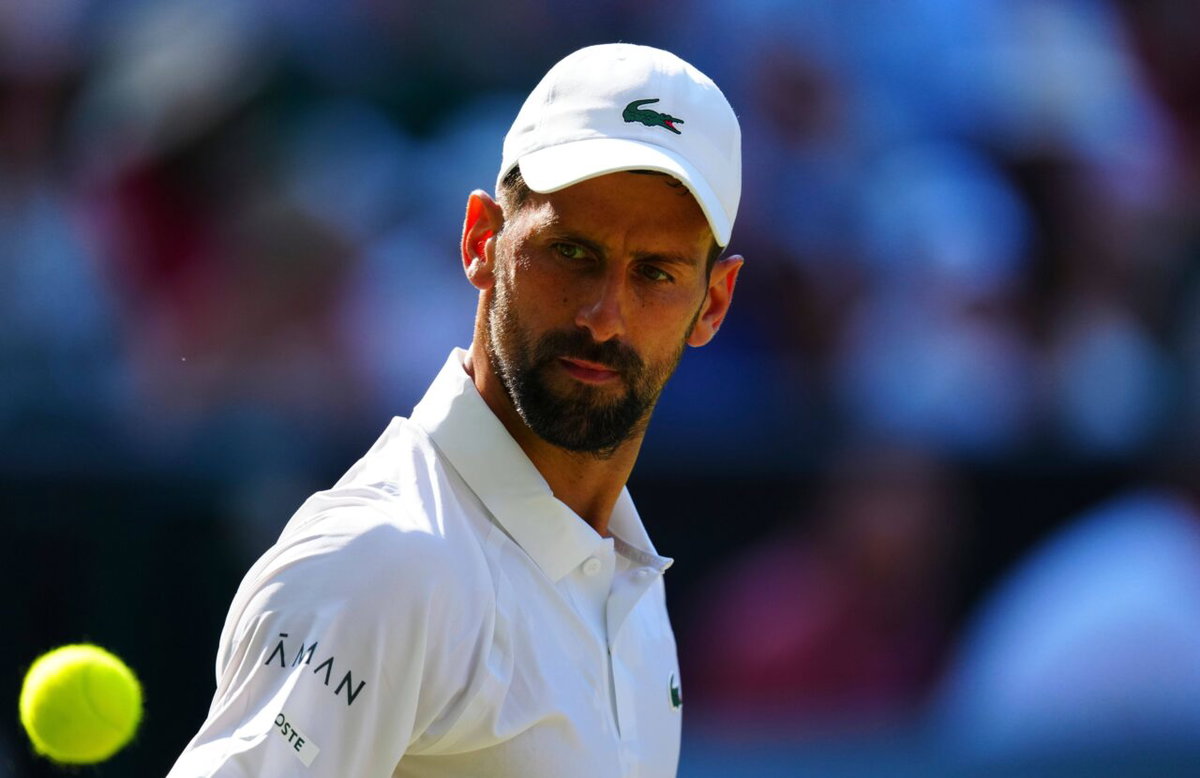
The quest for greatness is often mired in uncertainties and difficult realizations. 2026 has been a mixed year for Novak Djokovic. His feverish chase for a record-breaking 25th Grand Slam has culminated in tough losses to Carlos Alcaraz at the Australian Open and a shocking exit at the French Open. Yet despite these upsets, the field for the men’s singles at Wimbledon had better be on its toes as the mercurial Serb seems raring to go. After a limited and overall disappointing clay-court campaign, the Serb is back on grass, a surface that has long adorned his glittering career. Speaking ahead of his tournament opener on Monday, the 24-time major champion believes his return is fueled by both an improvement in fitness and a change in scenery.
Watch What’s Trending Now!
“It’s different in terms of my overall fitness”, said Djokovic in his pre-tournament press conference, per Punto De Break. “I think I’m better prepared here than I was at Roland Garros. Also, playing on grass rather than clay requires less physical effort, which helps me.” Djokovic’s comments on the surface change hold merit, as the surface allows for first-strike tennis, frequent net approaches, and a solid, accurate serve, which will help keep points short. At this stage of his career, such conditions are imperative for the Serb to go deep in the major.
During the clay-court season, Djokovic played only a few matches in the lead-up to the French Open, losing his first and only match in Rome to Dino Prizmic, who is ranked 73 spots below him. Later in Paris, he went through tough four-set matches against local favorites like Giovanni Mpetshi Perricard and Valentin Royer, before his five-set loss to Joao Fonseca. The physical toll of clay-court tennis became evident for the Serb during the later stages of the match against the Brazilian; he threw up on the court and looked exhausted.
However, coming directly to Wimbledon after Paris is a routine that Djokovic has followed for quite some time now. The Serb last played a grass-court warm-up event at the Queen’s Club back in 2018. Since then, his only grass-court action on the calendar has been Wimbledon, a scheduling tactic that has worked well for him, as he has won the Championships three times and finished as runner-up twice since 2019. The Serb has been on site at Wimbledon for the better part of last week and had a good outing against Tommy Paul at an exhibition event, winning a best-of-three-set match against the American. Besides the tradition, the surface itself lends well to Djokovic’s qualities.
The major reason for Djokovic’s success on grass has been his elite ankle flexibility — largely attributed to his skiing days, which makes him one of the very first players to slide on the slippery surface. Even though his movement is slightly compromised at 39, he continues to compete against the very best, and with the heat in London affecting on-court conditions, the Serb might have his best chance of clinching the elusive 25th Major title.
Heat and tricky draw being Djokovic’s twin challenges in Wimbledon quest

Imago
Wimbledon Jannik Sinner vs Novak Djokovic Wimbledon Championships 2025 Day 12, 11/07/25 Gentlemens Singles – Semi Final Centre Court Jannik Sinner vs Novak Djokovic Novak Djokovic leaves the court after his straight sets defeat PUBLICATIONxINxGERxAUTxSUIxONLY Copyright: xMarcxAspland/ThexTimesx NINTCHDBPICT001009244807
Although the weather is forecast to break, London has endured an unprecedented heatwave—one that may persist through Wimbledon, which is bound to alter playing conditions. Djokovic spoke about it in his press conference, pointing out the speed differential between the surface and the balls: the former quickens in the heat, while the latter “become (s) bigger and softer, which slows down the game.” However, if that’s the case, Djokovic is best equipped to handle it, given his experience.
Djokovic’s draw is a mixed one, with the first few rounds being relatively routine for the Serb, before a potential Fonseca rematch awaits in the fourth round. On grass, Djokovic will have an advantage over the Brazilian in terms of movement and the speed of the rallies. He will compete on Sinner’s side of the draw, with a chance to face the defending champion in the semifinal. The key for the Serb will be to remain healthy and spend as little time on court as possible for the early-round victories. Djokovic showed he still has the capacity to beat Sinner in Australia, but that was a result of having fresher legs following a withdrawal and a mid-match retirement in his previous two rounds.
Sinner also has lingering questions about his endurance in the heat, which might be a key factor in a potential matchup. A lot will depend on Djokovic’s mindset and his serve. If those two are fit and firing, the Serb will have an opportunity of staging a run at SW19, especially since one of his arch rivals, Carlos Alcaraz, remains sidelined with injury, and the rest of the field can’t boast the same experience on grass.