
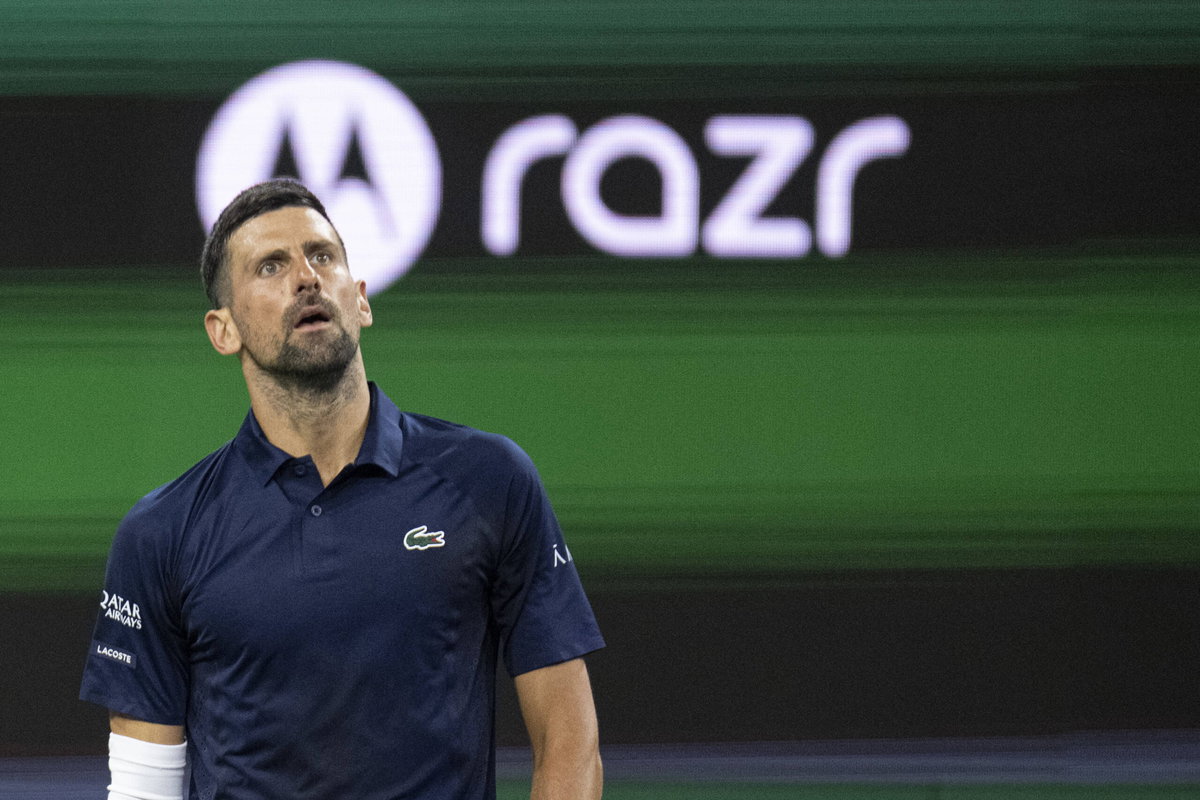
Tennis scoring rules have evolved to shorten match durations and make it less physically taxing, but one of Novak Djokovic’s suggested changes is quite radical. That may have been the case with all the changes that have become normal in the sport, but the 24-time major champion’s suggestion involves something unprecedented.
Watch What’s Trending Now!
This is a tweak to the sport that could see match durations reduced, with even five-set matches getting wrapped up inside two hours.
“We should change the format of the scoring. Not play up to six games in the set, play up to four. Possibly no ad. Best of five sets. Keep the matches within a two-hour window. It’s best for everyone,” said Djokovic to Instagram creator Nick Coutracos during the Fanatics Fest.
Playing the traditional ‘first to six’ games set with ad scoring has been a long-adopted scoring system, especially in singles, since as early as the 1870s, with the tiebreak being introduced at the 1970 US Open to make sure that marathon matches were no longer a broadcasting obstacle.
It was only in 2022 that all four Slams introduced a 10-point tiebreak in the fifth set of matches, instead of having a different set of fifth-set rules at each Slam. Australian Open became the first tennis major to officially introduce this in 2019.
Previously, besides the US Open, major finals’ deciding sets at the other three Slams required players to keep at it until one side had a two-game lead. While the French Open retained that rule till the 2021 edition, things changed in 2019 with the Australian Open and Wimbledon introducing a final-set tie-break.
The one difference at SW19 was that the tie-break would come in at 12-12 in a final. The Serb was part of this famous match at Wimbledon in the 2019 final.
Djokovic’s proposal to cut sets to four games will automatically shorten the time, but it can be seen as quite a jarring change. This may have been the case among audiences when men’s finals at the Masters 1000 (ATP Masters Series in 2007) changed into a Best of 3 sets from the earlier Best of 5 format. 19 years on, the new format feels normal and a key part of the sport.
In 2021, the Olympic Final also changed from a Best of 5 to a Best of 3 format. For those who watched the finals from Seoul (1988) to Rio (2016), which featured three five-setters, three four-setters, and two straight-set wins, the Tokyo and Paris finals wrapping up in two sets may have felt odd.
That’s how the four-game suggestion may feel initially, and audiences following the Next Gen Finals’ Fast Four format may agree. However, this may even stem from the fact that these fans are accustomed to a six-game set throughout the year.
While these four-game sets may be quite drastic, Djokovic’s other suggestion may be even more impactful
Removing the ad system and playing a deciding point at 40-40 can help increase the speed of a match. Often, servers lose their rhythm and can’t put together two good serves, making deuce games tedious affairs.
A deciding point will raise the stakes at 40-40 and reduce the time as well, as seen in doubles matches, especially at the non-Grand Slams. The faster formats have been used in certain events, but mostly in doubles.
Though modifying the sets will see best-of-five set matches finish quickly and allow players to remain fresh in the later rounds, Djokovic’s suggestions to shorten tennis matches aren’t coming in for the first time amidst his largest Grand Slam drought.
Novak Djokovic has made the case for best-of-three sets at Grand Slams in the past
Djokovic had spoken about having best-of-three set matches even at Grand Slams. The Serb’s comments were not unfounded, as a top player plays anywhere between 70 and 80 matches throughout the year in a rigorous schedule. On the court, the extreme baseline play has been normalized, and with uniform court speeds, points on all surfaces are often long.
“I am more a proponent of two-out-of-three everywhere, even though of course slams have always been best of five,” said Djokovic in 2020. “I don’t know whether there is a chance at all for it to change. I just feel that we have enough tournaments, enough matches during the year. We have the longest season of any sport in the world. Tennis has the longest season from January 1 to end of November.”
At that time it may not have felt jarring. This is because the suggestion simply saw him call for Slams to replicate the ATP Tournaments’ format, and not a shortened set or deciding point at deuce.
However, the Serb was also aware that five-set matches at Grand Slams are a unique asset of the sport, as they often result in classic contests at the biggest competitions.
At the 2024 Wimbledon, Nole voiced his support for a mixed format, with the Slams having three-set matches in the early rounds, while the second week would see best-of-five sets.
“The only thing that I’m maybe thinking it could be good to consider is the opening rounds that could go best-of-three, then you move into the hybrid of best-of-fives from the fourth rounds or quarters. I don’t know. That’s just me, my thinking”, said Djokovic in his press conference. “I think best-of-five, particularly in the last three or four rounds of a Slam, you need to keep.”
Djokovic himself has been part of some thrilling five-set contests over the years, such as the Australian Open quarterfinal in 2014 against Stan Wawrinka, and the 2018 SW19 semifinal against Rafael Nadal.
Even at this stage of his career, the Serb has played three iconic five-set matches at Slams this year, winning against the likes of Sinner and Felix Auger-Aliassime in Melbourne and London, while losing to Joao Fonseca in Paris.
What’s different from earlier and now is that the Serb is drained after these five-set epics. He had nothing left in reserve to play Sinner at Wimbledon after his five-four epic against Auger-Aliassime. The same was the case in the Australian Open Final against Carlos Alcaraz, after prevailing over Sinner.
Therefore, while there’s merit to the Serb’s suggestions to shorten the game, completely robbing the audience of a five-set thriller might reduce the sport’s entertainment value and test of tenacity at the highest level.