
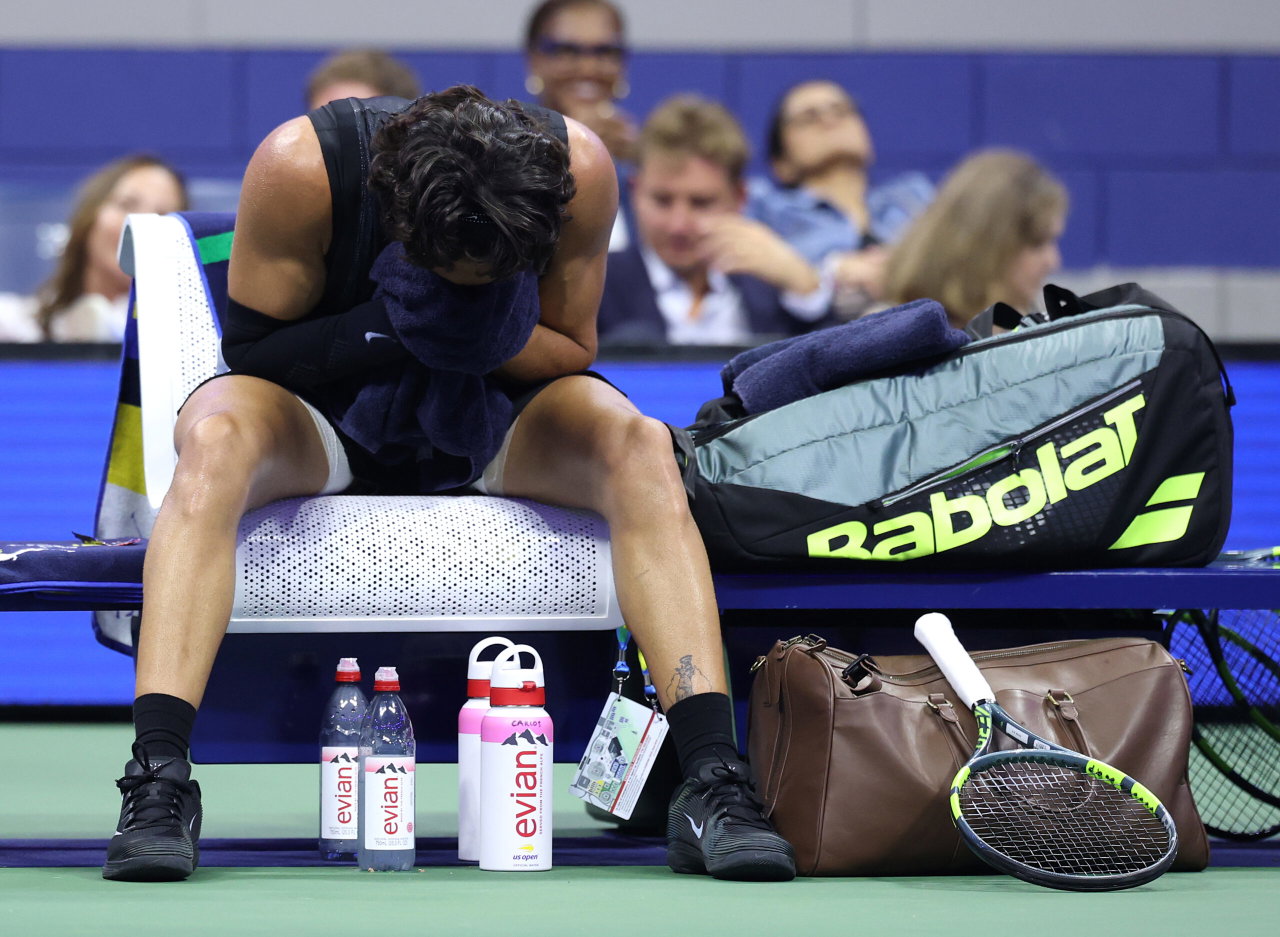
The US Open got exactly what it wanted: a late-night blockbuster. The players were the ones left paying for it. Ben Shelton finally put away Carlos Alcaraz with a 146-mph ace at 3:33 a.m. ET, ending a brutal four-hour, 28-minute fight inside Arthur Ashe Stadium. The crowd loved every second of it, but once the celebration faded, tennis was left with an uncomfortable question: how late is too late when the spectacle starts coming at the expense of the athletes?
Watch What’s Trending Now!
“It’s on some occasions that I know (I say this humbly) that the performance is not healthy… We have to adapt to any circumstance, and whoever does it sooner has a competitive advantage. But… starting a five-set tennis match at 11 at night is not at all healthy for the health of an athlete,” he wrote.
Alcaraz’s trainer, Alberto Lledó Quiles, called the scheduling what it was: unhealthy. After the match, he questioned why players are being asked to start five-set matches at 11 p.m. in the first place.
And the US Open could hardly have handed him better evidence. Once the match began, Shelton seized control with a 7-6(5), 6-1, 6-3 lead before Alcaraz hit back 6-1 in the fourth to force a decider. The fifth set went all the way to a 10-point tiebreak, where Shelton finally closed out a 7-6(5), 6-1, 6-3, 1-6, 7-6(10-7) win, turning an already late start into the latest finish in US Open history.
Shelton embraced the crowd that stayed with him. “I always say that this is the greatest sports city in the world,” he said. “The city of New York, they showed up tonight ’til 3 a.m.”
And Shelton-Alcaraz was hardly the first warning. Venus Williams and Sofia Kenin did not even begin their first-round match until 12:13 a.m., the latest start in women’s US Open history.
Alexander Zverev then survived Lorenzo Sonego in a four-hour, 53-minute opener that finished at 1:55 a.m., before returning two days later for another four-hour, 33-minute five-set battle against Quentin Halys. Shelton had already been dragged into the same cycle himself, beating Denis Shapovalov at 2:07 a.m. after their third-round match started around 10:45 p.m. By then, it was already the third match of the tournament to finish after 2 a.m.
That is why Martina Navratilova’s criticism hit harder after another 3 a.m. finish. “Something has got to give,” the former world No. 1 wrote on X. “This is not OK and it is not normal.”
Aryna Sabalenka had already warned about the same problem. “You still need to get your hours of sleep, so you start later,” she said. “You can just really mess up your schedule.”
She knows because she has been there. At the 2024 US Open, her third-round match against Ekaterina Alexandrova did not start until 12:08 a.m., then the latest start in tournament history. Sabalenka lost the first set before coming back to win 2-6, 6-1, 6-2, leaving her on court deep into the morning.
That is exactly the issue. When matches start that late, everything after them gets pushed back too.
And that is the bigger issue now. Late-night finishes are no longer rare, yet tennis keeps expecting players to absorb the consequences.
Carlos Alcaraz Has Already Warned About Tennis’ Scheduling Problem
For Alcaraz, the concern goes beyond one night in New York. His four-month injury absence changed the way he looks at the calendar, and he now expects to skip tournaments rather than try to play every major event.
“In the future, I’m going to take some breaks, some long breaks,” Alcaraz said. “Maybe not four months, but one month, two months, missing some tournaments, because it’s impossible to play them all.”
With Grand Slams, Masters 1000 events and other commitments filling the season, Alcaraz believes the strain is already showing.
“We are seeing a lot of players getting injured, a lot of players getting tired,” he said.
That gives his camp’s latest criticism more weight. The question now is whether the US Open can change its format without losing the appeal of its night sessions.
Andy Roddick has defended the current setup, arguing that match lengths are unpredictable and tens of thousands of spectators still have to be moved safely in and out of the stadium.
Others want changes. Tim Henman has suggested “protected” start times that would allow delayed matches to be moved to another court. Navratilova has proposed one singles match alongside doubles at night, while Marion Bartoli has suggested reducing the session to one match from the quarterfinal stage onward.
That leaves the US Open with a clear dilemma. Night sessions are part of its identity, but the Shelton-Alcaraz marathon showed how quickly that spectacle can turn into a scheduling problem. The match delivered. The schedule did not.