
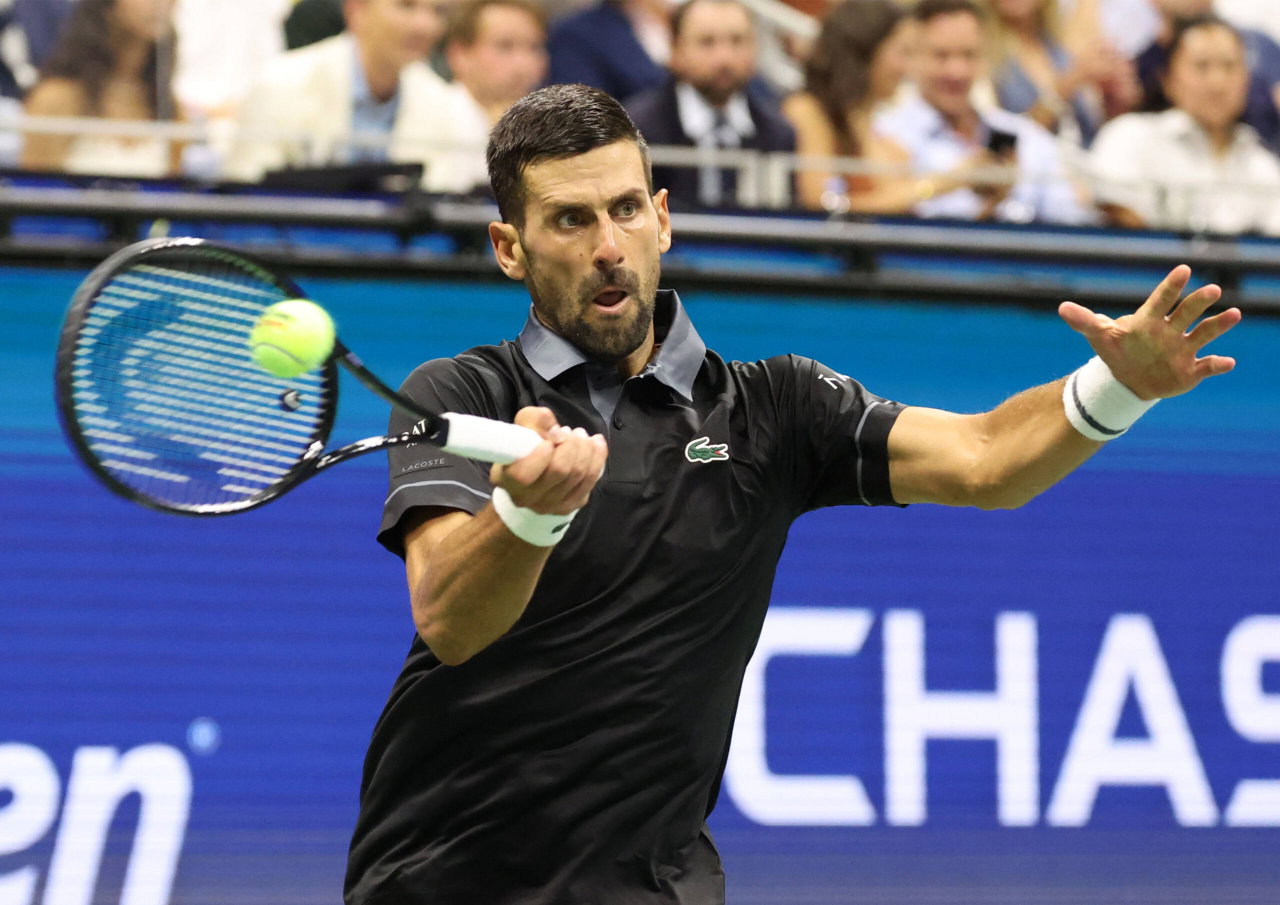
Novak Djokovic has spent years asking tennis to trust technology more. After a controversial call involving Jack Draper at the 2024 Cincinnati Open, Djokovic publicly pushed for video review to be introduced so that officials could go back to the footage and correct mistakes. A few years earlier, he had even argued that there was little reason for tennis to keep line judges on court when technology could make the calls more accurately. However, during his China Open quarterfinal against Alexander Zverev, he found himself dealing with an extended question around reviews and rules.
Watch What’s Trending Now!
In the second game, Zverev lost a point at 30-15, then approached chair umpire Adel Nour to question a courtside LED advertising board that had changed during his service motion. A video review confirmed the change, and the point was ordered replayed, even though the rally had continued for two more shots before Zverev missed his forehand. That was what puzzled Djokovic.
“He served. I played one shot and he played another shot. Is that ok? If he was annoyed by that change there, he’d stop after the serve & he’d call it,” Djokovic was heard saying to the umpire on the court.
The Serbian further stressed: “One second. If he was annoyed by that change there, he would have stopped after the serve and replayed the point. That doesn’t make any sense.”
As Zverev came closer to the net, Djokovic called him out directly. “You missed the forehand, and then you challenged.” Zverev, meanwhile, defended his decision, saying, “But I didn’t know if I could challenge; that’s why I came to him and I asked him.”
With things not going his way, Djokovic made his case again. “I think this must be the world’s most stupid change of rules that I’ve ever heard in my life. There is no sense that the players… if there is a hindrance, he stops immediately. That way we can play a 30-shot rally, and he can lose the point, and he’s like, okay, I’m going to challenge now.”
However, the umpire simply nodded, and boos filled the stadium once the replay was agreed, while Djokovic could only laugh and throw his hands up in disbelief. He got ready to play the point all over again. Fittingly for him, he won the replayed point anyway.
The broadcast team was also left surprised at how the incident unfolded. “I’ve never seen that before. Obviously the VAR is there to be used,” commentator Nick Lester said, while Annabel Croft sided with Djokovic, saying she had “never seen anything so ridiculous.”
Lester then noted from the replay that the board had already changed before the German made the mistake: “But it wasn’t impacted. It was a good serve. In fact, he hit a great serve; it just happened to come back with interest. That hasn’t impacted the forehand as far as I’m concerned, which is the miss.”
Croft then reaffirmed her support for Djokovic, adding: “Well, I think that Djokovic is right! I’ve never seen anything so ridiculous! I cannot believe he made that decision. I think that is going to poke the bear.”
The incident immediately brings to mind what happened at and after Indian Wells this year, during the match between Jack Draper and Daniil Medvedev. In March, at 5-5 in the second set of the quarterfinal between the two, Draper believed a Medvedev shot was out and briefly raised his arms mid-rally. The point continued, and Medvedev lost it, then asked for a review. Umpire Aurélie Tourte ruled that the gesture distracted him and awarded him the point. It was ruled a deliberate hindrance under Rule 7.22(F) of the ATP’s 2026 rulebook, as Medvedev won 6-1, 7-5.
Several reactions poured in later, with former pro John Millman suggesting that video review had produced too many hindrance calls and that the tours needed to clean it up. Aryna Sabalenka said a bothered player should stop immediately and ask for the review. Jessica Pegula said the rule was new this year and called it a “bad” one, though she did not think Medvedev meant to cheat the system. And Martina Navratilova disagreed with reviewing a point several shots later but still liked video replay in general, while Steve Johnson compared it with other sports, saying, “any other sport, football, hockey, baseball, you can’t challenge a play prior”.
Against that backdrop, on March 17, journalist Jon Wertheim posted two ATP changes.
“a) Video review of hindrance after the point (a la Medvedev/Draper)… (in effect no longer trialled). b) Video review challenges are unlimited but chair ‘will retain control over the process’ and has discretion to deny any unreasonable requests,” he wrote on X. The rulebook also cautions against rulings that give a player “two opportunities to win a point.”
That said, despite winning the first set, Zverev did not have the last laugh, as Djokovic rallied back to win in three sets, keeping his unblemished China Open record intact.
Beijing remained a fortress for Djokovic, who went 32-0 at the event after his win over Zverev. The Serb was understandably overjoyed.
“I can still beat the best in the world in the most important tournaments. I’ve always known it. I still know it.”I’m very proud of the effort I’ve put in. When you play like that, you forget the problems and difficulties and keep moving forward,” said Djokovic in a post-match interview. “I work to reach this level and be able to beat the best in the world, for matches like tonight’s”.
The Serb has repeatedly shown glimpses of his vintage tennis, but it has been his health that has hampered him, something that had already forced him to receive medical attention in his previous match.
However, against Zverev, there was no health scare, as Djokovic produced one of his best performances of the season. And it’s not like the German made things easy for him. Zverev fired 19 aces without serving a single double fault, won 80% of his first-serve points and even fended off a match point with a spectacular rally. Djokovic, though, made the most of his opportunities, converting two of his five break points and winning 95 of the 180 points played.
The victory also took Djokovic’s head-to-head record against Zverev to 10-5. It marked the 267th Top-10 win of his career and his fourth against a Top-10 opponent in 2026. More notably, it was his second victory over a world No. 2 this season and moved him into rare company: only Ken Rosewall and Jimmy Connors had previously defeated a Top 3 player after turning 39.
Djokovic now turns his attention to Daniil Medvedev in the semifinals. The Russian arrives with some momentum of his own after lifting the title in Hangzhou last week. Still, with Djokovic yet to lose a match in Beijing, Medvedev will have a daunting task ahead of him.