
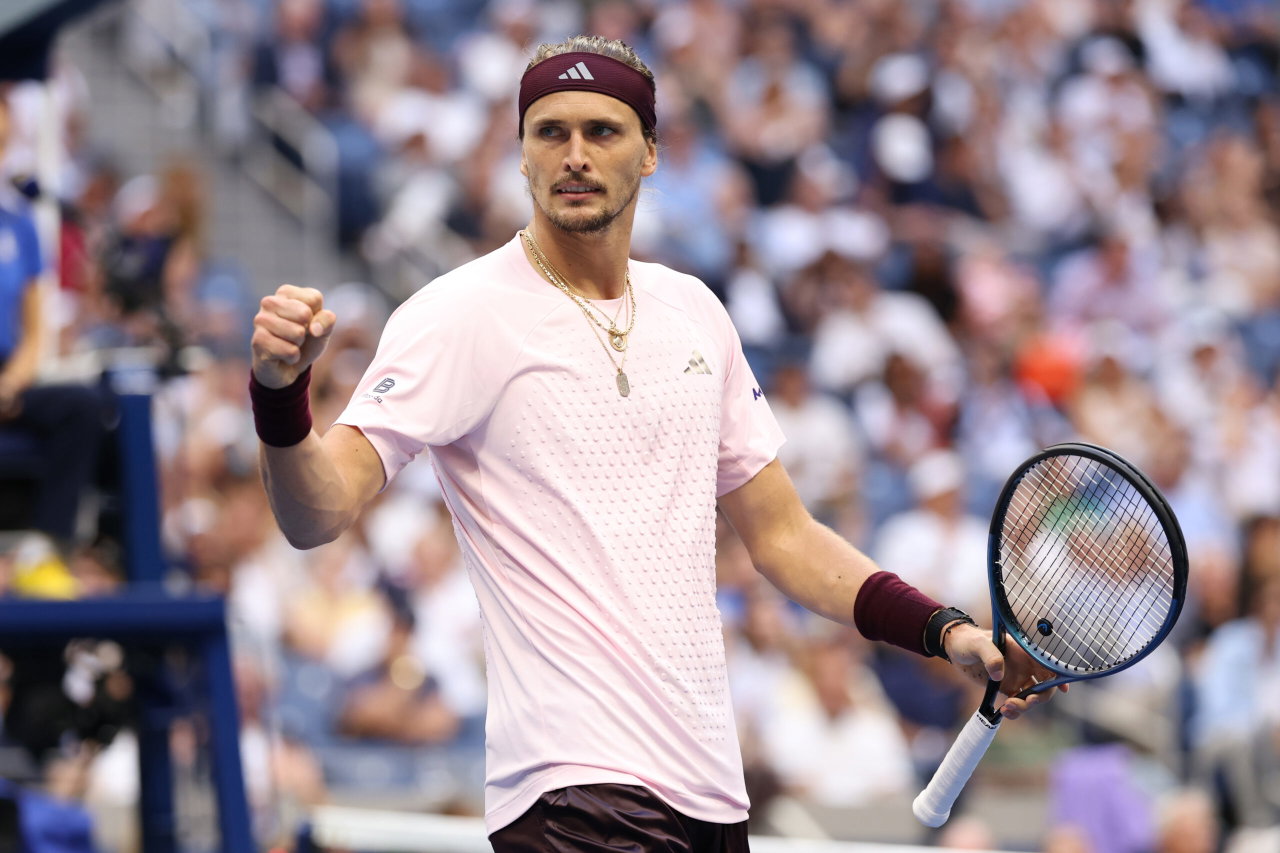
Alexander Zverev has rarely done anything quietly this season, and Shanghai has been no different. The German has won two Grand Slam titles in 2026 after starting with zero to his name, and he is now closing in on a ranking he has chased for years.
Watch What’s Trending Now!
On Sunday, he beat Quentin Halys 6-4, 6-7(8), 6-3 to reach the fourth round of the Rolex Shanghai Masters. It was the 60th victory for the German this season, which marks the most number of wins gathered by any man on the tour. Zverev has even kept his body fit enough to not miss any major events and has played almost everything on the calendar. He now faces 19th seed Alexander Bublik in the round of 16, who is coming off a marathon win against Brandon Nakashima.
The result mattered for the top seed, but it was only one of the stories that followed him this week. Here are the moments you may have missed.
Zverev edges closer to world No. 1 dream
It is the third time Alexander Zverev has reached 60 wins in a season, after 2018 and 2024. The match wasn’t easy. The German broke early in the first and third sets, but he let two match points slip in the second-set tiebreak. Halys took it 10-8 and forced a decider. Still, Zverev did not face a single break point in two hours and 17 minutes. He now leads Halys 4-0 in 2026, although each meeting has been a fight.

Imago
2026 US Open Alexander Zverev GER FOR EDITORIAL USAGE ONLY *** 2026 U.S. Open: Alexander Zverev GER FOR EDITORIAL USE ONLY
Zverev is on 9,720 points as of Saturday, 1,280 behind world No. 1 Jannik Sinner. The Italian has ended his season with a knee injury, so the door is open. On the men’s side, only Boris Becker has reached the top spot for Germany before, back in 1991.
Although Zverev cannot become world No. 1 in the official ATP rankings before November 2 at the earliest, he can secure the year-end No. 1 honour sooner by reaching the semi-finals in Shanghai or if Carlos Alcaraz and Ben Shelton lose at any point of the tournament.
The 29-year-old linked the milestone to how he has planned his year.
“I feel like this year I’ve been picking my places where I want to peak, and I feel like I did that quite well.”
Practice court controversy follows Zverev in Shanghai
Zverev faced criticism in Shanghai after spectator reports alleged that he arrived late for a practice session and continued using the court beyond his allotted slot. According to accounts, Zverev’s practice session was scheduled for 10:30 a.m. on Court 5, but he arrived at approximately 11:50 a.m., allegedly leaving his hitting partner waiting for around 80 minutes.
Ben Shelton and 17-year-old Cruz Hewitt, the son of Lleyton Hewitt, were reportedly due on the same court at noon. They were instead moved to Court 10, which is less accessible to fans.
The practice-court controversy emerged after Zverev’s previous-round opponent, Wu Yibing, criticized aspects of his behaviour during their match.
“But there were a few incidents during the match: falls, complaints about the lighting, and gestures at the net strap. It wasn’t just about tennis. He obviously did all of that to break the rhythm and regain his composure because I was putting pressure on him. Even though it didn’t work on me, I really don’t like that kind of behavior,” Yibing said.
He added that he preferred playing against Carlos Alcaraz instead.
De Minaur calls for rule change Zverev may not like
Alex de Minaur defeated qualifier Rei Sakamoto 7-6(6), 6-4 to reach the round of 16. After the match, the world No. 9 was asked in the mixed zone whether the shot clock should apply between first and second serves.
“Between first and second? Yeah, that’s fine. I think, ultimately, you would get away from people trying to take a little bit more time in between first serve and second,” De Minaur stated. His point is that a shot clock would stop players from stretching the gap.
De Minaur did not name any player, but his proposal invited comparisons with players whose pre-serve routines have drawn scrutiny, especially Zverev. The German was criticized at the US Open for bouncing the ball for long stretches before serving. Ben Shelton, Karen Khachanov, Tallon Griekspoor, and Sam Querrey were among those who took issue.
De Minaur then went further and proposed a one-toss rule.
“I think one of the things I would say personally is I would have only one ball toss. So, once you throw the ball, you got to serve, no matter what. If you decide not to, it’s a fault,” the Australian added.
He explained that he believed some players would exploit a bad throw as an opportunity to repeat their routine, and the rule would put that notion to rest.
Zverev, for his part, had explained that the prolonged ball-bouncing was not intentional. Speaking after his US Open semifinal victory over Karen Khachanov in September, the German admitted he had no idea why his routine had become so lengthy. By then, a fan-generated statistic claiming he had bounced the ball approximately 12,000 times across his first five matches had been circulating online. Zverev said he was neither counting the bounces in his head nor trying to reach a particular number.
In fact, after seeing the statistic before his semifinal, he consciously tried to reduce the habit and noticed that the number of bounces had decreased. The problem, he explained, was that he would occasionally forget about his effort to cut back and slip into the same routine again.