
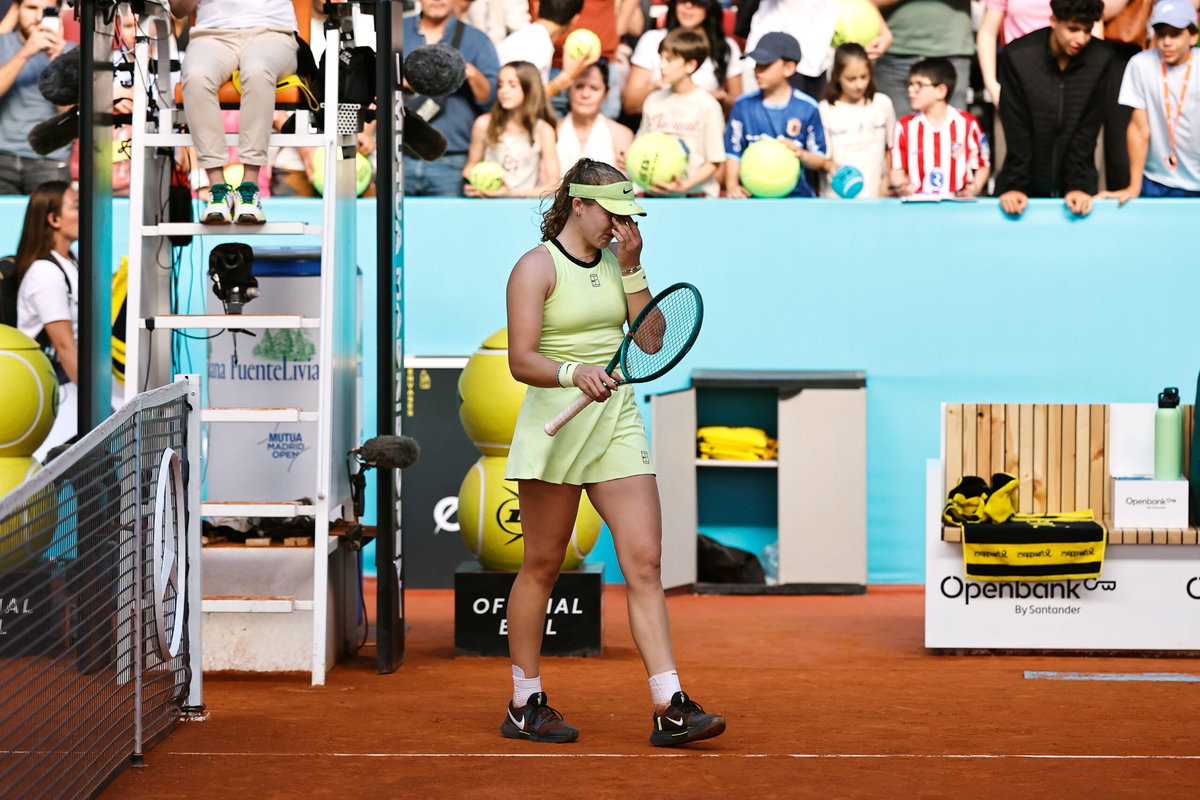
At the Dubai Tennis Championships in February, rising prodigy Mirra Andreeva broke down in tears after Amanda Anisimova stormed back to shatter her semifinal dream. She had been cruising after leading the first set, only to watch control slip away in brutal tiebreak battles. At the Madrid Open, history echoed again as she edged Anna Bondar in a draining fight, ending in tears once more.
Watch What’s Trending Now!
“I held a lot of emotions inside of myself,” Andreeva said to press. “I was trying to be very pumped in the third set, and I felt I was playing pretty good. Then after, being 5-1 up, I just felt a little bit nervous for some reason, even though I feel I should just have more confidence that I’m up on the score.”
Her admission captured the internal struggle that continues to define her matches. Even when she is in control, the battle within often proves just as intense as the one across the net. “I felt she started playing more consistent. I started missing a lot, not really going for my shots, not playing aggressive. All of that led to the tiebreak, and at the end, I just got relieved when all of that finished.”
Andreeva eventually found a way through against Anna Bondar, sealing a dramatic 6-7 (5), 6-3, 7-6 (5) victory. The win pushed her into the quarterfinals, though it was accompanied by another visible emotional outburst mid-match.

Mirra Andreeva to her box after losing a 5-1 lead over Bondar in the deciding set in Madrid: “I’m not a champion. I’m not a champion. I will lose. I will lose.” Tough scenes.
Despite the result, her struggles with controlling those emotions remain evident. It is a recurring theme that continues to shadow her otherwise rapid rise on tour. At 2-2, 40-40 in the second set, Andreeva approached chair umpire Jennifer Zhang to complain about an unusual distraction behind her side of the court.
“It literally smells like b***s**t over there. Like very bad,” she said.
Ironically, that moment seemed to trigger a shift in her momentum. From there, the 18-year-old surged, winning nine of the next 11 games and asserting control over the match.
She looked set to strengthen her clay-court dominance and move her season record on the surface to 10-1. Her aggressive play and composure briefly aligned, creating a commanding position.
Then, as has happened before, the momentum slipped. Andreeva dropped five consecutive games, including a missed match point on Bondar’s serve at 5-3, allowing tension to creep back in.
During the changeover, she turned to her team in a moment of raw honesty and doubt. “I’m not a champion. I’m not a champion,” in raising her hand with a no. “I’m going to lose. I’m going to lose.”
Yet somehow, she steadied herself just enough when it mattered most. Andreeva claimed the next seven points, taking a 4-2 lead in the deciding tiebreak and briefly regaining control.
Bondar refused to fade, erasing the mini-break with a sharp backhand winner and again at 4-6 when Andreeva mishit a delicate drop shot. The tension built to its peak as both players fought for every point.
Finally, on her third match point, Andreeva delivered. She attacked Bondar’s second serve and struck a clean backhand return winner up the line to seal the match after 2 hours and 53 minutes of relentless battle.
Tears followed immediately after the handshake, driven perhaps more by relief than celebration. It was another release of emotion after a contest that demanded everything from her mentally and physically.
Even in victory, Andreeva remained her harshest critic. “By the end of the third set, I was pretty mad at myself for not being brave enough to close the set earlier,” she said.
“I feel like I cannot make this happen again. I really have to be able to close things out when I have an opportunity,” she said on the Tennis Channel desk.
The result also placed her in elite historical company. She became the youngest player since Martina Hingis to reach three consecutive quarterfinals at a single Tier I/WTA 1000 event, matching Hingis’s Miami run from 1997 to 1999.
It marked her 12th main-draw victory in Madrid, the highest tally she has recorded at any WTA-level event. Additionally, it was her 10th clay-court win of the 2026 season, more than any other player so far.
Yet beyond the numbers, the story remains deeply human. As Andreeva continues her journey at the highest level, her battle with emotions is far from over, and it remains an integral part of her evolving identity on court.
Mirra Andreeva breaks down repeatedly, demands the cameraman stop filming mid-match meltdown
At the Wuhan Open last year, the emotional side of Mirra Andreeva was once again caught on camera during her defeat to Laura Siegemund. It was a match that revealed just how intense her reactions can become under pressure.
Andreeva cut a deeply frustrated figure in the 6-7 (4-7), 6-3, 6-3 loss. Her emotions fluctuated sharply as the contest unfolded. During the first set, the teenager was visibly emotional even while winning a tense tiebreak. The stress of the moment was already beginning to show.
As Siegemund gradually took control, Andreeva’s composure started to slip. She stunned onlookers when she suddenly broke into tears mid-match.
The situation escalated in the second set as Siegemund moved ahead. In response, Andreeva unleashed a foul-mouthed rant, audibly screaming in Russian: “(I’m) f******g sick of this f*******g tennis.”
After losing another game, she smashed her racquet on the court in frustration. When Siegemund claimed the next game as well, Andreeva’s emotions spilled over into full, tearful sobs.
The third set only intensified her frustration. After complaining about Siegemund’s perceived time-wasting, Andreeva lost control and deliberately struck a ball hard into the crowd.
Moments later, she hit the net with a poor shot and screamed that she “couldn’t believe it”. Still in tears during a changeover, she even warned a cameraman to stop filming her.
Similar scenes unfolded elsewhere last season, including in Montreal against McCartney Kessler, where she repeatedly punched herself in the leg, and at the Ningbo Open final against Daria Kasatkina, where she was in floods of tears after losing in 2024.
Now, as she prepares to face No. 24 seed Leylah Fernandez for a place in the semifinals at Caja Mágica, the tennis world is watching closely to see whether she can overcome that emotional side and take the next step.