Imago
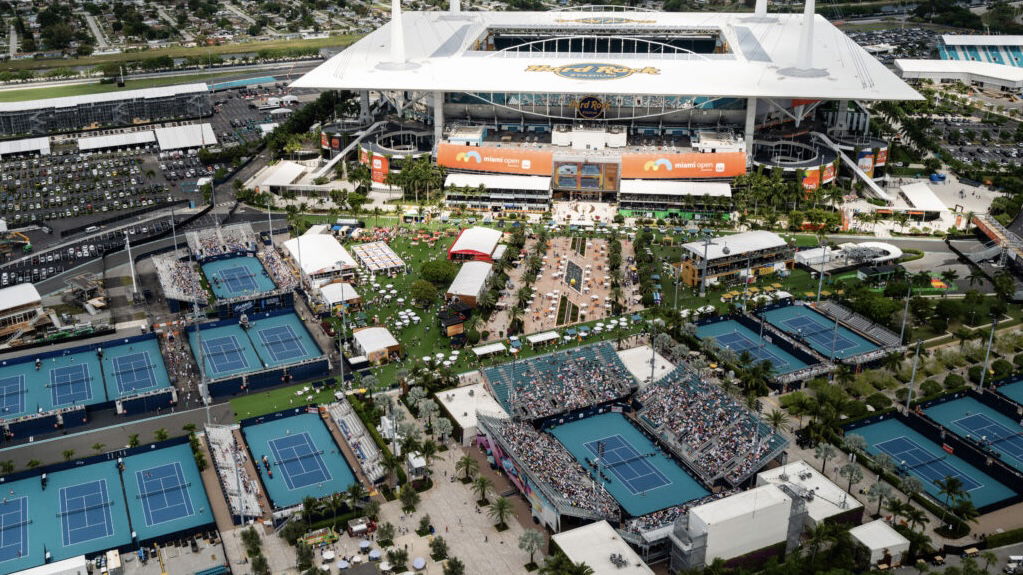
Helicopter Aerials during the Miami Open tennis tournament, Saturday, Mar. 23, 2024, in Miami Gardens, Fla. (Hiro Ueno/South Florida Stadium)
Imago
Helicopter Aerials during the Miami Open tennis tournament, Saturday, Mar. 23, 2024, in Miami Gardens, Fla. (Hiro Ueno/South Florida Stadium)
Rain delays, thunderstorms, cancelled matches, and constant schedule reshuffling, the Miami Open has had it all this year. And just when it seemed things couldn’t get any worse, a match was even suspended mid-play due to a lighting issue.
Watch What’s Trending Now!
On Friday, March 20, the first-round match between Matteo Arnaldi and Alexander Shvencenko on court 4 came to a sudden halt due to the lack of artificial lighting on the outer courts. When the play became impossible in the fading sunlight, the officials were forced to suspend the match at the score of 7-6(5), 5-5, with Shvencenko leading.
The match was then moved to the next morning, with the Kazakh player ultimately winning in three sets.
ADVERTISEMENT
However, the absence of proper lighting at the Miami Open has created a tricky situation, forcing players into an uneven schedule.
After defeating Matteo Arnaldi earlier in the day, Alexander Shevchenko is now set to return to court to face eighth seed Ben Shelton in the Round of 64, meaning he’ll have to play two matches in a single day, handing his opponent a clear advantage.
Wow… play suspended for Arnaldi-Shevchenko due to lights.
We’re three days into the tournament and this is still first round matches yet to be finished…
Whoever wins this match will surely have to play again tomorrow
What a mess the organizers have made in Miami man
— US Tennis Center (@USTennisCenter) March 20, 2026
The lighting failure did not come along as a single anomaly. It is the most recent in a week that has been marked by crisis upon crisis, and the issues were underway before a single ball was hit on the main draw.
On March 15, prior to the qualifying, a massive weather havoc hit Miami-Dade, and officials had to cancel all qualifying matches and practice sessions. Players who had made the trip to Florida with the express purpose of gaining their place in the main draw had to wait for extended hours. However, that was just the start of what had to be followed.
When the main draw at the Miami Open got underway, the rain simply refused to let up. March 18 saw a complete washout, forcing organisers to push all scheduled matches to the following day, and the ripple effect has been significant.
By Friday, March 21, the fifth day of the tournament, the second round should ideally have been wrapped up. Instead, first-round matches were still being completed in the morning session, leaving the event scrambling to catch up on a backlog that has been building since day one.
A root cause has been raised multiple times over the years, but never satisfactorily addressed. The Miami Open is hosted at the Hard Rock Stadium, which is the home of the football team, the Miami Dolphins. Every year, courts and stands are assembled specifically for the tournament. More importantly, the stadium is not built specifically for tennis. Hence, the venue poses many structural problems.
For example, there is a large canopy that protects fans from rain and sun, but it has no roof that covers the court from the heavy downpours.
Hosting a two-week tennis tournament in Miami, known for its tropical downpours, in a completely open-air arena is a very difficult task. This continues to cost players, the audience, and the tournament’s own reputation significantly.
Masters 1000 is the sport’s most prestigious category, situated just below the Grand Slams. Miami Open, which is a part of the coveted Sunshine Double, sits alongside the Indian Wells, Madrid Open, Rome, and many more.
A tournament of that level cannot just keep offering weather chaos and infrastructure failures as a recurring feature on its calendar. Another operational hiccup, one that didn’t go down well with fans, came during Aryna Sabalenka’s second-round match.
Aryna Sabalenka’s match shifted from the main stadium to Butch Buchholz
Tournament organizers moved Sabalenka’s R64 match from the main stadium to the third-ranked arena in Miami Gardens, Butch Buchholz. This was done to make room for Carlos Alcaraz’s match on the centre court.
The Spanish world No. 1 was set to face the 19-year-old sensation, Joao Fonseca, in the round of 64. Last year, there was outrage among the fans when the Brazilian’s match was moved from the Grandstand to the main stadium, and the fans were stranded on the Grandstand. So this time, James Blake, the tournament director, had promised the fans that the Brazilian would play all of his matches in the stadium. It was already a high-octane clash, and therefore, the organizers had to make a last-minute adjustment.
The move sparked backlash from Sabalenka’s fanbase. Still, supporters turned up in numbers to back their favorite player.
On court, Sabalenka delivered, beating Ann Li in straight sets to set up a clash with another American, Caty McNally. The Belarusian, along with many observers, later pointed out that she deserves a spot on Centre Court in the upcoming rounds.
Taken together with rain disruptions, lighting issues, and scheduling backlogs, the episode adds to a growing sense of disarray at the Miami Open. For players, broadcasters, fans, and vendors alike, the strain is becoming increasingly evident.
It also raises a larger question, whether the tournament can continue to justify its Masters 1000 status without consistently meeting the basic infrastructural demands of a world-class event.
ADVERTISEMENT
ADVERTISEMENT
ADVERTISEMENT
ADVERTISEMENT