
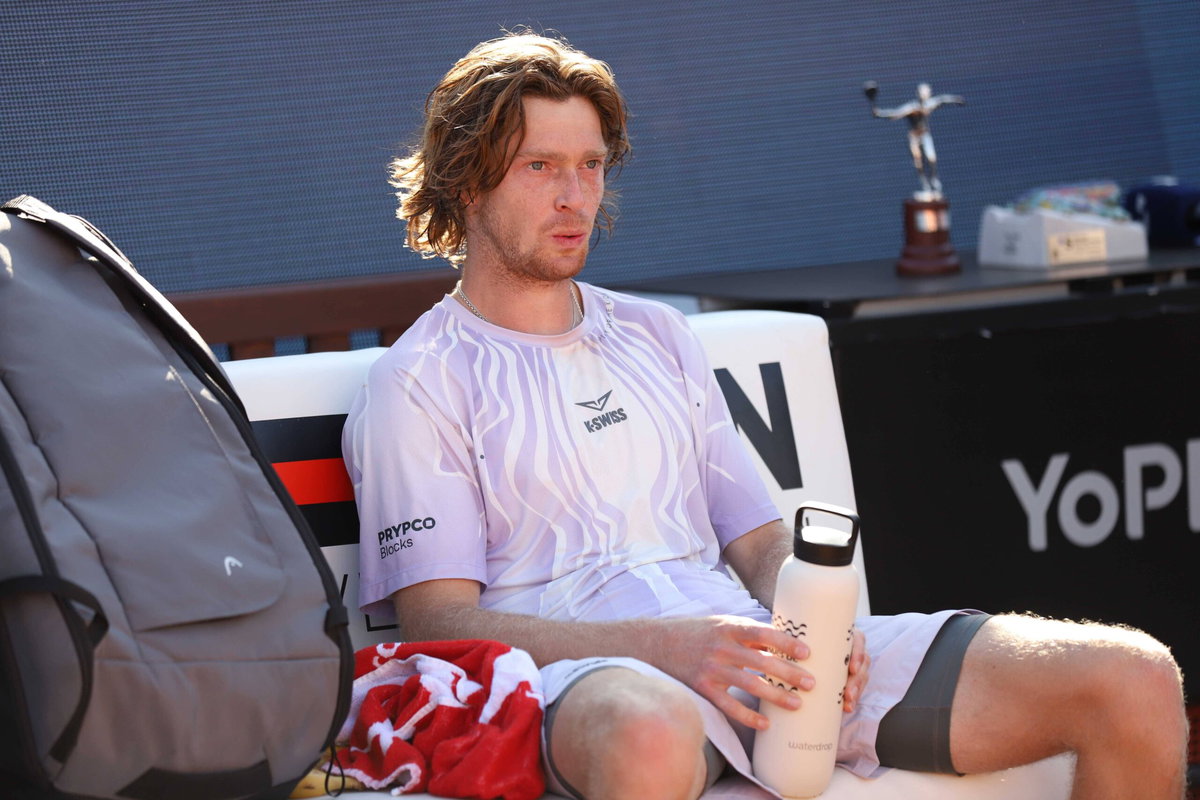
Coaching relationships on the ATP Tour usually follow a familiar script. The coach travels with the player, watches from the box, and helps him work through the good days and the ugly ones. Andrey Rublev and Marat Safin, however, have never quite followed that blueprint. Their arrangement has raised eyebrows before, and Safin’s appearance in Shanghai after Rublev’s campaign had already ended has put their unusual partnership back under the spotlight.
Watch What’s Trending Now!
Rublev’s Shanghai Masters campaign ended on Oct. 9, when Japanese qualifier Rei Sakamoto stunned the 23rd seed 6-4, 6-4 in the second round. Six days later, attention turned to Safin’s presence at the tournament, where he was scheduled to play alongside his sister Dinara Safina in an exhibition match inside Qizhong Forest Sports City Arena against Roger Federer and Li Na. The timing prompted questions about a coaching arrangement that has always allowed Safin considerable freedom over when he travels.
“After traveling to Rhode Island for Federer’s HoF induction instead of joining Rublev in NYC for US Open, Safin now arrives in Shanghai *after* Rublev has been eliminated from the tournament. A very… uhmm… peculiar coach/player relationship they have developed,” a fan account posted.
The questions first grew louder during the US Open. Safin was absent from Rublev’s campaign in New York, where the Russian recovered from two sets down to beat Otto Virtanen before losing to Spain’s Daniel Mérida Aguilar in the second round. Some fans questioned the arrangement after Safin attended Roger Federer’s International Tennis Hall of Fame induction ceremony in Rhode Island in August. He also took part in the doubles exhibition held on October 3 at the Rafa Nadal Academy in Manacor (Mallorca) to mark the Academy’s tenth anniversary.
Rublev, though, has offered a straightforward explanation. Speaking to Russian tennis outlet Bolshe, he described the relationship as unusually flexible.
“It’s hard to say anything specific because we have a fairly loose relationship. He travels when he feels like it… It all depends on Marat. In any case, I know the tasks I need to accomplish.”
Safin had also already confirmed before the 2026 US Open that he would not attend Rublev’s matches, even though he initially intended to, adding that the Russian knew what work he needed to do in his coach’s absence. As for his Wimbledon absence, Safin clarified in an interview with the Best Tennis Podcast channel, as reported by Russian outlet Sports.ru — “I need to work on myself, play my games.”
He expanded on how he keeps himself busy, adding, “I like to travel, I like to hike in the mountains. I have a few friends I visit. They’re very interesting people: we chat, or I study something. So I also need time to myself to study, to do my homework. We should always be learning something. That’s why I’m learning a few things.”
Safin then made clear that his goal is to make Rublev independent, because one needs to “live and be responsible” for their own actions.
“There’s no point in walking hand in hand with me (laughs),” Safin concluded.
Last year, too, there were questions around Safin’s availability in New York, but for a different reason. “We hope he can be with me at the US Open, but it is not certain that he will be able to get his visa in time. If he doesn’t succeed, we’ll have to wait for the tournaments in Asia,” Rublev had clarified.
The arrangement between the two did not begin as a permanent appointment from the outset, either. When Safin joined Rublev’s team in spring 2025, the two initially treated the partnership as a trial, with Rublev saying they would assess how it developed. Meanwhile, Fernando Vicente, Rublev’s coach since 2016, retained his position as the team’s principal coach. So, Safin contributes when his schedule allows. Rublev has also said the pair were training together in Barcelona after the US Open, a sign that Safin’s absence from certain tournaments did not mean their collaboration had ended.
Why Rublev Credits Safin With Helping Him Find Himself Again
There is a deeper reason Rublev has been willing to make the arrangement work. In an interview with L’Équipe published in May 2026, Rublev discussed the difficulties he experienced in 2025 and credited Safin with helping him through a period when he felt he had lost his way.
“I wasn’t finding meaning in life in general. I no longer took any pleasure in anything.”
Rublev explained that his difficulties went beyond tennis. He had stopped enjoying everyday activities. He described the period as reaching rock bottom and said he was feeling much better by the time of the interview. His account offered a revealing explanation for why Safin occupies such a significant place in his life and career.
Rublev described Safin’s impact through an unusually vivid metaphor. Comparing the mind to a car engine, he explained how the former world No. 1 helped him examine problems he had struggled to understand on his own.
“What really helped me was Marat. You know when you open the hood of a car to look at what’s inside? Well, he did the same with my brain. He opened my skull and a lot of answers to my questions appeared.”
Rublev also reflected on the emotional patterns behind his on-court outbursts. He said every defeat once felt like a personal disaster, and that pattern gradually became destructive. He admitted that he had not eliminated those tendencies entirely, even after making progress. Safin’s role, therefore, has involved helping him understand the person behind the player, not simply correcting his behavior during matches.