

A weird thread runs through Novak Djokovic‘s career. He made his debut in the sport as one of the outsiders joining a Federer-Nadal duopoly that no one was expecting to be broken. Now, 20 years later, at 39, he is still seen as the outsider. This time, between Jannik Sinner and Carlos Alcaraz, as the new generation assert themselves. In both eras, the same question keeps surfacing: why does the man with the better numbers keep getting cast as the third wheel in his own sport’s story?
Watch What’s Trending Now!
In his new documentary, Novak Djokovic: The Wolf in Winter, much of the film’s time has been devoted to allowing the people who know him most, his toughest competitors and closest friends, to speak for themselves. The documentary begins with a telling visual: Djokovic training in Melbourne prior to the 2025 Australian Open, still at the peak of his career, able to defeat the top players, and then, in the opening minutes, Andre Agassi sets the tone.
“I don’t feel like he’s been appreciated nearly as much as he’s worthy of for what he’s brought to the game of tennis,” he said. “Nobody can touch what he’s accomplished. I mean, it is as clear as it gets. He’s the best of all time.”
The film then transitions to Djokovic’s rise as a real contender to the Federer-Nadal era, and the eight-time Grand Slam champion Agassi explained his methods, which became the architect of his results. “Novak quickly started establishing himself as one of the greatest defensive players that the game has seen. He could just put the wall down and wait for you to implode, but he could transition from defense to offense probably better than anybody that’s ever played. It would just demoralize you,” Agassi added.
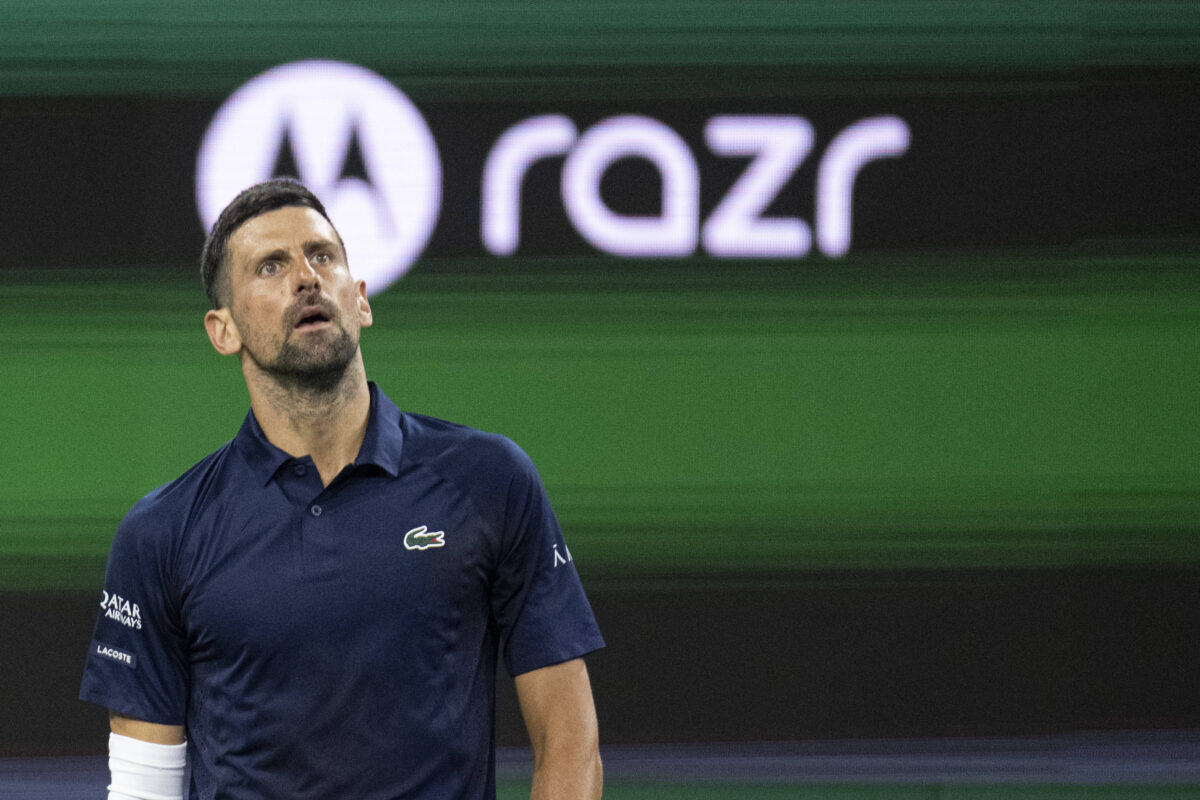
Imago
March 11, 2026, Indian Wells, California, USA: NOVAK DJOKOVIC of Serbia stops play because of a flash in the crowd while serving against Jack Draper of Great Britain during their round of 16 match at the BNP Paribas Open at Indian Wells Tennis Garden on March 11, 2026 in Indian Wells, CA. Tennis 2026: BNP Paribas Open – March 11, 2026 PUBLICATIONxINxGERxSUIxAUTxONLY – ZUMAl140 20260311_aap_l140_081 Copyright: xShelleyxLiptonx
That description came on the backdrop of one of Djokovic’s most significant successes of his career. A straight-sets win over Nadal in the 2007 Miami Masters quarter-final, his first win over the Spaniard, a week after which he was demolished by Nadal in the Indian Wells final. The Serbian went on to win that Miami title, his first ATP Masters Series title, and the victory truly started what would prove to be the most competitive rivalry in the sport’s history.
Contested is almost an understatement. Djokovic and Nadal have played 60 times, more than any two players in tennis history, and the Serbian holds a narrow overall lead in that head-to-head with 31-29. But at the majors specifically, Nadal has the better of him, 11 wins to 7, and has inflicted more Grand Slam final defeats on Djokovic than any other player has managed.
Continuing where Agassi left off, crediting Djokovic’s method, 14-time Grand Slam champion Pete Sampras expressed his awe for the Serbian’s movement. “He’s arguably the best mover I’ve ever seen. He’s got incredible feet, he’s got incredible stretch, incredible athletic ability, I mean I have never seen anything like it,” Sampras said.
Finally, following up on that thread was Nadal himself. He was asked what it was like to play Djokovic and the Spaniard didn’t hesitate. “Difficult,” he says, laughing. “Intense. I felt always that I needed to be at my 100% playing so well to have real chances. A lot of times it will not be enough.”
Coming from his fiercest rival and a 22-time Grand Slam champion, that is about as high a compliment as tennis has to offer, an admission that even at his very best, his best sometimes still wasn’t enough.
A career defined by resistance
The final big statement in the documentary comes in a much more recent setting, and it closes the loop on exactly the theme the film opened with. The background is Djokovic’s Australian Open quarter-final against Carlos Alcaraz, which he won 4-6, 6-4, 6-3, 6-4. The 37-year-old tore a muscle in his leg while reaching for a drop shot; against the 21-year-old had already won four Grand Slams. It took Djokovic painkillers to finish the match, and he had admitted that he was not sure he would have continued if he had lost the second set.
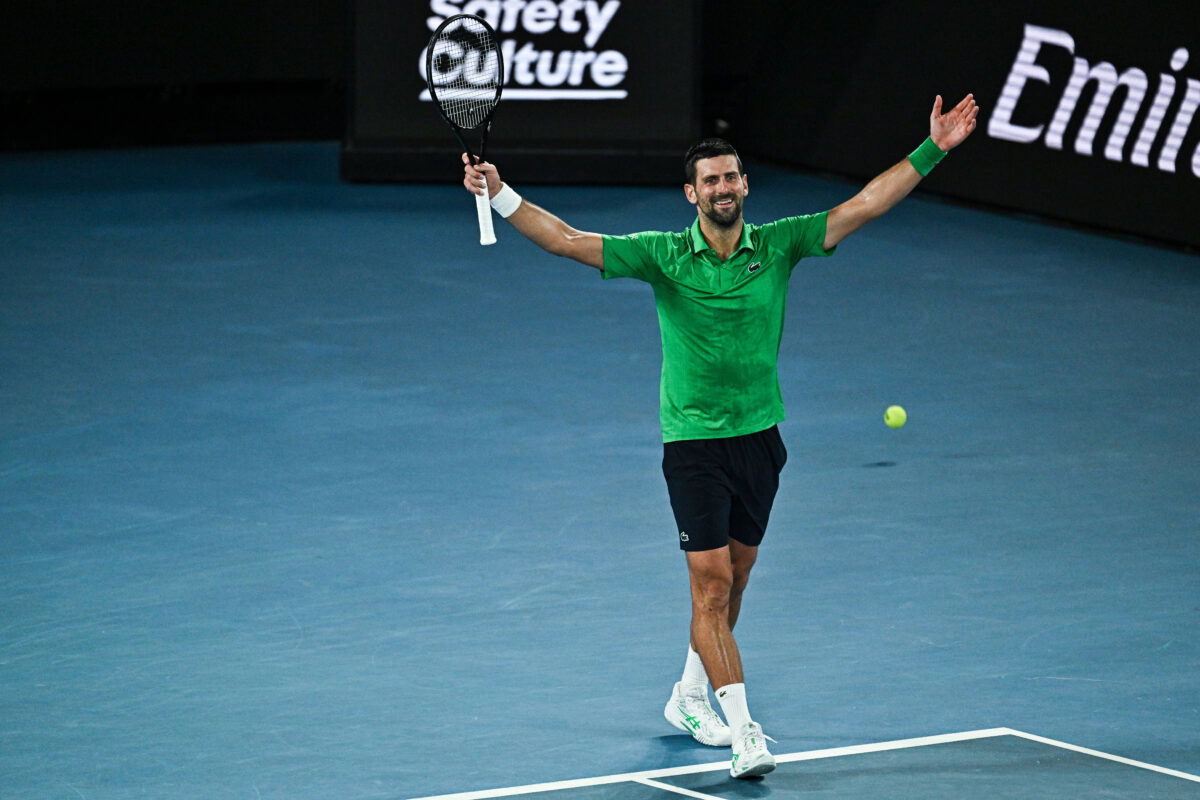
Imago
2026 Australian Open Novak Djokovic SRB *** 2026 Australian Open Novak Djokovic SRB
It is in the shadow of that performance that Agassi delivers what might be the documentary’s most defining line. “He’s probably as strong mentally as anybody I’ve ever seen. He has a capacity for pain that I think is unmatched. It’s like the harder something gets, the more locked in he gets and he is willing to go the distance.”
That win over Alcaraz cost Djokovic the tournament. He was forced to retire from the following semi-final against Alexander Zverev, unable to continue after just one set. Even Zverev, who benefited from the walkover to make his place in the final, defended his opponent in his on-court interview and stopped the crowd from booing.
“Please, guys, don’t boo a player when he goes out with injury. He has won this tournament with an abdominal tear, won this tournament with a hamstring injury. So please show some respect.” It is a small, telling detail that even his rivals feel compelled to advocate for him in moments when the crowd won’t.
The film ultimately hands the last word to Djokovic himself, and it reframes everything that came before it. “The number one doubter is here (pointing at himself), I am the number one doubter, and I’m trying to prove myself wrong more than anybody else,” he says.
The documentary then jumps forward to this year’s Australian Open, the same tournament where his major title count began, where at 38 years old Djokovic reached the semi-finals once again, beating two-time defending champion Jannik Sinner in a five-set marathon to book his 38th career Grand Slam final, breaking the record for most major finals ever reached, a record that, fittingly, had previously belonged to no one else but Djokovic himself.
The film closes on that moment, Djokovic kissing the sky at Rod Laver Arena, and the whole stadium is chanting his name, “Novak, Novak,” the same arena that booed him off a year ago could not stop roaring for the 24-time Grand Slam champion.