
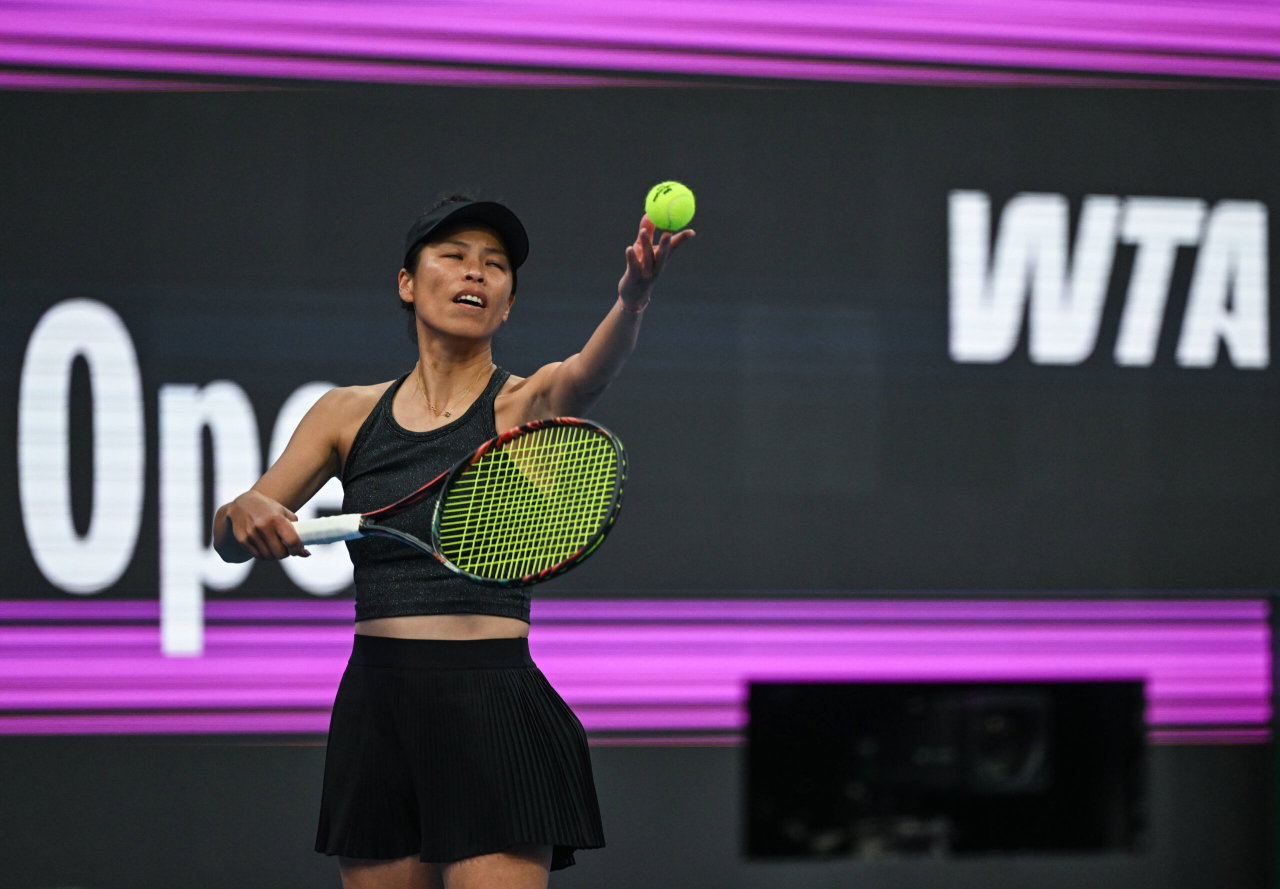
Chan Hao-ching had decided before the Asian Games final that this time would be different. Regardless of what had happened between her and Hsieh Su-wei, this was a match for Taiwan, she said, and that she would extend her hand at the net when it was over. However, when Chan reached out, Su-wei appeared to briefly hesitate before pulling her hand back. She touched her cap and turned toward Wu Fang-hsien instead, shaking Wu’s hand before walking away, while Liang En-shuo greeted Chan.
Watch What’s Trending Now!
That sequence of seconds garnered enough attention to reopen the feud between the two. After winning the women’s doubles gold at the Aichi-Nagoya Asian Games, Hsieh was asked about her decision.
“If you respect me, I’ll respect you, okay?” Hsieh told the reporter. “If you ask me disrespectful questions again, I’ll slap you in the mouth. I’m joking. Do I look that fierce?”
Later on, she added: “It’s important to respect your opponents on court. If my opponent doesn’t respect me, what’s there to say? I wouldn’t feel like shaking hands, that’s it.” For Hsieh, “This is not important. It’s good that we won.”
Chan, meanwhile, said, “I do my job. I think no matter what, I have to do what I’m supposed to do, so I extended my hand first. But I still didn’t get a response. I think it’s okay. Everyone has their own choice.”
What left Chan more frustrated, though, was when, during the tiebreak, Taiwan’s head tennis coach clapped for Hsieh. “At that moment, I felt quite down. After all, his role today is the head coach,” said Chan.
It was the pair’s second meeting in under a month. On September 7, in the US Open women’s doubles third round, Hsieh and Jelena Ostapenko, the fourth seeds, beat Chan and Maya Joint 6-4, 6-4. Ostapenko later told the chair umpire that Chan’s coach was being “very disrespectful”, and Chan shook Ostapenko’s hand but not Hsieh’s. Afterward, Hsieh posted on Facebook that some Taiwanese players liked to provoke and that their cheering section lacked tennis etiquette. Chan replied on Instagram that her team had said nothing improper, accused Hsieh of deliberately bumping her with a tennis bag off court, and said she had waited at the net for handshakes three times in a row without a response.
“At the US Open, I didn’t shake her hand, and that’s because in previous times I didn’t get any response and I felt that there was no point in sticking my warm face to a cold b**t,” Chan explained to Reuters after the Asian Games final.
The roots of their feud can be traced back to the run-up to the 2016 Rio Olympics, when a dispute over coaches and Olympic funding put Hsieh Su-wei at odds with Taiwan’s tennis authorities, and, by extension, the Chan sisters.
In early July, Hsieh publicly accused the Chinese Taipei Tennis Association (CTTA) of treating her unfairly by refusing to fund her coach’s trip to Rio, while Chan Yung-jan (now Latisha Chan) and Chan Hao-ching were allowed to have their father, Chan Yuan-liang, travel as their coach.
Hsieh argued that the arrangement left her at a disadvantage, particularly because she was competing in both singles and doubles. The CTTA, however, rejected the suggestion that the Chans had received preferential treatment, with officials saying that Taiwan’s Olympic tennis team was limited to two coaches, one for the men’s team and one for the women’s team, and that the selections were made according to the players’ rankings and the association’s established system. At the time, the Chan sisters were ranked higher than Hsieh in doubles.
Things escalated on July 20, when Hsieh announced on Facebook that she would withdraw from the women’s doubles and compete only in singles. Her decision came after CTTA official Su Chia-hsiang publicly described her as the lowest-ranked of the five Taiwanese players headed to Rio. Hsieh took the comment as another slight, arguing that she had been treated unfairly throughout the Olympic selection process.
Then, on Aug. 3 in Rio, Hsieh met with Chinese Taipei Olympic Committee officials to discuss the matter. According to Hsieh, the meeting turned heated, with CTOC vice chairman Tsai Szu-chueh pounding the table and raising his voice at her. Afterwards, Hsieh announced that she would no longer accept a call-up to play for Taiwan.
The Olympic delegation, though, gave a different account of the confrontation, saying Tsai had admonished Hsieh after she said she was a professional player who played for her fans rather than the national team. The following day, Hsieh announced that she would no longer represent Taiwan, with her withdrawal from the Olympics formally confirmed some days later.
The tension increased the following year. At the 2017 Summer Universiade in Taipei, Latisha Chan was scheduled to play the mixed-doubles semifinal with Hsieh Su-wei’s brother, Hsieh Cheng-peng. But after struggling with health issues, Chan withdrew after being assessed by the medical team. Hsieh was left to appear alone on Centre Court, where he picked up the microphone and addressed the waiting spectators, as the pair ultimately received the bronze medal.
The withdrawal attracted controversy after Chan left for the US Open. She later explained, “The decision to quit the match was made by a doctor after evaluating my physical condition.” Hsieh Cheng-peng, however, said: “I did not read her statement. She really does not need to apologize to me. She only needs to explain what happened to the fans.” Hsieh Su-wei also publicly criticized the withdrawal.
That said, another drama followed Hsieh to the finals.
Hsieh had teamed up with Joanna Garland at the Singapore Open, where the pair won their opening match before Garland retired during their quarterfinal against Erin Routliffe and Aldila Sutjiadi. Garland had been playing both singles and doubles that week, and the retirement came after the first set had been taken 6-4. However, things turned tense when Garland posted, “In conclusion, I got played,” followed by, “And backstabbed*.”
Australian doubles player Ellen Perez subsequently alleged: “Well Su Wei asked Joanna to pull out so she can make it to the mixed doubles in time and now Joanna goes back in prize money and will be penalized in other ways. And now Su Wei has dropped her for Liang and will probably cite Joanna as injured as her excuse.
“Joanna will go back a round in prize money and no longer be able to use her singles ranking to enter doubles. She only played for Su Wei and in the end she gets dropped anyways for Asian games. Toughhhhh.”
By the time the Asian Games started, Hsieh was paired with Liang En-shuo in women’s doubles, while she partnered Tseng Chun-hsin in mixed doubles. Hsieh later explained herself, saying that the women’s-doubles pairing with Liang was not finalized until the last day. She added that Liang had expressed an interest in playing with her and said she liked players who took the initiative because it showed they were “very keen to win.”
“I think the media should pay attention, because we didn’t do anything. If you’re just listening to other people spreading rumors and then putting us in the news, I think that’s very unfair to me. Because I haven’t done any of these things, and then [people are] adding things to them,” Hsieh said after winning the women’s doubles gold on Oct. 3 with Liang.
Chan, though, didn’t forget to take a subtle shot at her.
“I think she may really hate our family, but I hope she can be better to the younger generation. Because Joanna Garland is really pitiful. Everyone has worked very hard to reach this level, and everyone is representing Chinese Taipei and bringing glory to the team.”
Clearly, for now, the rivalry shows no signs of ending.