
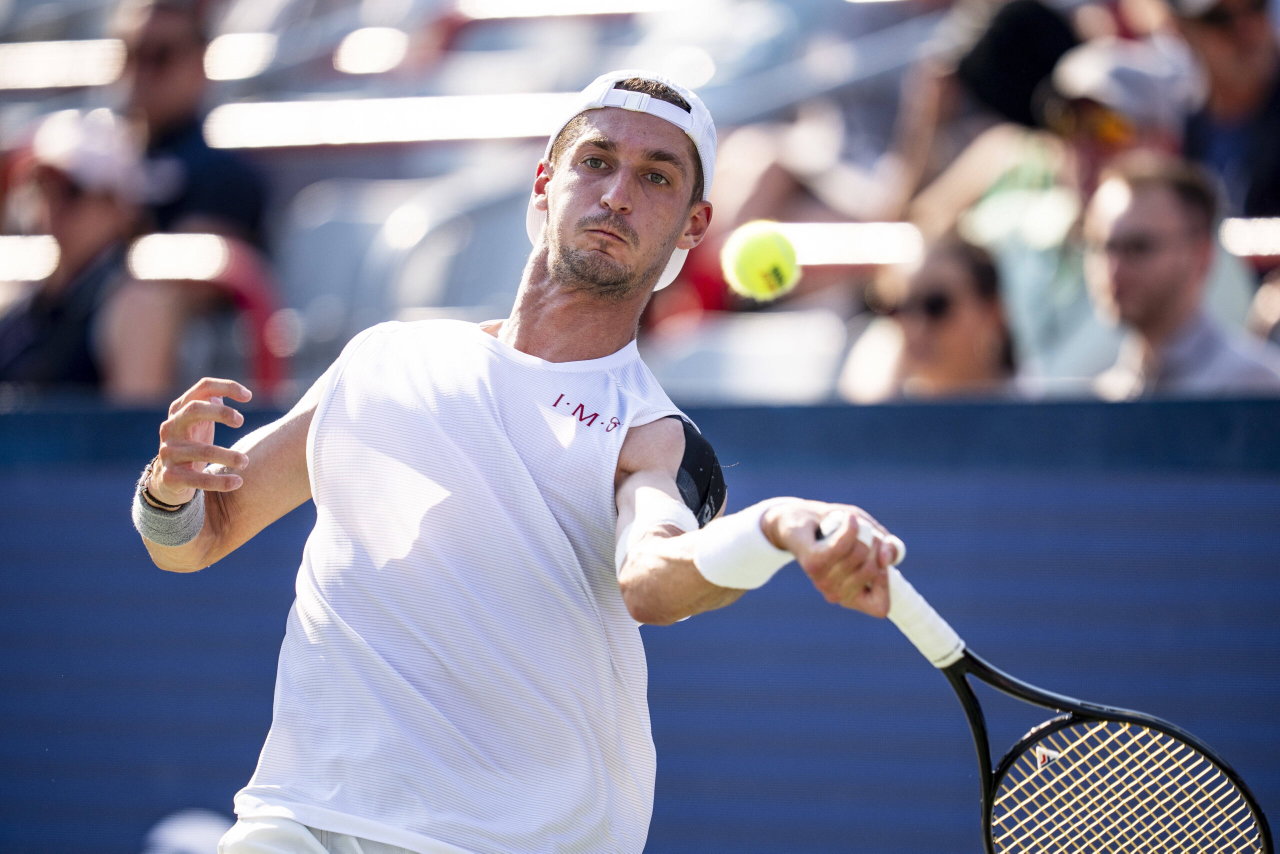
Terence Atmane knows he crossed a line in Shanghai, and he is no longer trying to brush it aside. After throwing his racket toward the stands during qualifying for the Shanghai Masters, the Frenchman faced fierce criticism from tennis fans and former players. Now, following his first-round win at the Almaty Open, he has admitted that the backlash was deserved and opened up about the mental health struggles that had made the past few weeks difficult.
Watch What’s Trending Now!
“I received a lot of hate from that, which is pretty normal because I deserve it, I’ve been behaving pretty badly,” Atmane told CLAY after defeating Rinky Hijikata 7–6(5), 6–2. It was a frank acknowledgment from a player whose conduct in China had sparked widespread anger.
The 24-year-old did not use his mental health struggles to excuse what happened. Instead, he spoke about how the long season had affected him and accepted that his actions had no place on a tennis court. “I was struggling a lot mentally these past couple of weeks. The season has been very long for me and I was also struggling with my mental health, so it hasn’t been easy for me,” he said.
The Almaty victory also gave Atmane something positive to take from a difficult stretch. It was his first main-draw win since August, and he said he wanted to use the tournament as an opportunity to start again. But the Shanghai incident remains a serious moment in his season, one that has forced him to confront both his conduct and the pressure he has been carrying.
Following the incident, Atmane publicly apologized for his conduct in Shanghai after a racket-throwing incident during qualifying drew widespread criticism. The Frenchman also retired from the match against Bernard Tomic as he moved closer to defeat, bringing an eventful encounter to an abrupt end.
Ranked World No. 98 at the time, Atmane faced Tomic in the opening round of qualifying but struggled to contain his frustration as the match slipped away. He repeatedly struck his racket against the court and net before finally launching it into the stands beside the court. The racket struck the railings and bounced away without hitting anyone.
With Tomic leading 6-3, 4-6, 5-3, the Frenchman retired from the contest. The Shanghai incident sparked further debate because Atmane was not defaulted after sending his racket into the stands. Although it did not strike anyone, critics questioned why he was allowed to continue without a disqualification. Some drew comparisons with Daniil Medvedev’s disqualification at the China Open, arguing that the Russian had faced a harsher penalty for behaviour they considered less aggressive.
In his initial Instagram apology after the Shanghai incident, he explained that dropping from inside the top 40 to the edge of the top 100 had put him under far more pressure than he expected.
“Being inside the top 40 a month ago and seeing myself almost out of the top 100 made me way more stressed and pressured than I could possibly imagine,” he wrote. But he was clear that the pressure did not justify his actions. He also said he needed to take a step back and rebuild himself, although at the time he had described his health issues as physical rather than mental.
His comments in Almaty offered a more personal explanation of what he had been experiencing. Atmane did not suggest that his struggles excused the racket throw. Instead, he acknowledged the harm his behavior could have caused and apologized to those who had supported him. “I want to deeply apologize to everyone, because I feel this is not the type of behavior that I want to show to people,” he told CLAY.
The Frenchman also spoke about the people who had stayed by his side despite the controversy. He admitted he had been disappointed in himself, but said he was grateful to those who continued to love and support him through the difficult period. Their support, he explained, had helped him feel that he could make a fresh start.
That opportunity began with his win over Hijikata. Atmane said he wanted to enjoy the victory rather than immediately look ahead, although he was already keen to build on it. “Of course, you get one win, you want a second one,” he said. After a turbulent few weeks, the result gave him a chance to turn his attention back to tennis.
Andy Roddick, Rennae Stubbs Demand Tougher Consequences for Atmane’s Shanghai Outburst
Atmane’s apology came after several prominent tennis voices questioned why he had been allowed to continue his Shanghai qualifying match. The incident took place against Bernard Tomic, when Atmane lost his composure after an unforced error in the deciding set. He smashed his racket against the net before throwing it toward the stands. The racket struck a railing, preventing it from reaching spectators, and Atmane received a code violation and a point penalty rather than an immediate default.
Rennae Stubbs, the former world No. 1 doubles player who coached Serena Williams, was among those who strongly criticized the decision. Sharing footage of the incident on X, she argued that the railing was the only thing that had stopped the racket from reaching the crowd. “He should have absolutely been defaulted for this,” Stubbs wrote, calling the situation “ABSOLUTELY RIDICULOUS!”
Brad Gilbert also agreed that Atmane should have been defaulted. The criticism grew more pointed because Daniil Medvedev had been defaulted at the China Open after hitting a spectator with a ball. Although the incidents were different, they prompted questions about whether tennis applies its rules consistently when a player’s actions put spectators at risk.
Andy Roddick made that comparison on his Served with Roddick podcast. The former world No. 1 acknowledged that he had also lost his temper on court during his career, but said Atmane’s throw was particularly dangerous because it came close to hitting someone. “He threw it 30 or 40 yards. Impressive throw,” Roddick said, before stressing how narrowly the racket had missed a spectator in the first row.
Roddick’s central argument was that the outcome should not determine the punishment. “The penalty should be the same,” he said, arguing that it should not matter whether a racket hits a railing or reaches a fan. “The action should dictate over the result.” His comments added to the pressure on tennis authorities to take a firmer approach to dangerous conduct on court.
The backlash was not simply about Atmane losing his temper. It was about the potential consequences of throwing a racket toward spectators and whether a player should escape disqualification because nobody was injured. Atmane has since accepted that his conduct was unacceptable, and his comments in Almaty showed that he understood why fans were angry. His admission about his mental health adds context to a difficult period, but his own words make clear that he does not see it as an excuse.