
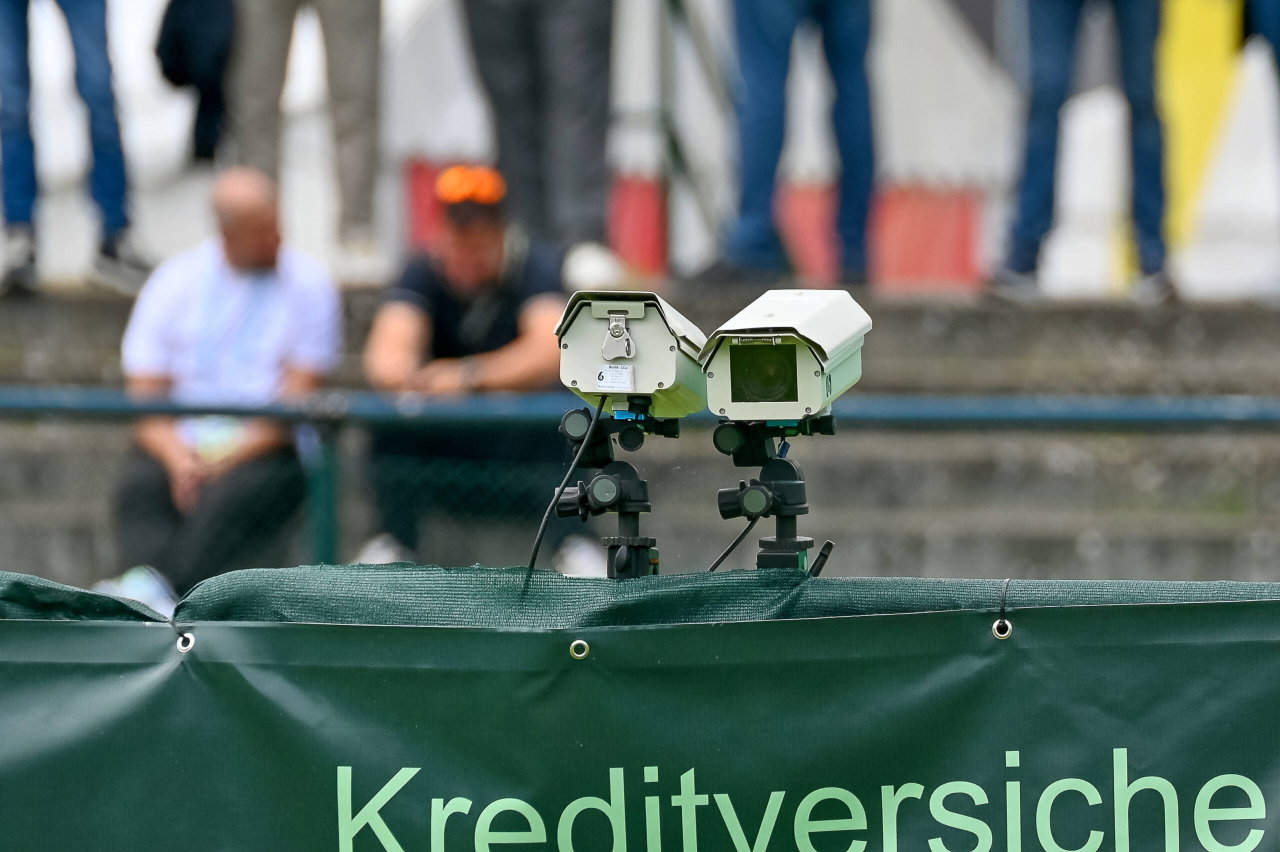
In 2006, Hawk-Eye recorded its first official line call at 130 mph, changing how tennis is officiated and analyzed forever. What began as a simple tool to resolve controversial out calls soon turned into a full-court tracking network. By converting every serve, bounce, and stroke into measurable data, Hawk-Eye laid the groundwork for a complete technological shift in the sport.
Watch What’s Trending Now!
Now optical tracking systems are able to record the exact physical dynamics of each match played on both the ATP and WTA circuits. The current tracking systems record over sixty different performance figures for each player in every match. This technological change has eliminated ambiguity from top-level tennis and has substituted subjective judgments with measurable values such as velocity, trajectory, spin rate, and impact points. Consequently, the sport has become an advanced form of high-speed data processing.
From Electronic Line Calling to a Multi-Camera Tracking Network
At the Nasdaq-100 Open, when the tournament organizers introduced Hawk-Eye, they saw it as a reliable safety net for the human line judges. The system made use of a number of high-speed cameras, which were placed around the roof of the stadium in order to work out the three-dimensional path of the ball. Dr. Paul Hawkins, who had invented the system, had originally created the platform with the aim of helping television viewers and the tournament umpires to resolve difficult calls.
“Hawk-Eye was designed to bring clarity to broadcasting and officiating,” Hawkins stated at the time of its first use, “although the tracking algorithms underneath it also determined the physical geometry of each stroke.”
Before 2006, tennis relied entirely on human line judges, leading to high-stakes disputes at major events like Wimbledon and the US Open. To eliminate human error, the sport introduced Hawk-Eye, making tennis an early pioneer in optical ball-tracking alongside the technological shifts happening in other major sports like baseball and basketball.
The tournament directors soon came to the realization that the optical tracking system was recording much more than just the line margins. The cameras recorded the point at which the ball hit the court to within millimeters, the height from which the ball was released on a serve, and the precise position of contact in relation to the baseline.
The various governing bodies, such as the International Tennis Federation and the ATP, then extended the use of Hawk-Eye to the major tournaments. When the technology companies increased the frame rates of their cameras, the software engineers developed automated pipelines to instantly process the spatial coordinates.
While Hawk-Eye provided the core tracking data, the broader data transformation required key industry partnerships. The WTA partnered with technology providers like SAP to process and publish this raw camera data in real time. Combined with upgraded camera frame rates, Hawk-Eye’s initial line-calling tool grew into a complete data engine that turned every court into an automated laboratory.
Micro-Metrics and Tactical Engineering on Court
In the past, elite coaches judged players by looking at match stats—like how many aces they served, how many unforced errors they made, and how many points they won. Hawk-Eye changed all that by giving analysts a deeper look at every rally.
Now, experts don’t just count the stat numbers. They look at how long rallies last, how far the ball clears the net, where a player stands when they hit the ball, and how fast the ball is spinning. By guessing a player’s stamina by watching for signs of tiredness, analysts now measure work rate by calculating how far a player sprints sideways and how many times they burst into speed during a match.
Some stats are way more useful than career averages. The variation in a player’s serve speed, for example, can reveal a lot about their state. If Hawk-Eye records a drop of ten kilometers per hour in a player’s average first-serve speed, it often signals a shoulder problem, an abdominal strain, or just plain fatigue.
In a similar way, analysts look at the number of return points won on second serves and at break point conversion rates using moving windows. Data models have shown that the break point conversion rate over a sample of ten matches is the single best predictor of what will happen in the next set.

Getty
TOKYO, JAPAN – OCTOBER 05: Simone Bolelli of Italy plays a backhand with Andrea Vavassori of Italy against Austin Krajicek of United States and Nikola Mektic of Croatia during their Men’s doubles semifinal match on day six of Kinoshita Group Japan Open at Ariake Tennis Park on October 05, 2026 in Tokyo, Japan. (Photo by Kenta Harada/Getty Images)
The analytical reports directly determine the tactical strategies used in the players’ locker rooms. Instead of starting a match with general tactics, top players prepare specific game plans using heat maps powered directly by Hawk-Eye’s tracking feed. The coach notices that the opponent tends to keep their returns short when receiving cross-court kick serves that come in wide on the ad side.
The players then examine the opponent’s backhand striking area under pressure, focusing on exact sections of the court where the efficiency of contact falls below forty per cent. Because of the precision of the data, competitive tennis has become a tactical sport in which mathematical advantages decide championship titles.
The Algorithmic Transformation of Betting and Forecasting
The coming of granular tracking data had a radical effect on the way in which analysts, sportsbooks, and predictive modelers assessed professional matches. In the past, odds-makers used players’ public reputations, their world rankings, and their head-to-head records on particular surfaces to set the prices for a match. Meanwhile, today’s computer systems don’t rely on old-school predictions. They use real-time data from Hawk-Eye to calculate efficiency in real time.
It processes the data and adjusts the odds between points instantly. Moreover, optical tracking reveals clear inefficiencies in the secondary markets, for example with respect to set handicaps, the total number of games, and the results of the first set. The pre-match odds frequently take into account recent match results rather than the actual quality of the players’ strokes.
The tendency for the winner of the first set to show this information lag is often seen. Bookmakers may not adjust their prices until several days after the tracking data has highlighted a new mechanical fault. Those who keep an eye on the metrics specific to each tournament are able to spot these opportunities before the general market makes the necessary adjustment.
A player who is outside the top thirty but who leads the field in first-serve percentage during a tournament frequently ends up exceeding the baseline historical predictions. What used to be a speculative activity has now become applied statistical modelling in tennis forecasting, the entire process being based on automated camera feeds.
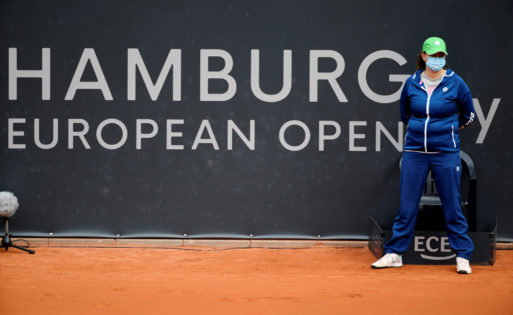
Reuters
Tennis – ATP 500 – Hamburg European Open – Am Rothenbaum, Hamburg, Germany – September 23, 2020 A line judge wearing a protective mask during the Hamburg Open REUTERS/Fabian Bimmer
Hawk-Eye eliminated guesswork from professional tennis. It abolished the earlier distinction between what the spectators saw and what the top players did on the court. The tracking algorithms, by recording the speed, bounce angle, and positional trajectory of each rally, established an objective criterion for performance analysis.
The sport is still adopting a greater degree of algorithmic integration. Nowadays, high-speed cameras together with machine learning software are able to automatically make baseline calls, develop player strategies, and drive global predictive markets. Although tennis is still a tough struggle of individual determination, the competitive environment is now controlled by data architecture. Hawk-Eye has changed a game based on instinct into one based on absolute precision.