
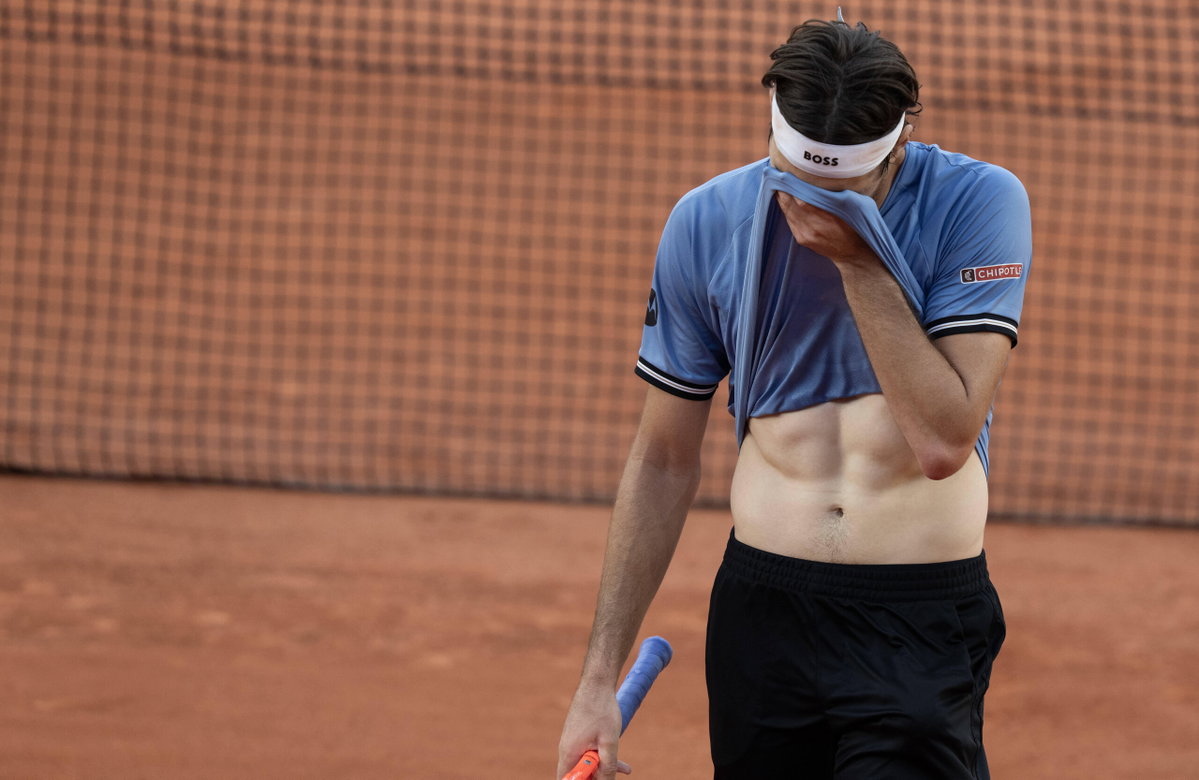
Taylor Fritz arrived at the French Open carrying the scars of last year’s collapse, when Daniel Altmaier stunned the top American on Court Simonne-Mathieu in a brutal first-round exit. This season offered little redemption, as his clay campaign began and nearly ended in Geneva, where Alexei Popyrin dismantled him in straight sets. That fragile preparation haunted Fritz again in Paris, where, despite flashes of resistance, he failed to overpower fellow American Nishesh Basavareddy.
Watch What’s Trending Now!
“I really don’t think my level was that bad, to be honest. All things considered, I thought actually I played all right,” said Fritz at the post-match press conference. On Sunday, Basavareddy secured a memorable 7-6(5), 7-6(5), 6-7(9), 6-1 victory after two hours and 45 minutes. The result sent the young American into the second round of the French Open and extended Fritz’s difficult run on clay this season.
Fritz also admitted there were several areas where he could have performed better during the match. He particularly pointed toward his serving accuracy and return game, which failed to deliver consistently at key moments.
“[There were] certain things here and there that I could do a bit better,” Fritz added. “I wasn’t hitting some of the spots on my serve as good as I could have. I could have returned a lot better as well, but a bit frustrating because a lot of times I’m not returning well, it’s more like I’m having trouble just getting my racquet in a good place to make contact.”
Even though Fritz struggled in patches, he still produced several strong moments on serve. The 28-year-old fired 21 aces during the match, while Basavareddy managed only four, showing that Fritz’s power remained one of his biggest weapons.
However, Basavareddy proved far more efficient in the most serious situations. The younger American won a higher percentage of points on both his first and second serve and stayed calmer during crucial break-point opportunities.
Fritz converted only one of his four break points during the contest. Basavareddy, meanwhile, capitalized on three of his six chances, and those moments ultimately made the biggest difference in the outcome.
One particular aspect of Basavareddy’s game left Fritz especially frustrated throughout the afternoon. The American repeatedly used drop shots to disrupt Fritz’s rhythm and pull him out of position on the clay court.
“The biggest thing was just that the drop shots were crazy. Typically, when someone is dropshotting me too much, I kind of just tell myself, ‘Okay, I need to hit the ball deeper,” Fritz added.
“He was hitting insane drop shots, off balls that were landing on the baseline. He killed me with that, and there’s not really much I can do about it, like I said. I feel like he’s just hitting insane dropshots off of crazy shots to hit dropshots off.”
With the defeat, Fritz’s clay-court season lasted only four days as he finished with a disappointing 0-2 record. After spending an extensive period away from the tour because of a knee injury, he will now shift his focus toward the upcoming grass-court season.
For Basavareddy, though, Court Suzanne Lenglen turned into heaven on earth. The young American walked away with one of the biggest wins of his career and a well-earned place in the second round of Roland Garros.
Nishesh Basavareddy is thrilled after stunning compatriot Taylor Fritz
Nishesh Basavareddy delivered the first major upset of Roland Garros on Sunday evening in Paris. The 21-year-old held his nerve throughout a highly competitive battle against Fritz. Despite facing relentless pressure from the 28-year-old, Basavareddy produced fearless tennis from start to finish.
Fritz struck an incredible 71 winners during the match, but Basavareddy answered with 51 winners of his own. More importantly, he stayed composed in the biggest moments to secure the first Top-10 victory of his career after previously going 0-3 against elite opponents.
The win also placed Basavareddy in rare American company at Roland Garros. He became the first American man to defeat a Top-10 opponent at the Parisian clay since Jan-Michael Gambill knocked out then-World No. 8 Nicolas Kiefer back in 2000.
After the match, Basavareddy admitted he felt proud of the way he handled pressure situations. “I think I raised my level most of the time in the bigger moments, especially my serve. So I would say that’s kind of what I was most happy about,” Basavareddy told the press after the match.
The American also spoke honestly about his limited experience on clay courts. Still, he believed he could trouble Fritz if he managed to execute his game properly.
“Obviously, it means a lot. I haven’t had much experience on clay, so I don’t know if I was really expecting this, but I still thought I’d have a good chance today if I played well, and that’s what I did.”
The two-time Next Gen ATP Finals competitor will now await the winner between fellow 21-year-old Californian Alex Michelsen and Kazakhstan’s Aleksandr Shevchenko. Do you think the bright American can make a deeper run at the French Open? Share your thoughts below.