
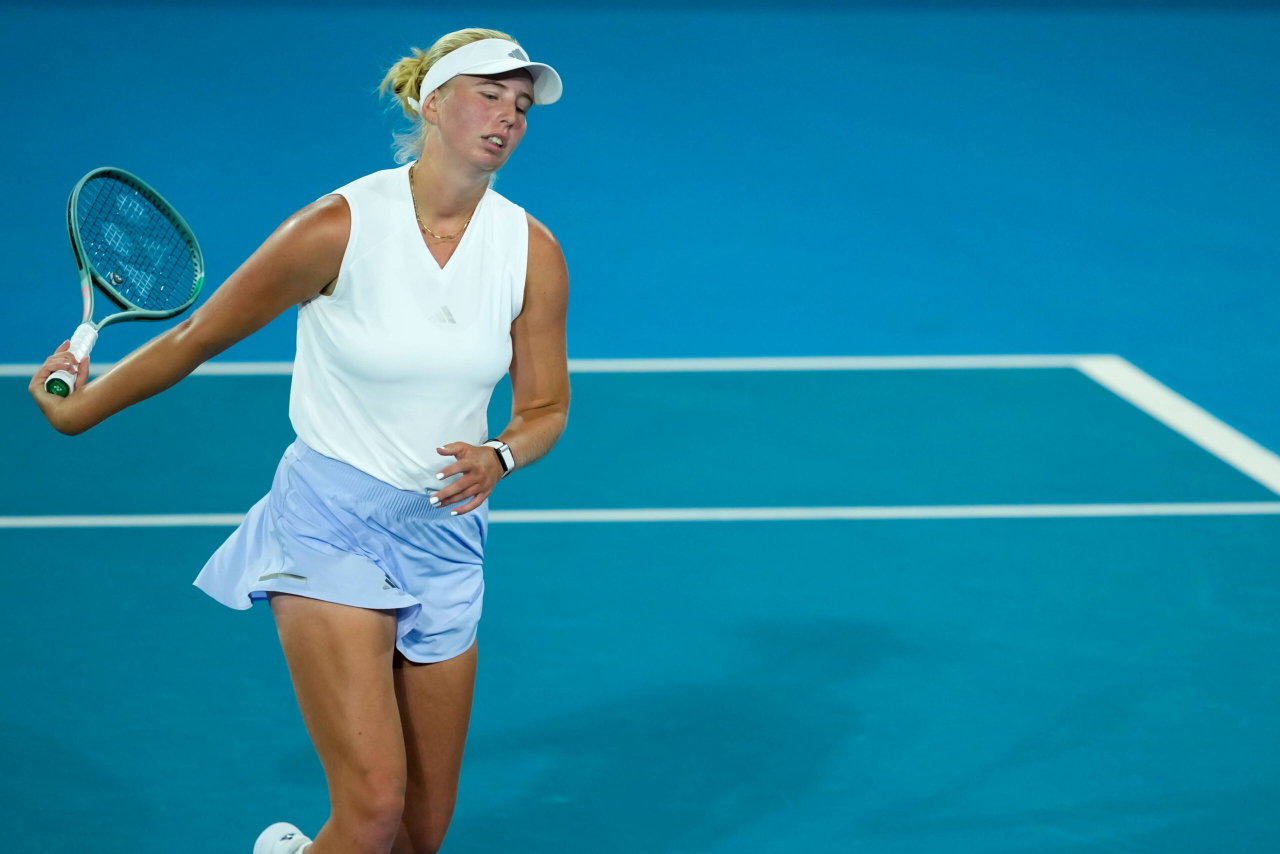
Clara Tauson had plenty of reasons to look forward to 2026 after a breakthrough season that took her into the world’s top 15. Instead, the Danish star has spent much of this year searching for the form that made her such a difficult opponent in 2025. Her latest setback in Wuhan proved to be her final appearance of the season, and she has now admitted just how frustrating the campaign has been.
Watch What’s Trending Now!
Tauson announced on social media on October 14 that she would not play again this year. Her decision followed a calf injury that forced her to retire from her opening match at the Wuhan Open just days earlier. The 23-year-old did not hide her disappointment in the message.
“I fought as hard as I could throughout the season and kept my head high, but there were more downs than ups, and too few weeks where I could play the way I wanted,” Tauson wrote.
There is also a personal element to her decision. In a statement reported by Danish media, Tauson said she had not taken an uninterrupted holiday in ten years and intended to do so this winter. She plans to focus on recovery and physical preparation rather than rush back for the remaining autumn tournaments.
Tauson’s final match came against Marie Bouzkova in Wuhan on October 12. The Dane struggled from the outset and lost the opening set 6-1 in less than 30 minutes. She received treatment on her calf between sets, but her movement remained restricted. After falling behind 2-0 in the second set, she decided to stop. Bouzkova advanced after winning 35 points to Tauson’s 13.
The retirement was particularly frustrating given what Tauson had achieved in 2025. She began that year with a title in Auckland, reached the final in Dubai and made the semifinals in Toronto. Those performances helped her climb to a career-high No. 12 in the WTA rankings. She entered 2026 with a chance to build on that progress, but the season never developed as she had hoped.
Instead, Tauson has fallen to No. 53 in the rankings. Her best results this year were her quarterfinal appearances in Dubai and Monterrey, and semifinal appearances in Athens and Abu Dhabi. Her Grand Slam campaign also proved difficult. She reached the third round of the Australian Open but lost in the opening round at the French Open, Wimbledon, and the US Open.
A season troubled by injuries
Tauson first made her mark as a junior, winning the girls’ singles title at the 2019 Australian Open and reaching the top of the junior rankings. She moved onto the professional tour that same year and won her first two WTA titles in 2021, in Lyon and Luxembourg. Back problems then restricted her opportunities in 2022, when she managed only 11 main-draw appearances, according to TennisWatcher.
This year, too, the problems had begun well before her final appearance in China. Tauson retired during her opening-round match against Ajla Tomljanović at the Adelaide International after losing the opening set 7–6 (7–5). Although she played with a bandage on her left hamstring, tournament organisers subsequently informed DR Sporten of a lower-back injury as the reason for her withdrawal.
This was just before the Australian Open. While she reached the third round in Melbourne, her fitness became a recurring concern over the following months.
The Miami Open marked another major interruption in March. Tauson retired against Katie Boulter in the second round after experiencing back pain during the match. Despite winning the opening set, she appeared increasingly restricted in her movement before withdrawing at 1-0 in the deciding set. She repeatedly touched her back during the match, and after calling for the physiotherapist, she was unable to continue.
April was no better, as the injury also forced her to withdraw from the WTA 500 tournament in Linz, Austria, where she had reached the semifinals the previous year. At the time, her back inflammation had left the duration of her absence uncertain.
Tauson then skipped Stuttgart and also withdrew from her singles match in Madrid because of a right shoulder issue sustained during rehabilitation for her back. She had competed in doubles in Madrid, but the singles withdrawal was enough of an indication that she had not yet recovered sufficiently to resume a full schedule.
In May, she attempted to return at the Italian Open in Rome after an extended break from singles competition. Facing Oleksandra Oliynykova, Tauson won the opening game but subsequently lost six consecutive games to surrender the first set 6-1. She was trailing 3-1 in the second when she retired after receiving treatment on her back. It was her first singles appearance in more than a month and a half, following her March withdrawal in Miami, and the comeback ended without a completed match.
Before Roland-Garros, Tauson then revealed that she had two herniated discs in her back, a condition she described as chronic.
“I have two herniated discs in my back. It’s chronic, you could say, and you have to train yourself out of it, but it’s not always that easy when you have to play a lot of tournaments and go to the gym a lot.
“That’s what I’ve had for some time, but I feel like I’ve come out on the other side mentally. I’m ready to give it a shot, even though I have the problems I have now.”
By June, TennisWatcher reported that she had been unable to complete a full training week on any surface. After Italy, she lost four times in the opening matches, with the French Open offering another indication of how severely the problem was affecting her tennis.
Tauson faced Daria Snigur in the first round and came close to securing her first victory since March. She led by a set and was serving for the match at 5-3 in the second, but Snigur recovered to take the set 7-5 and then dominated the decider. As Tauson fell behind in the third set, she expressed frustration about being unable to move. She eventually lost 3-6, 7-5, 6-2
“I feel like my back is okay until we get an hour into the match, and then you can see that I can barely move towards the end. It’s both because I’ve been running on reserve and because of the problems I have. Towards the end of the match, everything was switched off. It was a really tough experience,” she said, per Eurosport.
A former Danish national-team physiotherapist, Sune Dombernowsky, later explained the difficulty of treating such injuries in a professional tennis player, per Flashscore.
“It can, of course, be a challenge for an elite tennis player to give the back the right amount of rest and exercise. It is almost impossible for Tauson to take a year out of the tournament calendar. At the same time, there is a risk that her struggles will persist if her back does not get enough rest.”
“I am sure the people around Tauson know how to handle her rehabilitation. In the beginning, there needs to be great focus on strength and stability around the back, and then gradually, training should be more and more focused on tennis. It’s not dangerous if rehabilitation exercises hurt a little bit, but it’s of course important to respect the pain so as not to increase the risk of relapse or permanent discomfort.”
Tauson did find moments of progress during the summer. Her victory over Alexandrova in Monterrey was one example, and she also recorded wins against Diana Schnaider in Germany and Sara Bejlek in Athens. She then pushed Karolína Muchová and Barbora Krejčíková to three sets, showing that her competitive level had not disappeared entirely.
However, these results did not translate into a sustained recovery, and her first-round loss to Sloane Stephens at the US Open became another difficult moment in an already frustrating season.
Against Stephens, Tauson had taken a 4-2 lead in the opening set before losing control of the match. Afterward, she openly criticised her own performance, saying she had been unable to recognise herself on court and could not find solutions to the problems presented by her opponent. It was her third consecutive first-round exit at a Grand Slam.
“I’m playing terribly. Really badly. I just have to admit it. I have no excuses. My brain and body are giving up. I’m making strange errors that I’m not used to. It’s all just falling apart,” she said after the loss.
Flashscore tennis expert and former WTA player Katerina Teruzzi argued that regaining full fitness, rather than continuing to chase results while injured, was the key to Tauson’s recovery.
“Playing through pain when you are not 100% makes no sense; it brings no results, no peace of mind, and ultimately only leads to a ranking drop and frustration,” Teruzzi said.
Teruzzi, though, remained confident that Tauson could rebuild her form once she was healthy. “Taking a proper break to get 100% healthy is completely fine, and once she does, she can definitely return close to the Top 10,” she said.
And that now remains the focus for Tauson.
That said, Tauson is not the only prominent player to decide that stepping away is the best option before the 2026 calendar ends. Amanda Anisimova and Emma Navarro have also brought their seasons to an early close, although their circumstances differ. Nonetheless, all cases raise questions about the physical toll of the tennis calendar.
The likes of Aryna Sabalenka had already called for the calendar to change, and fortunately, the WTA responded.
The WTA unveiled its calendar for the 2027 season this month, introducing changes to the requirements for top players. Under the revised rules, the mandatory number of WTA 500 tournaments has been reduced from six to four. Players can also substitute one eligible WTA 1000 result with a better-performing result from a WTA 500 or WTA 250 event.