
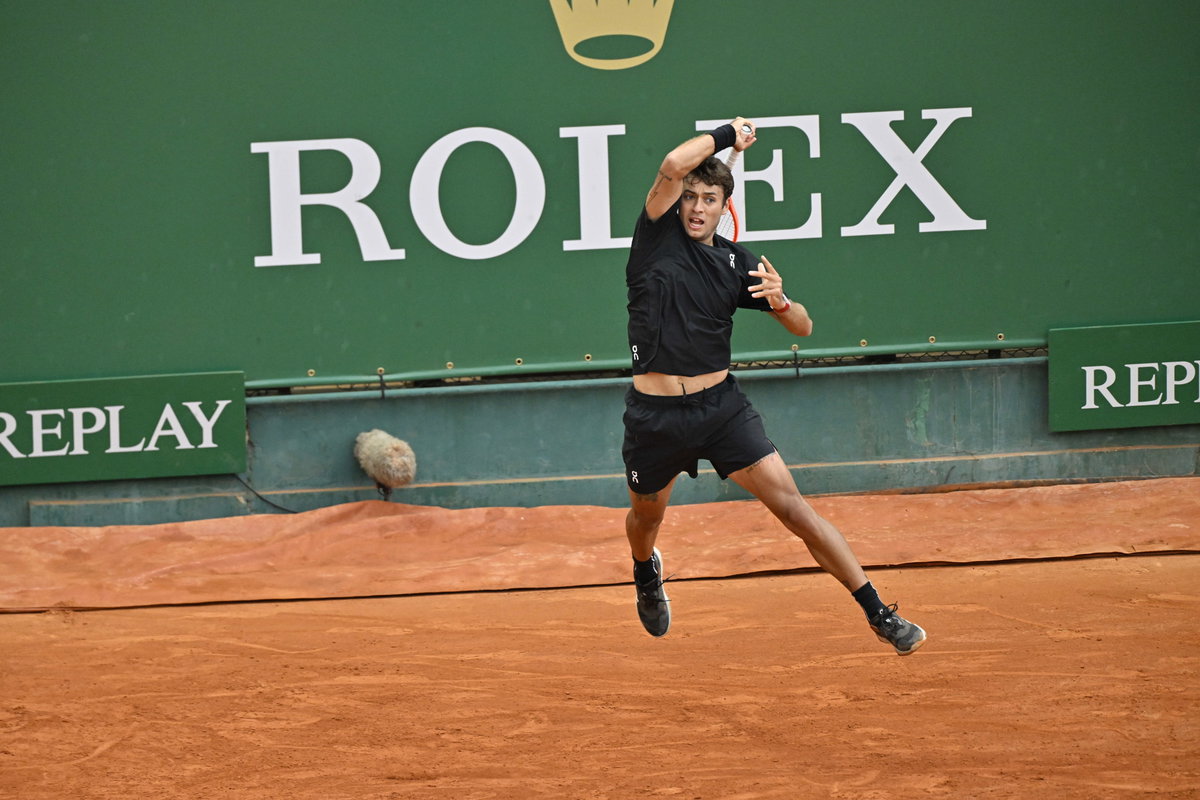
Back in 2013, Rafael Nadal slammed the indoor clay court at São Paulo after slipping alongside David Nalbandian, warning, “This court is bad for the health of the players, and I hope someone takes action.” The outrage exposed serious safety concerns, and now, years later, a similar issue at the outdoor court of the Madrid Open enraged Flavio Cobolli.
Watch What’s Trending Now!
During his match against Camilo Ugo Carabelli, Cobolli directly addressed the ATP supervisor, saying, “You need to do something for this court; it’s impossible to play.” He did not stop there and made his point even clearer. “It’s not clay, it’s really slippery, it’s like playing ice hockey on a tennis court.”
The protest reflected a serious concern about safety and playability. According to Cobolli, the surface made it extremely difficult to move with control. He explained that the court lacked the feel of real clay. For a player relying on balance and controlled sliding, that difference was significant.
The comparison to ice hockey captured the extent of his discomfort. On clay, stability and proper sliding are essential, and without them, the game becomes unpredictable.

“you need to do something for this court, it’s impossible to play. it’s not clay, it’s really slippery, it’s like playing ice hockey on a tennis court” clock them
Despite the frustration, Cobolli managed to stay composed enough to compete. He fought through the difficult conditions and kept himself in the match. In the end, he defeated Camilo Ugo Carabelli in three sets, 6-7 (7), 6-1, 6-4. The match lasted more than two and a half hours and tested both players physically.
The victory was important, but it did not erase the concerns. Instead, it raised further questions about the quality of the courts at the Madrid Open. Even after the match, Cobolli continued to express his dissatisfaction during the press conference. He made it clear that the issue had affected his performance.
“With the game I have, I think I can play well here. I had some problems in the first set with the court, which was very slippery. There was no clay on that court; it felt like playing ice hockey! But you also have to fight with those aspects,” he added.
He went on to explain the extent of his struggle. “ It was difficult to find a way to move well, and it was a very different court than those of the first days and I was really struggling with my movements, and there was no clay.”
This situation is not limited to one player alone. In recent years, even WTA players have voiced similar dissatisfaction with clay court conditions, making the issues seen in Madrid stand out even more.
Emma Raducanu struggles with movement on Madrid Open clay courts
Last year, under the searing heat of the Spanish capital, Marta Kostyuk stepped onto the clay courts of the Caja Mágica with clear intent. She was determined to make a statement against one of her most high-profile contemporaries. By the end of a tense and physically demanding contest, she delivered exactly that. Kostyuk produced an impressive performance to defeat Emma Raducanu 6-4, 2-6, 6-2 in the second round.
Raducanu fought hard throughout the match and maintained her composure until the final point. However, a win over Kostyuk would have marked her best career victory outdoors on clay. After the match, Raducanu reflected honestly on her struggles with the surface. Her comments revealed how difficult she found adapting to the conditions.
“I found moving really difficult,” said Raducanu. “I felt like I was slipping around, but it was taking me a long time to get out of the corners and after the serve as well.” Her words highlighted a recurring issue players face on clay, especially when the surface does not behave as expected. Movement, balance, and recovery become far more challenging under such conditions.
However, one of the most prominent complaints about Madrid’s clay dates back to 2012. That year remains one of the most controversial moments in the tournament’s history.
Rafael Nadal was so unhappy with the conditions that he even warned he might never return to the event. His frustration stemmed from a dramatic change introduced by the organizers.
In 2012, the Madrid Open switched to blue clay, aiming to make the ball more visible for spectators. The experiment quickly backfired, drawing criticism from players and fans alike.
“My thoughts haven’t changed on the concept and organization of this tournament. My criticism is not directed at the tournament but at the ATP, which should never have allowed such a change at a tournament of this scale,” Nadal said at the time.
The backlash forced the tournament to act quickly, and from 2013 onward, Madrid returned to traditional red clay. It was a clear acknowledgment that the experiment had failed.
Now, with Flavio Cobolli adding his voice to the conversation over current red clay conditions, the spotlight is once again on the organizers. The question remains whether they will respond this time as well.