
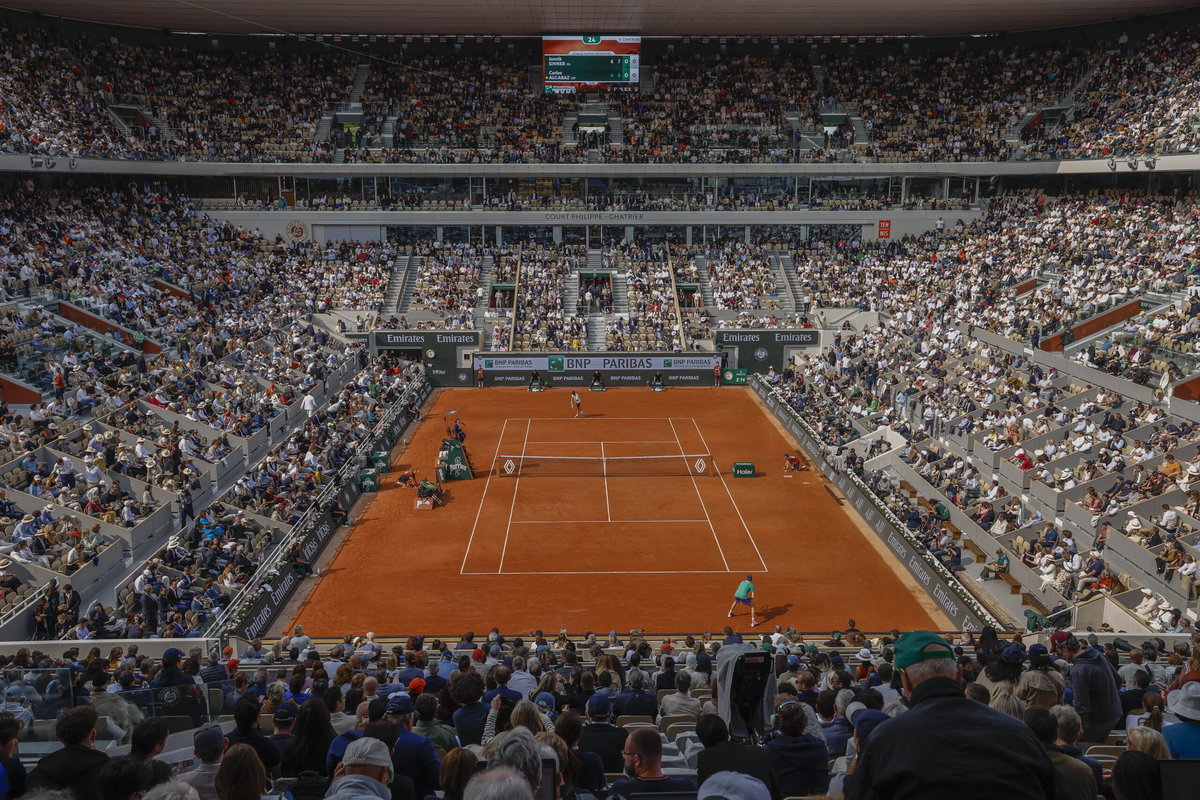
When French Tennis Federation (FFT) president Gilles Moretton defended retaining human line judges by calling Electronic Line Calling (ELC) “not perfect” yet, Roland Garros reignited tennis’ growing war between tradition and technology. Even as Wimbledon embraced ELC last year, many expected Paris to finally follow the modern wave this season. Instead, the French Open stood firm, while former pros Anne Keothavong and Tim Henman now openly leaned toward the inevitable future of ELC.
Watch What’s Trending Now!
The debate surrounding ELC at Roland Garros once again returned to the spotlight during TNT Sports UK’s coverage of the French Open. During the discussion, Anne Keothavong was first asked about the French Open’s decision to continue using human line judges instead of ELC. The former British player admitted she still enjoys certain traditional aspects of the sport.
“Once in a while, it’s fine, it’s fine to see the line judges. It’s fine to see the empires get up and down,” Keothavong noted.
Her fellow broadcaster and former Wimbledon semi-finalist Tim Henman quickly stepped into the conversation with an important clarification. “Only on clay, obviously,” Henman added.

Roland-Garros remains the only Grand Slam tournament not to use electric line calling 👀 Anne Keothavong and Tim Henman discuss the pros and cons of ELC 💬
The conversation soon shifted toward whether Roland Garros could eventually adopt ELC in future editions of the tournament. Henman, however, appeared doubtful after listening to recent comments from FFT officials.
“I don’t think so, listening to the French Tennis Federation,” Henman said while discussing the possibility of change in Paris.
Despite respecting the tournament’s traditions, the Briton admitted he still believes technology should now become part of the game. “I think if we have the technology, we should use it. It’s been a huge success on all the other surfaces,” he added.
Henman also addressed the ongoing confusion surrounding ball marks and umpire inspections on clay courts. “While the umpires will go and see the ballmarks, which sometimes are not particularly clear, and sometimes with the television channels, have the electronic line calling, the Hawkeye ball marking, sometimes they disagree.”
Even with his support for modernization, Henman still acknowledged his appreciation for tennis traditions. “I am a traditionalist, but having said that, I think electronic line calling should be there,” the Briton admitted honestly.
The French Open’s reluctance to introduce ELC largely comes down to two major factors. Roland Garros wants to preserve traditions associated with the 134-year-old tournament, while the FFT also hopes to retain human involvement in officiating for as long as possible.
“The federation wants to keep our referees for as long as we can. I hope we’ll be able to maintain it in our tournaments in the future,” Gilles Moretton explained last year while defending the tournament’s position.
ELC uses cameras, computers, and sensors to determine whether a ball lands in or out. Critics of the system at Roland Garros have argued that the moving red clay surface can affect the technology’s reliability because the court changes constantly during matches.
However, Hawk-Eye inventor Paul Hawkins strongly disagrees with that criticism. According to Hawkins, the technology itself remains accurate on clay courts, while the actual ball mark left in the clay can sometimes create confusion. “The mark on the court looks like it is out, whereas actually it has clipped the line,” Hawkins told BBC Sport.
Still, Hawkins also admitted that Roland Garros may actually benefit from preserving its traditional system. He believes that if players accept judging by ball marks, as tennis has done for more than a century, then “it is still fair”.
Yet despite those arguments, the absence of ELC continues to create tension and controversy at this year’s French Open.
Pierre-Hugues Herbert erupts after a controversial line call sparks a heated on-court argument
The implementation of ELC has created controversy across several tournaments this clay-court season. One of the biggest incidents came during Elena Rybakina’s third-round clash against Zheng Qinwen at the Madrid Masters. At a crucial stage of the match, Zheng struck a serve that the ELC system ruled as an ace, even though the ball mark appeared outside the line.
Rybakina immediately walked toward the net and pointed directly at the mark on the clay. Clearly frustrated by the decision, the Kazakh star openly challenged the technology in front of the crowd.
“This is not a joke,” she said. “The system is wrong. It is not touching (the line). It is absolutely wrong.”
And with those complaints from players around the tour, Roland Garros decided against introducing ELC this year. The FFT officials instead continued backing human line judges, insisting they provide greater accuracy on clay courts.
However, the debate exploded once again during Pierre-Hugues Herbert’s dramatic first-round battle against Lorenzo Sonego. Under the lights of Court Simonne-Mathieu, the match turned into one of the most emotional contests of the opening round.
Sonego grabbed early momentum after edging the opening set 7-6(3), handling the pressure moments better in the tiebreak. Herbert responded strongly in front of his home crowd by taking the second set and pulling himself back into the contest.
The biggest controversy arrived during the deciding fifth set when Herbert faced a break point at 0-1. Believing Sonego’s shot had landed out, the 35-year-old immediately challenged the line call and looked toward the chair umpire for intervention, leading to a heated verbal exchange.
Now, with Roland Garros continuing without ELC, pressure surrounding line-call controversies is only growing stronger. The coming matches could ultimately determine whether the tournament’s resistance toward ELC will continue influencing future editions of Roland Garros.