
Reuters
Tennis – Madrid Open – Park Manzanares, Madrid, Spain – May 1, 2024 Kazakhstan’s Elena Rybakina celebrates winning her quarter final match against Kazakhstan’s Yulia Putintseva REUTERS/Susana Vera
Reuters
Tennis – Madrid Open – Park Manzanares, Madrid, Spain – May 1, 2024 Kazakhstan’s Elena Rybakina celebrates winning her quarter final match against Kazakhstan’s Yulia Putintseva REUTERS/Susana Vera
Elena Rybakina’s controlled demeanor has become a fascination in a sport driven by adrenaline, volatility, and high-stakes momentum shifts. While many competitors scream through stress or celebrate to recharge, she has built her rise near the top of the WTA on a striking calm that keeps prompting questions about whether she suppresses her feelings or simply experiences pressure differently. Now, as the offseason unfolds, she issues a brutally honest confession about her feelings on court.


In a recent podcast appearance, Rybakina addressed her calm demeanor on court. She explained that she does not display emotional reactions during matches. Instead, she prefers to remain composed and internalize her feelings.
Watch What’s Trending Now!
“I’m generally a calm person. On the court, you can see that I don’t have many emotions… If something goes wrong, I will not show it. Even if it is good, I’m not going to scream, ‘Come on,’ or some other things. But, inside, of course, there are a lot of emotions and nerves, and everything…”
Her approach has been visible for years. One of the most memorable examples came after her 2022 Wimbledon title. She defeated Ons Jabeur in three sets and completed a comeback to become a Grand Slam champion.
elena saying people might think she has no emotions since she doesnt react much when things are going wrong and shes also not the type to yell “cmon” when things are going right 😅 pic.twitter.com/y7ayhmGxvd
— jelly (@toughmatches) December 16, 2025
Her entire celebration consisted of a small fist bump, a handshake at the net, and then a quiet moment on the bench while waiting for the trophy ceremony.
That reaction went viral because it was the opposite of what many expect from a major final winner. Since then, discussions about Rybakina’s personality have increased.
Some observers wanted her to “show more emotions.” They viewed her silence as an unusual trait for a top player. But Rybakina never shifted from her natural character.
She has repeatedly insisted that her calm exterior does not reflect a lack of passion. She emphasized this again after reaching her first Wimbledon quarter-final against Ajla Tomljanovic in 2022.
“I’m just a very calm person. I’m not showing my emotions. It’s always been like this. Of course, I’m full of emotions inside.”
That statement reinforced that nothing about her self-presentation is accidental.
The 2025 season added further pressure. Early in the year, her coaching situation became unstable. Goran Ivanisevic ended their partnership after only two tournaments. Stefano Vukov was then banned from coaching her for eight months. Those disruptions forced Rybakina to manage stress without visible frustration.
Her results improved after Vukov returned. Rybakina quickly restored form, won the title in Ningbo, and then claimed the WTA Finals.
With those victories, she moved back into the top-10 and re-established herself as a major threat. The turnaround suggested she could succeed even through off-court turbulence.
Rybakina credits her parents for shaping her calm on-court demeanor
Elena Rybakina continues to generate curiosity, especially regarding her personality. People see her powerful tennis and decisive game style, but they often wonder why she appears so introverted. Those questions resurfaced again during an interview with Championat last month, where Rybakina discussed her temperament in honest terms.
“Of course, we all have moments during matches when we are angry, when something doesn’t work as it should. Including myself, and I assure you that what you want to do is destroy and break everything.”
Rybakina made those comments shortly after winning the WTA Finals in Riyadh, where she grabbed the last qualifying spot and then closed the tournament with the title.
She explained that she works hard to resist emotional outbursts.
“In those moments, what I try to do is restrain myself, I try not to let my emotions go further, not to cross the line at any moment. Obviously, when you reach that mood, there is no escape, but I always try to control myself as much as possible.”
Rybakina even admitted that she has lost control at times.
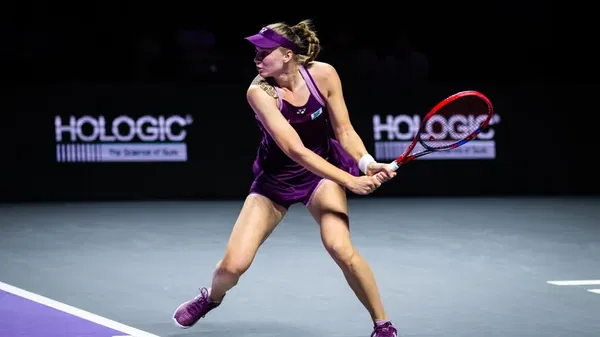
Imago
Jimmie48/WTA
“I have thrown my racket sometimes, in moments when I can’t deal with my emotions.”
But even in those moments, she feels responsible for her behavior. She added that young athletes and children are always watching, so she thinks about the example she sets.
“I hold my ground because I understand that there are always kids watching, and I wouldn’t want to set a bad example. Everyone has their principles and reflections on that matter, so I prefer to maintain that type of neutrality in any situation, not showing my strong emotions, especially the negative ones.”
Her upbringing plays a major role in her restraint.
“My parents have given me such a level of education that it’s pointless to expect a reaction of that kind on the court,” she revealed.
Rybakina ended the season with a strong finish, and she looks confident heading into next year. She reclaimed top form after coaching challenges earlier in the year and finished with significant momentum.
With the Australian Open approaching, many observers expect her to challenge for another hard-court Grand Slam.
Written by

Edited by

Ahana Chatterjee