

Maxime Cressy could not hit a forehand the day he found the style that would define his career. He was 14, and an elbow injury had taken the shot away mid-match, so he tried serving and running to the net instead of giving up. One point, he said, changed everything. Roughly a decade later, that habit had carried him to a tour final against Rafael Nadal. In an Instagram post on Sept. 28, the former ATP Tour player wrote about that final and what has happened to the game since.
Watch What’s Trending Now!
“Two completely opposite styles. Two completely different ways of seeing the same game. And that was the beauty of tennis,” he wrote in an Instagram post. “Today, I sometimes feel sad watching that variety slowly disappear. Slower and increasingly homogenized conditions have made serve-and-volley, the style that gave me my dream at 14, almost disappear at the highest level. And I keep thinking about that 14-year-old version of myself.”
Serve-and-volley is an aggressive tennis approach in which the server follows the serve toward the net rather than staying at the baseline. The idea, basically, is to close the distance quickly, pressure the returner into producing a difficult pass, and then finish at the net with a volley or overhead.
The tactic tends to work particularly well on quicker surfaces such as grass, where the ball stays low, and points can move rapidly. On slower courts like clay, players generally have more time to respond, making it harder to rely on serve-and-volley as consistently.
“What happens to the next kid like him? The kid whose heart tells him to attack. The kid who wants to rush the net when everyone tells him not to. Does he still get to dream?” he added.
“Tennis should never be about creating the same player over and over again. It should be a place where completely different personalities, ideas and styles can meet on the same court. Maybe that’s why this picture means more to me today than it did then. It isn’t just a memory of playing Rafa. To me, it’s a memory of the tennis I fell in love with,” he further wrote.
The match Cressy refers to was the final of the ATP 250 event held in Melbourne in 2022. On his route to that final, Cressy arrived ranked 112th, beat second seed Reilly Opelka after saving two match points, then took out third seed Grigor Dimitrov to reach his first tour-level final. Waiting there was Nadal, ranked sixth and playing his first event since August because a foot injury had ended his 2021 season early.
Cressy saved all five break points he faced in the opening set and held a set point at 6-5 in the tiebreak, but did not land another first serve in the set. Nadal won it 7-6(6), rallied from a break down in the second and served seven aces in that set to win 6-3 and collect his 89th tour-level title. Nadal later called Cressy “a very uncomfortable player for every opponent”. And soon enough, Cressy entered the top 100 for the first time. He had not grasped then what the picture meant while he was living it, and now it looks to him like a tennis slowly disappearing.
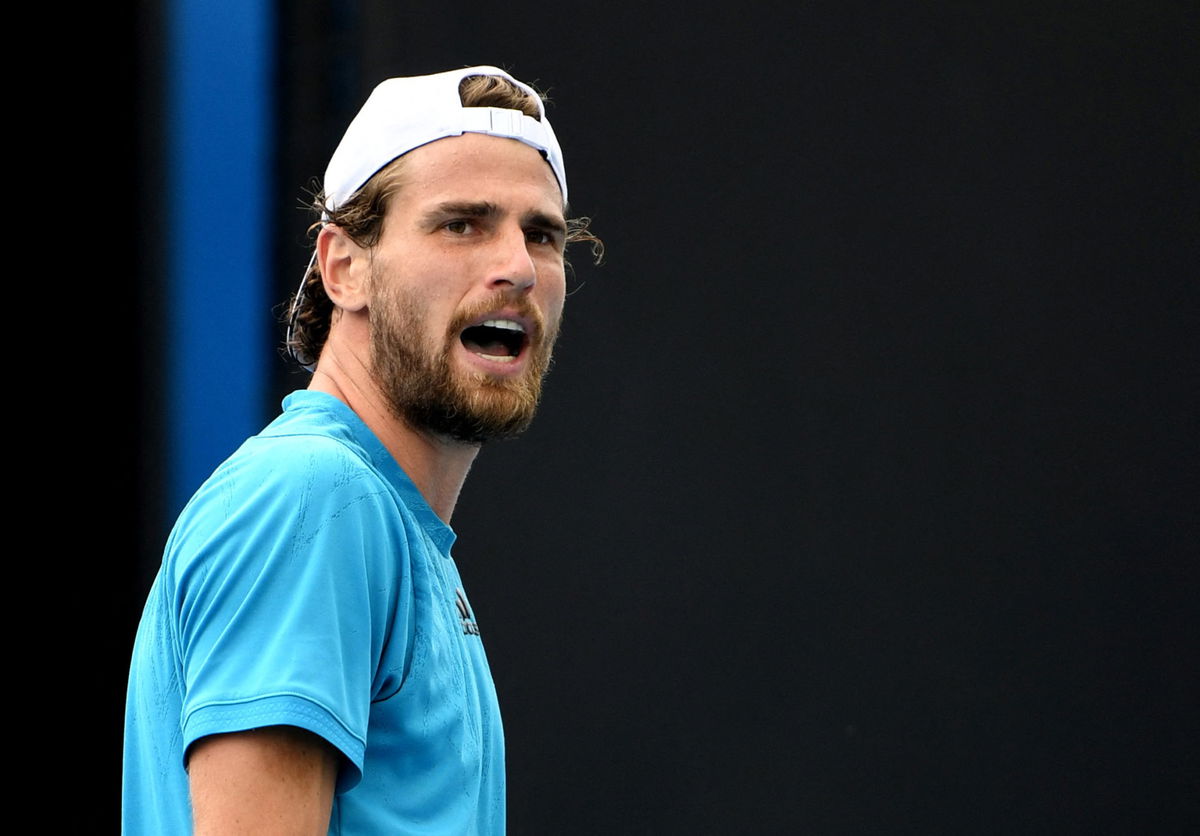
Reuters
Tennis – Australian Open – Melbourne Park, Melbourne, Australia – January 18, 2022 Maxime Cressy of the U.S. reacts during his first round match against John Isner of the U.S. REUTERS/Morgan Sette
Cressy has named Pete Sampras, Pat Rafter and Stefan Edberg as influences, and the ATP Tour reported that he spent hours studying video of Sampras serving against Andre Agassi, paying particular attention to the toss. He backed the style with volume. Over his first three rounds at the 2022 Australian Open, he served and volleyed on 74 percent of points and won 74 percent of the 283 points on which he did, according to tournament figures.
John McEnroe had further argued in his book “You Can’t Be Serious!” that the decline of serve-and-volley can be owed to the rise of lightweight composite rackets, arguing that modern equipment made it easier to generate power from the baseline. Wooden rackets simply did not offer the same kind of easy pace.
Then there are the polyester strings, allowing the main strings to slide and snap back against the crosses, helping players generate more topspin and making it easier to attack fast serves while keeping the ball in the court. The resulting shot can also dip sharply over the net, making it harder for a serve-and-volley player to reach and control.
Former world No. 4 Tim Henman made a similar point to Cressy’s in 2016, arguing that slower surfaces and heavier balls had contributed to the decline of serve-and-volley.
“It’s really sad that the art of serve and volley is vanishing,” he had told PTI in 2016. “The game has changed. The surfaces are slow and the balls are heavier. The players are not playing that game.”
More recently, former ATP pro Rajeev Ram made a blunt assessment about the fading nature of serve-and-volleying. He argued that very few courts and conditions remain that are conducive to the style.
“It’s completely fading,” he said. “The technology, the strings, the rackets, the courts, the balls, nothing is conducive to that style of tennis. Basically, it feels there’s no court, or very few courts and conditions in the world, that are conducive of that style.”
The lack of incentive and encouragement from the USTA’s side is considered another factor in the decline. Volleying has become mostly limited to the doubles game, while the baseline play of the junior players is more focused upon. There are conspiracy theories, too, around how some of it might have been orchestrated by tennis organizers to bring in longer rallies for more spectators and more cash.
Some accounts point to past attempts to curb serve-and-volley tactics, including rule changes reportedly aimed at players such as Pancho Gonzales and Jack Kramer. These included the VASSS system introduced in the 1950s, a three-bounce rule, and moving the second-serve line back by one yard. The measures, though, were later abandoned.
That said, Wimbledon changed its grass mix in 2001, moving from 70 percent ryegrass and 30 percent creeping red fescue to 100 percent ryegrass, which slowed bounces. Head groundskeeper Eddie Seaward told The New York Times in 2010 that the response-time difference was a tenth of a second.
The 2001 final between Goran Ivanisevic and Rafter was shaped by serve-and-volley, while the 2002 final between Lleyton Hewitt and David Nalbandian had barely a volley in it. Strategist Craig O’Shannessy found serve-and-volley used on nearly a third of Wimbledon points in 2002 and just under seven percent in 2018. Wimbledon officials, though, have said that they never intended to make the courts slower.