
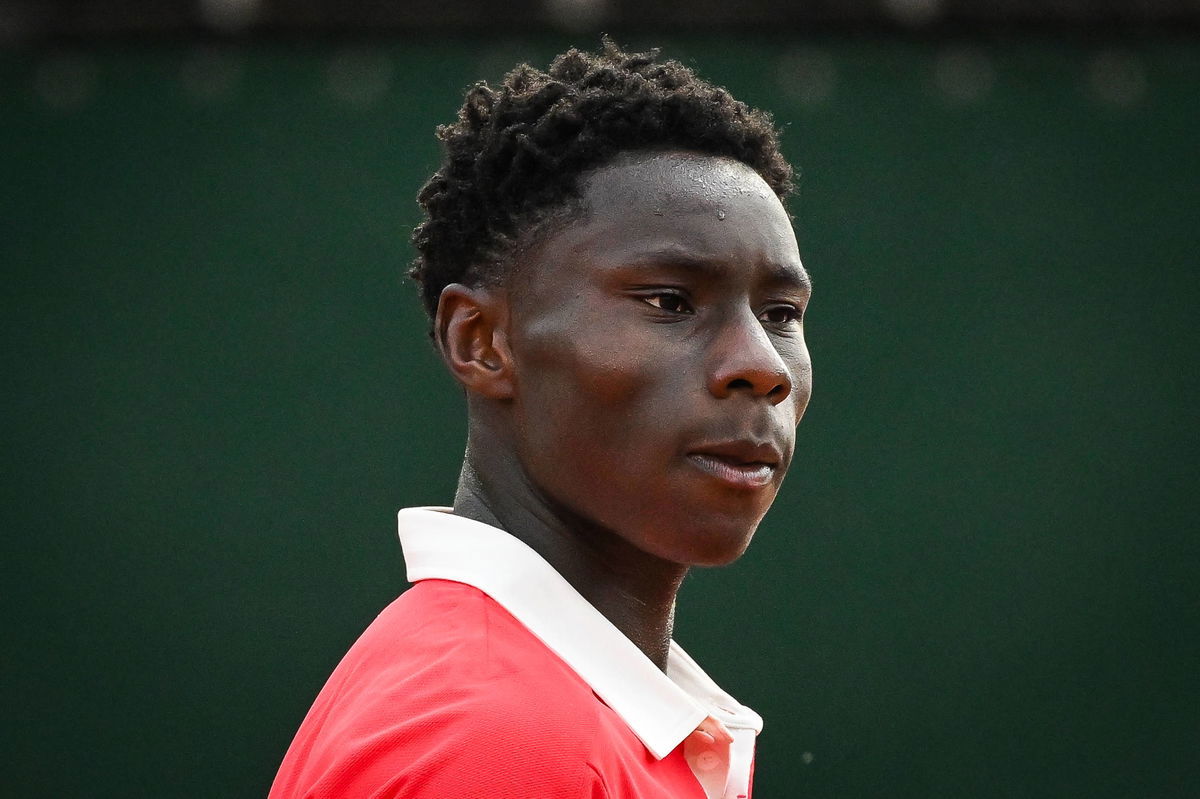
The teenage French sensation, Moïse Kouamé, has already earned more prize money at this tournament than in his entire career combined. After defeating Adolfo Daniel Vallejo in the second round of the French Open, he is entitled to nearly $220,000. However, what stands between him and the prize money is nothing but his age.
Watch What’s Trending Now!
Mike Hayden, producer of Andy Roddick’s podcast Served, raised the issue first on the evening of Kouamé’s second-round win. “He can’t even collect his winnings because he’s not 18 yet,” Hayden said on the latest episode of the podcast. “There’s a French law that you can’t collect the prize money until you turn 18.”
To this, Roddick replied, “He better be getting an interest rate while the government keeps that bag.”
Kouamé turned 17 in March and, in May, was given a wildcard into the main draw of the French Open. After an epic match against Vallejo that lasted for over five hours, Kouamé became the youngest male player to reach the third round of a Grand Slam since Rafael Nadal at Wimbledon in 2003.


French law may prohibit 17-year-old Moïse Kouamé from being able to access the nearly $220,000 he's won so far at the French Open. @FOS frontofficesports.com/lawyers-explai…
Before the French Open, Kouame had a total of $175,637 in his career earnings. However, this situation and its legality are a bit more nuanced. According to Article 382 of the French civil code, a minor is not allowed to manage his own assets unless he is emancipated, an exceptional situation that occurs only when the parents give him their authorization. The money itself doesn’t disappear but goes to Kouamé’s legal administrators, which practically means his parents.
When Front Office Sports reached out to Claire Germain, a France-educated lawyer, for more information about the legal aspect of the situation, they found out that Kouamé’s case may fall under Article L. 7124-9 of the French Labor Code, and under this provision, the winnings of minors like Kouamé would be placed in a special savings account under their name and be accessible by legal representatives for living or career expenses, per FOS.
His agent, Daryl Monfils, brother of French veteran Gaël Monfils, pushed back on early reports, calling the framing “wrong information.” However, several French legal experts told Front Office Sports that Kouamé will almost certainly not receive the money directly before he turns 18 in March 2027.
While Moïse Kouamé Advances, the Big Names Keep Falling
While the French Open has been losing some of its biggest names at an alarming rate, Moïse Kouamé, ranked outside the top 300, has qualified for the third round.
Jannik Sinner, the world No. 1, suffered a shock second-round defeat by Juan Manuel Cerundolo after a controversial medical timeout dominated the headlines. World No. 9 Taylor Fritz was beaten in the first round by wild card Nishesh Basavareddy. Second seed Elena Rybakina was eliminated in round two by world No. 55 Yuliia Starodubtseva. 2021 US Open champion Emma Raducanu lost 6-0, 7-6(4) to Argentina’s Solana Sierra on day one. Novak Djokovic, the 39-year-old, 24-time Grand Slam winner, also fell in the hands of Joao Fonseca in an epic five-setter.
Amidst all that mess, a wild card 17-year-old still stands. Kouamé’s next test will be against Alejandro Tabilo, who advanced via walkover and will be well rested. The legal question over his prize money will be answered in time, but what he has done this week, walking into Roland Garros as one of the youngest players in the draw, is something French tennis will be talking about for a long time after the tournament is over.