
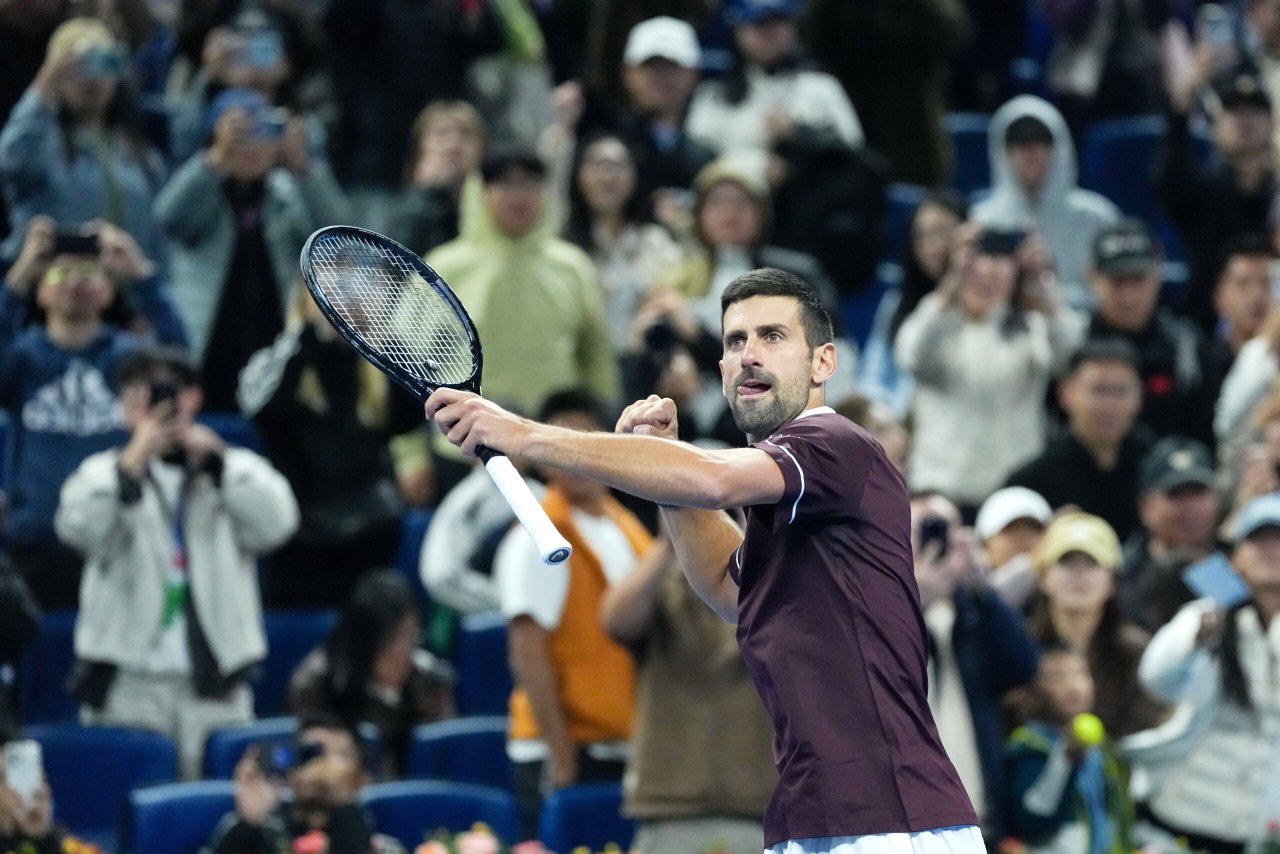
On Friday night, as Novak Djokovic stood across the net from 24-year-old Chinese wildcard Bu Yunchaokete, spectators in Beijing were quick to switch allegiance from their home favorite to the player who has never lost at the China Open. Roughly 15,000 fans at Beijing’s National Tennis Center were behind the Serbian, pushing him across the line and ensuring that his perfect record remains intact.
Watch What’s Trending Now!
Bu came closer than anyone ever has to changing that. He took the first set 6-4, which ended Djokovic’s run of 30 straight sets won in Beijing, per the China Open, and pushed the 39-year-old to nearly three hours before falling 6-4, 6-7 (2-7), 2-6. Asked afterward whether it hurt to hear his own supporters back his opponent, the world No. 104 was remarkably gracious.
“Of course he has committed so much to this industry, he has done so much for this industry, put tennis on a higher level. The number of Grand Slams he has won, he is number one in history. Of course he deserves respect,” Bu said.
He called the atmosphere normal for Djokovic anywhere, the United States and Europe included, said he had prepared for it mentally, and signed off with “I thought he deserved this. Nothing to complain on my side.”
Then came his awe as the question moved from the stands to the court.
Djokovic let a break lead slip in the second set and was also forced to take a medical timeout during the match. The treatment appeared to be for an issue around his ribs, the same area that had required attention during his first-round match on Wednesday. But it didn’t seem to bother him for long. Djokovic took control of the tiebreak and then broke Bu twice early in the third set, racing out to a 4-0 advantage. The 39-year-old eventually wrapped up the win on his second match point, finishing things off with a crosscourt backhand. He hit 15 aces without a single double fault and won 107 points to Bu’s 90. The Chinese player was left drained by the effort and said so openly.
“I am shocked by him. This is a 40-year-old man I’m facing,” he said, rounding up Djokovic’s age. “In more than two hours, there’s no decline in his energy. I’m a 24-year-old, but I’m exhausted. My level dropped, but he was just starting.”
The defeat still brings some reward for the Chinese wildcard, whose run to the second round will lift him back inside the top 100.
For Djokovic, such welcome has been hard to come by
Interestingly, before the match Djokovic had joked that playing a Chinese opponent in China “is definitely not fun” and predicted Bu would get plenty of support. The forecast, though, missed; chants of “Let’s go, Novak!” echoed through the evening, providing Djokovic with a much-needed surge of energy during the second set.
Djokovic’s love affair with China is easy enough to understand when you look at his record.
Djokovic won the China Open in 2009, 2010, 2012, 2013, 2014 and 2015, missing only 2011 through injury. He won his first Olympic medal, a bronze, at the same venue in 2008, and later took four Shanghai Masters titles between 2012 and 2018.
His last Beijing match before this week was the 2015 final against Nadal. Then came an 11-year gap. He said scheduling had kept him to Shanghai alone and that this time Beijing “was on the priority list.” Fans hence swarmed his practice session on Monday, as he called his Chinese supporters the “NoleFam” and named them his best memories from the country, ahead of the trophies.
The funny part is that he’s never exactly been a fan of playing in such heat and humidity, even once calling Shanghai’s conditions “brutal.” Yet, China has always felt strangely comfortable.
Despite growing up in the Balkans, Djokovic has picked up some conversational Mandarin over the years and seems genuinely fascinated by the culture. This week in Beijing, he even took a break from tennis to try tai chi by Kunming Lake and have a go at Chinese calligraphy, writing his name in Chinese characters.
At this stage of his career, he said, he wants tournaments where he feels “welcomed by the fans in a positive way.” And it’s pretty easy to understand why.

Imago
March 11, 2026, Indian Wells, California, USA: NOVAK DJOKOVIC of Serbia waves at the standing ovation crowd after being defeated by Jack Draper of Great Britain during their round of 16 match at the BNP Paribas Open at Indian Wells Tennis Garden on March 11, 2026 in Indian Wells, CA. Indian Wells USA PUBLICATIONxINxGERxSUIxAUTxONLY – ZUMAl140 20260311_aap_l140_019 Copyright: xShelleyxLiptonx
The reception on Friday night was important for a player who has spent two decades of his career as an ‘anti-hero’. Djokovic was usually looked at as an outsider during the era of the ‘Big Three’ as he broke the beloved duopoly of Roger Federer and Rafael Nadal. Crowds frequently sided with Federer or Nadal when Djokovic faced either man.
In the 2019 Wimbledon final, which lasted nearly five hours, the crowd backed Federer, and Djokovic said he told himself the chants of “Roger” sounded like “Novak” to get through. John McEnroe even compared him to Darth Vader next to the more beloved Federer and Nadal.
Over time, though, Djokovic came to frame that reception less as hostility toward him and more as an expression of the affection fans had for Federer and Nadal. With Federer and Nadal now retired, Djokovic has increasingly become the link between that era and the next generation.
The win moved Djokovic to 31-0 in Beijing, equaling Rafael Nadal’s 31-0 start at Roland Garros as the longest unbeaten run from a tournament debut in the men’s Open Era. Nadal’s streak ended when Robin Soderling beat him in 2009. And after beating top seed Alexander Zverev 4-6, 6-4, 6-4 to reach the semi-finals, he has now effectively moved past Nadal’s record.
“These are the kind of moments that I still play for, compete for,” Djokovic said after his win over Zverev.
“The motivation is big when you are feeling good and competing at par with the best players in the world, in front of 15,000 people. These are the kind of moments that define dreams, I think, of every tennis player. It’s been a struggle this year, to be honest, for different reasons, but I’m still there, still grinding, still making the youngsters work for their money. I’m just glad to push it through.”
Considering both tours, the record belongs to Monica Seles. She won her first 33 matches at the Australian Open, earning her four titles before Martina Hingis defeated her in the 1999 semifinals. Against Bu, he also became the oldest ATP 500 quarterfinalist since the category began in 2009.