
Imago
Silhouette von Eva Lys GER beim Aufschlag,von oben, Australian Open 2025, Melbourne Park, Melbourne, Victoria, Australia. Australian Open 2025, Australia. *** Silhouette of Eva Lys GER serving, from above, Australian Open 2025, Melbourne Park, Melbourne, Victoria, Australia Australian Open 2025, Australia Copyright: xJuergenxHasenkopfx
Imago
Silhouette von Eva Lys GER beim Aufschlag,von oben, Australian Open 2025, Melbourne Park, Melbourne, Victoria, Australia. Australian Open 2025, Australia. *** Silhouette of Eva Lys GER serving, from above, Australian Open 2025, Melbourne Park, Melbourne, Victoria, Australia Australian Open 2025, Australia Copyright: xJuergenxHasenkopfx
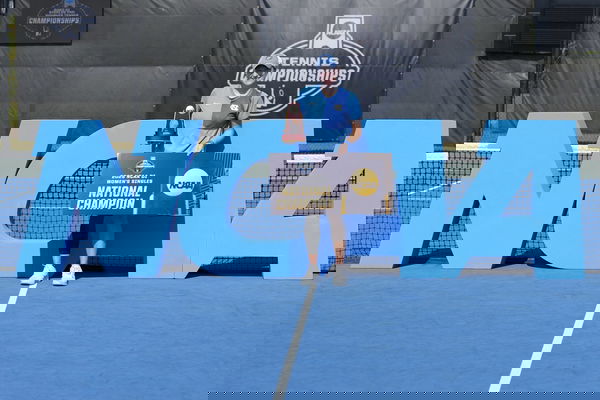
American rising talent Reese Brantmeier recently etched her name into college tennis history, winning the NCAA women’s singles title with a dominant straight-sets performance over Berta Passola Folch of UC Berkeley. Competing for the University of North Carolina, the 21-year-old showcased poise well beyond her years. But her victory alone isn’t news, as the American is currently suing the NCAA over its prize-money rules.


Reese Brantmeier has quickly become one of the biggest names in college tennis. At 21, she has already earned the ACC Player of the Year award and received All-American honors in both singles and doubles this season. With a solid 6-3, 6-3 win, she secured the NCAA women’s singles title and showed her growth and confidence.
Watch What’s Trending Now!
However, her success on the court is matched by a battle off of it. Brantmeier is part of a class-action lawsuit against the NCAA. The lawsuit challenges a rule that limits athletes to $10,000 in prize money per year before they enroll in college. She argues that the restriction is unfair.
Brantmeier studies at the University of North Carolina. She is a senior with a double major in exercise science and studio art, along with a minor in global cinema. Before college, she played in the 2021 US Open as a high school student. She earned $50,000 but was allowed to keep only $10,000 because of NCAA rules.
Imago
November 23, 2025, Orlando, Florida, USA: 11/23/25 2025-26 Reese Brantmeier UNC defeats Berta Passola Folch Cal 6-3, 6-3 to win the Womenà s Tennis NCAA, College League, USA Individual Championships at the USTA National Center in Orlando, Florida. Orlando USA – ZUMAd212 20251123_zsp_d212_055 Copyright: xRichardxDolex
Once enrolled, the rules became even stricter. College athletes can only accept prize money equal to actual costs, such as travel or equipment. Anything extra must be forfeited if they want to stay eligible to compete. Brantmeier says this creates a financial burden for athletes who perform well in professional tournaments.
In March 2024, she filed a federal lawsuit claiming the NCAA’s prize money limits violate antitrust laws. She also pointed out a contradiction. Athletes are allowed to earn from NIL (Name, Image and Likeness) deals, yet cannot keep money earned through competition.
In August, the case moved forward when U.S. Chief District Judge Catherine Eagles approved class-action status. The trial is scheduled for late 2026.
Despite the legal battle, Brantmeier continues to shine on the court and recently shared her joy and pride after becoming an NCAA champion.
Reese Brantmeier hails NCAA title as ‘pinnacle of college tennis’
College athletes in many sports can earn huge amounts of money through sponsorships, appearances, and advertising. Some make even 7 figures before they even graduate. However, tennis players face a different reality. If they want to maintain NCAA eligibility, they cannot keep all their prize money from major tournaments like the US Open.
This inequality became a key point in Reese Brantmeier’s lawsuit as stated by her lawyer.
“The NCAA’s arbitrary rules restrict the amount of prize money that student-athletes competing in tennis may accept, causing anticompetitive harm to the markets for their labor and reducing their earning ability.“
And after winning the NCAA championship, Brantmeier acknowledged the irony. “A few people have pointed it out to me.”
“This title is so meaningful, this is the pinnacle of college tennis,” she added. “It’s a great accomplishment, independent of some of our legal disagreements.”
With the championship trophy now hers, Brantmeier is enjoying the moment. Still, many eyes remain on her case.
As the lawsuit continues, the outcome could shape the future for college tennis players nationwide. What do you think? Let us know in a comment.
Written by

Edited by

Sowmya Anantharaman