
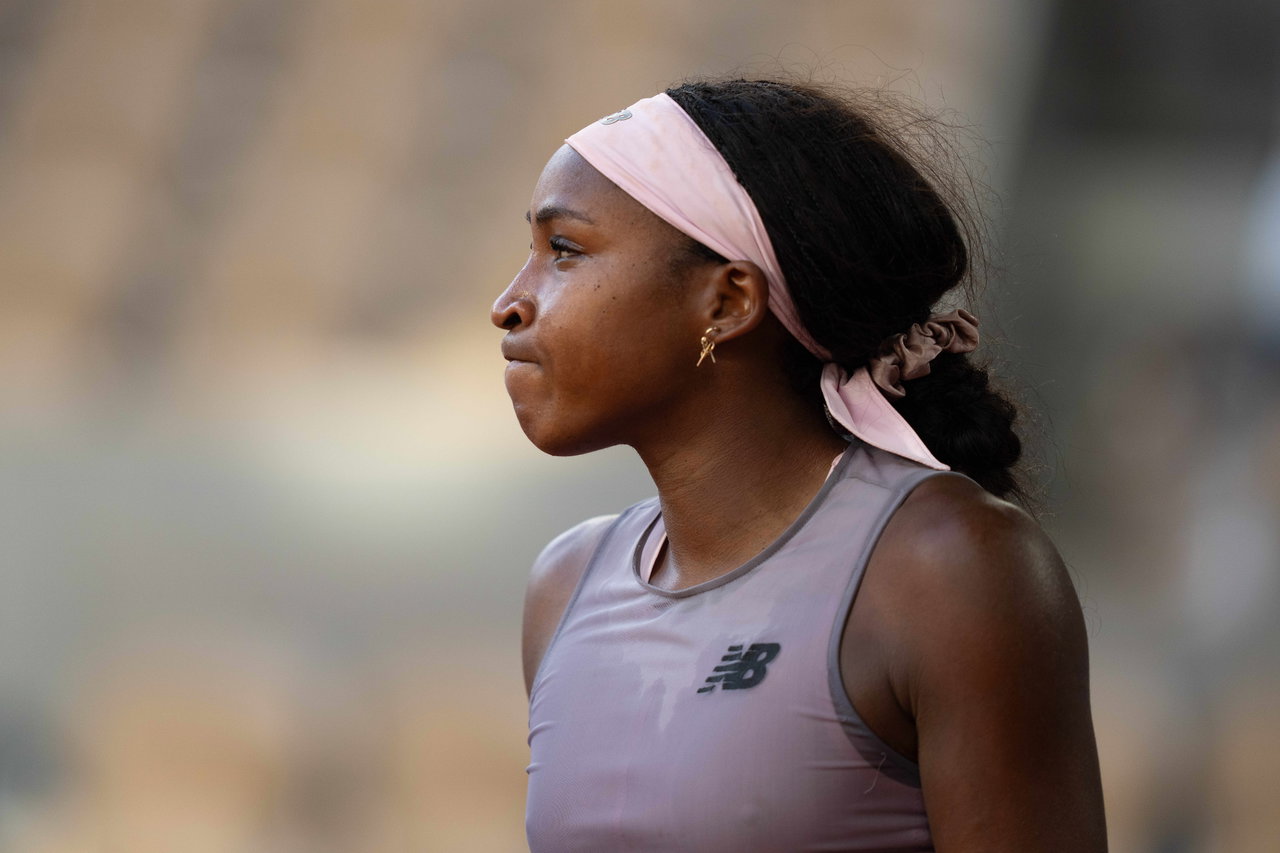
Coco Gauff had opportunities. She knew it as she walked off the court, in front of the press, and unsolicited. The defending champion lost to Anastasia Potapova, 6-4, 6-7 (1), 4-6, but the result wasn’t the only thing that hurt. It was the familiarity of it.
Watch What’s Trending Now!
“I feel like I’m practicing well, and when the moments get there, I’m not quite translating that. I do it at times, and then I also don’t do it. I think it’s just a learning experience, and hopefully when I’m in this position again I can make better decisions,” she said in her post-match press conference.
One of the biggest frustrations of Gauff’s clay-court delivery is the difference between what she practices and matches up to. She was the defending champion at the French Open with a 20-7 season record, but has not won a title since the Wuhan Open in October 2025. Miami and Rome both ended in final losses. And now, in Paris, it is a third-round exit to the 28th seed. The losses begin to take a toll and form a pattern she can’t ignore.
“I lost the same way in Rome as I did here, which is not good. You never want to lose the same way back-to-back times, and I did. And I feel like also in Madrid it was a similar thing, losing the same way.
It’s one thing to lose, but today I competed, I fought my hardest, but I don’t think I played the way I wanted in the crucial moments,” Gauff explained.
The match was filled with such evidence. Early in the third set, when Gauff had broken to lead 3-1, she had break point opportunities that she failed to convert. She was down 5-4 in the third set, and up 3-0, only for Popatova to win it back the hard way, scoring the next four points.
“I had a couple of break points and missed, I think, two backhands or three backhands, which just can’t happen in that scenario,” she said.
She also lost the leads she earned. She led 5-2 in the third, then saw it slip to 5-6. The tiebreak in the second also slipped away. “From 5-2 to 6-5 I played great, and after that the tiebreaker was really bad,” she admitted.
What struck her was a recurring mental pattern that she identified clearly but had not yet solved. “When I see the momentum is on my side, I should keep putting my foot on the gas instead of maybe letting up a little bit and I think that’s what I did,” Gauff stated.
She also recognized that Potapova’s volatility made the match difficult to manage psychologically. “Most players, when they have the lead, especially against me, kind of get a little bit tight. But when you lose a lead and you’re playing from behind you’re a lot more free because you’re just like, whatever. And I think I need to have that same mentality when I’m behind to get back into the lead, and figure out how to make that mental switch of keeping that level of play when I do have the lead,” the American added.
On the serve, she was candid about the gap between process and outcome. She acknowledged the serve was more consistent than it had been, but then took a step back.
“I guess who cares how many serves I make in the court if the result is still the same,” she said.
She added that she could have been more aggressive with her patterns at key moments and simply did not follow through on what she worked on in practice.
The defending champion status, she insisted, was not the issue this time. The weight of the title did take a toll at the U.S. Open last year, when she exited the tournament as the reigning champion in the fourth round against Naomi Osaka.
“At the US Open, it did a lot more, but honestly, this time it didn’t. I wasn’t really nervous. I learned from my US Open experience.” That, in its own way, made the loss harder to process. “That’s what’s more frustrating. Because I felt like I learned a lot from that US Open experience and I’m a better player since then, and I just don’t think I portrayed that today,” Gauff concluded.
The same question keeps coming up in Madrid, in Rome, and now in Paris. For a player who has been able to find a solution when the challenges have been the toughest, it’s a question she can’t afford to leave unanswered heading into the grass season.
Gauff Turns Attention to Wimbledon With Questions Still Unanswered
The clay swing is over, and the grass season begins. Serve has been one of the strongest weapons of Coco Gauff’s game, and with a surface change, it might just suit her more. She admitted the same in response to the question about the upcoming tournament.
“Obviously the grass I think will help a little bit more. I have a lot of trust now in my serve but at the same time I got broken a lot of times and I have to correct that,” she said, while adding that the same fundamentals still need fixing.

Imago
Sport Themen der Woche KW26 Sport Bilder des Tages 210702 — LONDON, July 2, 2021 — Coco Gauff of the United States competes during the women s singles second round match between Coco Gauff of the United States and Elena Vesnina of Russia at Wimbledon Championship in London, Britain, on July 1, 2021. SPBRITAIN-LONDON-TENNIS-WIMBLEDON-DAY 4 HanxYan PUBLICATIONxNOTxINxCHN
The serve can be played at Wimbledon. Gauff’s issue at the French Open, the inability to translate what she practices into the actual match, is not surface-exclusive but rather a mental one. She has now lost three in a row in the same style in Madrid, Rome, and Paris. In Madrid, she let a lead go. In Rome, she went to the final and lost. At Roland Garros, she was the defending champion and went out in the third round. Every time, same story. She competed. She had her chances. She didn’t take them at the right time.
There’s really no easy solution to that. Coco Gauff is a two-time Grand Slam winner at just 22; one of the most mentally mature players on the tour, in terms of her age. She has been through it before, had form dips and losing streaks, but she has made it through. The 2023 US Open title was won after a tough clay campaign. She then faced questions about her ability to make it to the farthest in a major tournament before winning the 2025 Roland Garros championship. She has answered doubts in the past.
But when she was talking about the specificity of giving up leads, the pattern of not taking break points, the drop in tiebreaks, in three consecutive tournaments on three different conditions, there’s something she has to address structurally rather than simply reset from.
The world No. 4 will head into Wimbledon as one of the favorites. It will have a huge impact on how her grass swing plays out if she arrives with a correct understanding of what is wrong, or if she arrives with a wish that a surface change would obscure it. The grass will help a little bit more, she said. It might. But the moments she keeps talking about happen on every surface, and they have not changed yet.