

Dressed in white, covered in clay, and smiling through every frame: that’s how Carlos Alcaraz looked during his recent photoshoot for Vanity Fair. The Spaniard was featured on the cover, with the magazine calling him the “King of the Courts,” a title the 22-year-old seemed to embrace with ease.
Watch What’s Trending Now!
From the outside, it all looks like the life he dreamed of – success, recognition, and the spotlight. But behind all of that, Alcaraz also spoke about the side people don’t often see. During the interview, the World No. 2 opened up about some personal aspirations he feels he missed out on, sharing a few honest confessions about the life he never quite got to experience away from tennis.
What regret is Carlos Alcaraz confronting?
Ask an average 22-year-old man in Spain what his daily life looks like, and the answer would probably sound familiar and balanced. He would likely be managing university studies, vocational training, or an entry-level job while still making time for friends, family, travel, and late-night social gatherings.
For Carlos Alcaraz, however, life at 22 has looked completely different. While millions admire the trophies, fame, and global success surrounding him, the Spaniard quietly admits there is something deeply personal he feels he has missed along the way.
“I sometimes wish I could have more moments for myself, to do things a 22-year-old guy would do,” he revealed during an all-Spanish interview with fellow Spaniard and Style Correspondent, José Criales-Unzueta, for Vanity Fair.
View this post on Instagram
Behind the smile and success, the statement carried the weight of sacrifice that elite athletes rarely discuss openly.
There are several reasons why that regret continues to follow him. One of the biggest issues has been the demanding tennis calendar, something Alcaraz has repeatedly criticized over the last year.
Back in October 2025, when asked about complaints from players regarding scheduling pressure, Alcaraz openly agreed that the tour demands too much from athletes physically and mentally.
“I think that the schedule is really tight. They have to do something with the schedule. I think there are too many mandatory tournaments, too many in a row,” Alcaraz said at the time. His comments immediately fueled wider debates around burnout, exhaustion, and the nonstop nature of professional tennis.
Despite those concerns, critics pointed out that Alcaraz still participated in several exhibition events, including the Saudi Arabian-backed Six Kings Slam. That contradiction drew criticism from some fans who believed he was saying one thing while continuing to add matches to his calendar.
Even so, his opportunities to truly disconnect from tennis have remained extremely limited. Between tournaments, media obligations, sponsorship commitments, and recovery periods, Alcaraz has spent most of his early twenties inside one of the sport’s most demanding routines.
On the court, however, his achievements at such a young age have already become historic. Alcaraz opened the 2026 season with an extraordinary run, winning two consecutive tournaments and completing his career Grand Slam. He built a dominant 16-0 record through Melbourne and Doha before Daniil Medvedev finally stopped him at the Indian Wells Masters.
After that defeat, Alcaraz entered the Miami Open with a first-round bye and faced Brazilian sensation João Fonseca in the second round. However, his campaign quickly unraveled when American Sebastian Korda eliminated him in the third round.
Still, history already belongs to him. On February 1, 2026, Alcaraz became the youngest male player ever to complete a career Grand Slam, surpassing Don Budge, who achieved the feat just before turning 23 in 1938.
Alcaraz accomplished it before even reaching his own 23rd birthday in May, and despite the regrets surrounding the life he missed at 22, his words still echo with gratitude: “I know I’m living a dream life, a life I dreamed of.”
Mental health challenges remain a constant concern for Carlos Alcaraz amid mounting pressure
Tennis has become an endless cycle for Carlos Alcaraz, and lately, the emotional exhaustion has started showing more openly than ever. Since the beginning of the year, the Spaniard has barely managed to spend even a couple of weeks at home in Murcia between tournaments, obligations, and nonstop travel.
His schedule has dragged him across continents without pause. From South Korea, where he played an exhibition match with Jannik Sinner, to the Australian Open, and then onward to Bahrain for Formula 1 preseason activities before heading to Qatar for the Doha ATP 500.
From there, the grind continued with back-to-back Masters 1000 events in the United States. Every week brought another flight, another court, another expectation, and another spotlight waiting for him.
Whenever Alcaraz briefly returned home, he tried to make the most of it. He spent time with family, met friends, and occasionally escaped for karting sessions, but even those moments disappeared quickly under the pressure of professional tennis.
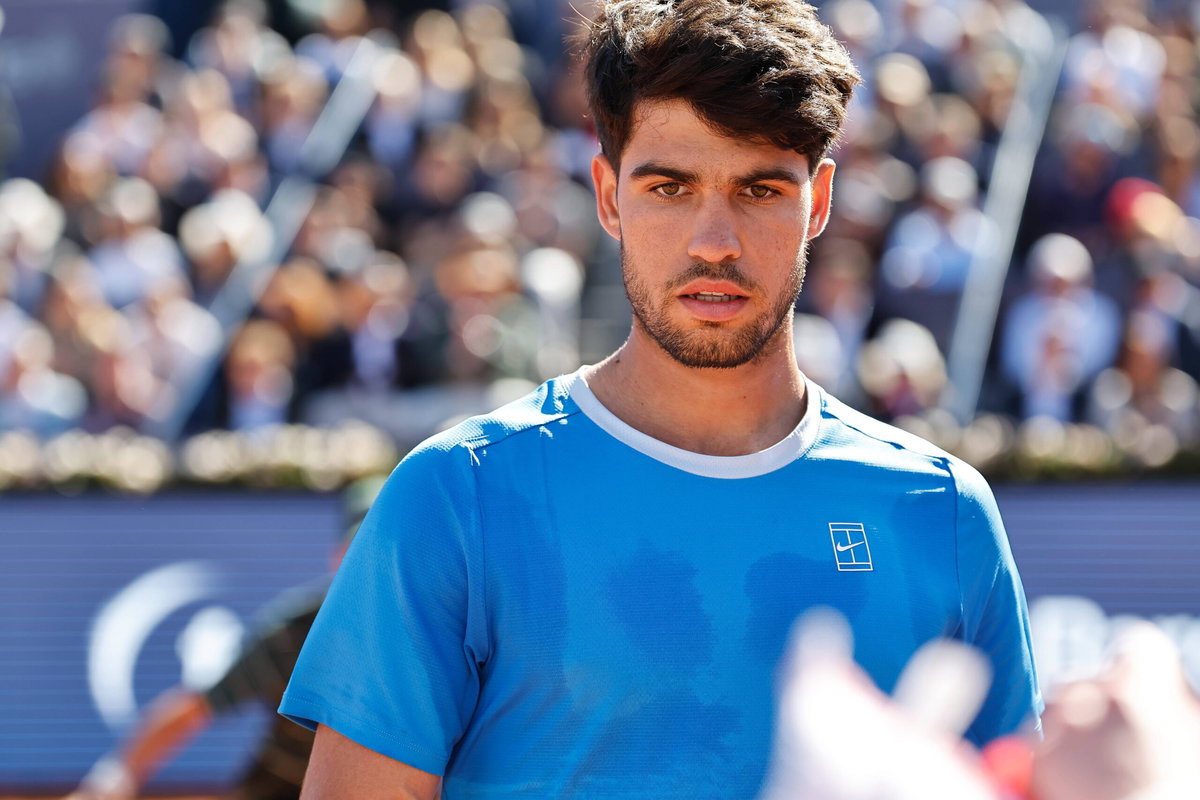
Imago
Carlos Alcaraz ESP, APRIL 14, 2026 – Tennis : Carlos Alcaraz during singles 1st round match against Otto Virtanen on the Barcelona Open Banc Sabadell tennis tournament at the Real Club de Tenis de Barcelona in Barcelona, Spain. Noxthirdxpartyxsales PUBLICATIONxNOTxINxJPN aflo_326978050
Not long ago, however, things had finally seemed balanced in his life. During Christmas, Alcaraz believed he had discovered a rhythm that made him genuinely happy both on and off the court.
For three weeks, he trained at the courts of his childhood at the Real Club de Campo de Murcia. Surrounded by family, close friends, and familiar surroundings, he looked happier than ever while sitting at the top of the tennis world.
Without constantly traveling to Valencia to work with former coach Juan Carlos Ferrero, Alcaraz felt mentally and physically connected again. Life seemed lighter, calmer, and more complete, something he later reflected in his impressive performances at the Australian Open.
But that peace did not last very long. The joy and balance he once felt now seem distant memories as the demands of the tour slowly consumed him once again.
Everything finally exploded during his third-round loss at the Miami Open against Sebastian Korda. Furious with himself, emotionally drained, and overwhelmed by the endless cycle of competition, Alcaraz reached a breaking point.
Tennis, tennis, and more tennis.
That feeling had clearly built up for months before the frustration erupted publicly. During the match, Alcaraz could no longer contain the emotional exhaustion tearing through him.
“I can’t take it anymore! It’s non-stop! I want to go home now! I can’t take it anymore! I can’t take it anymore, man! I can’t take it anymore!” he shouted before eventually confirming defeat. In that moment, the calm and inner peace he once believed he had found was completely shattered.
The most painful part is that nothing dramatic had really changed around him. His desperation against Korda instead served as a warning that no matter how successful things appear externally, mental exhaustion can quietly continue growing underneath.
Now, away from the court, Alcaraz has openly admitted that he desperately needs time for himself and especially for his mental health. Looking back at the nonstop pressure, he confessed, “There’s been times in which I didn’t stop to take a break,” he says, “and that led to me not playing well, or becoming injured, or… Let’s just leave it at that, that it didn’t end well.”
He later emphasized how important recovery is beyond physical training alone. “I think it’s just as important, or more, than taking care of your body. There’s people who are, fairly so, obsessed with body aesthetics, but to me it’s just as important to take care of your head.”
For Alcaraz, the relentless tennis calendar remains one of the biggest reasons why protecting mental health has now become impossible to ignore.
Alcaraz battles relentless stress through tennis’ exhausting demands
Constant scrutiny has become an unavoidable part of Carlos Alcaraz’s life, especially after achieving extraordinary success at just 22 years old. Every performance, every loss, and even his personal choices now attract intense public discussion.
One clear example came after his defeat to Sebastian Korda at the Miami Open. The loss quickly sparked criticism and analysis from several figures inside the tennis world.
Among them was renowned French coach Patrick Mouratoglou, who questioned Alcaraz’s motivation during the tournament. “The guy has already seven Grand Slams, and I feel like playing Masters 1000, he won so many already, he’s not that interested,” Mouratoglou said while discussing Alcaraz’s defeat.
The comments immediately fueled wider debates around pressure, motivation, and burnout at the top level of tennis.
The scrutiny surrounding Alcaraz has not remained limited to his performances on the court either. Even the way he spends his free time has started becoming a topic of public criticism and debate.
Several tennis legends, including Casper Ruud, Roger Federer, and Rafael Nadal, have long enjoyed playing golf alongside their professional careers. For years, the sport has been viewed as a relaxing escape for elite players away from tournament pressure.
However, when Alcaraz began showcasing impressive golf swings that many fans described as some of the best among tennis players, criticism surprisingly followed. Former ATP player Jacopo Lo Monaco openly questioned whether golf was affecting the Spaniard’s focus and preparation.
“Golf may have impacted Carlos. At this level, he must understand he has to make sacrifices,” Lo Monaco said after Alcaraz’s withdrawal from the Barcelona Open. The comments blended criticism of his professional performances with judgment over how he chooses to spend time away from tennis.
The scrutiny feels even harsher considering Alcaraz has already played the highest number of matches during the 2025 season. Despite carrying one of the heaviest workloads in tennis, discussions around his discipline and lifestyle continue following him everywhere.
Speaking openly about the pressure surrounding modern athletes, Alcaraz admitted, “ I think that nowadays we have to be way more careful with what we say, and what we do, but at the end of the day, we’re just human, you know?”
He continued by explaining how exhausting that reality can become over time. “It’s stressful, because you have to think about what you do and when you do it and where you are all the time. But as a person, we have good days and bad days, we wake up sometimes not wanting to do anything, but we still have to show up, and sometimes we don’t react in the way we should.”
Now, with his return to competition expected only after the French Open and without any confirmed comeback date, Alcaraz’s recent feature with Vanity Fair presented a calmer and more reflective side of the Spaniard.
Away from the noise of the court, he instead opened up about how difficult life can become while carrying fame, pressure, and relentless expectations in the shadows.