

The first Open Era Grand Slam semifinal between two Black men delivered on its promise, as Ben Shelton reached his first major final by outlasting good friend and fellow American Frances Tiafoe 4-6, 6-3, 6-3, 7-5 in three hours and 17 minutes. After Tiafoe took the opening set by targeting Shelton’s backhand and attacking the net, Shelton responded by winning the next three sets, carrying the momentum from his five-set win over Carlos Alcaraz into another statement victory in New York.
Watch What’s Trending Now!
A lot of things unfolded during that three-hour, 17-minute semifinal. Here’s the breakdown of five such moments that defined the historic night at Arthur Ashe.
1. A “record” serve that wasn’t quite what it seemed
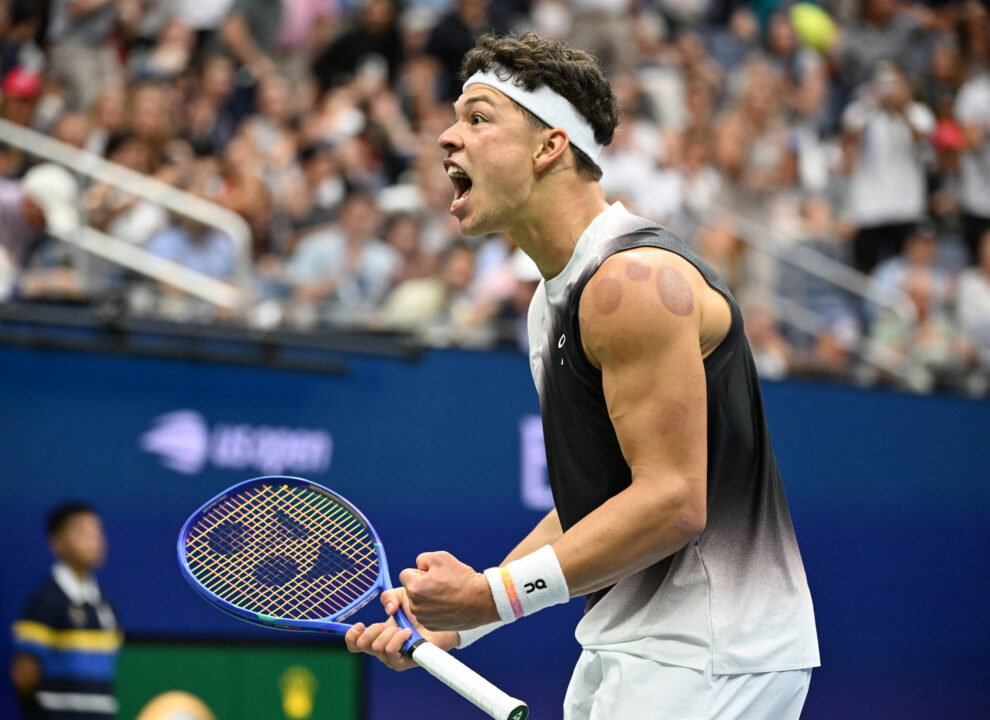
Trailing 2-1 in the third set, the eighth seed unleashed a serve that flashed up at 158 mph, seemingly eclipsing every mark in tennis history. For a few moments, it looked as if Shelton had done something no one had done before. Sam Groth of Australia holds the fastest recorded serve at 163.7 mph, set at a Challenger event in 2012, while John Isner’s 157.2 mph remains the benchmark generally cited for the top level of the professional game. Shelton’s serve would have topped even that if the initial reading had been correct.
It wasn’t. Hawk-Eye and the USTA later confirmed that the 158 mph reading was a miscalculation and that the serve had actually travelled at 144 mph. The US Open subsequently corrected its own post about the speed.
Imago
Ben Shelton Vs Hubert Hurkacz on Arthur Ashe Stadium during The US Open at the USTA Billie Jean King National Tennis Center on September 2, 2026 in Flushing Queens Copyright: xmpi04x
But it was still a night of Shelton’s raw power, as he posted 75 percent first serve and finished with 20 aces. In fact, the 144 mph delivery wasn’t even his fastest serve of the night: Shelton had already reached 149 mph earlier in the match. He also finished with 47 winners, giving the power display some substance beyond the faulty radar reading.
2. The shot clock complaint
With Tiafoe serving at 2-1 in the third set, Shelton pulled the umpire aside with a pointed complaint, telling her the shot clock had run past zero on three consecutive points and questioning why no warning had been issued. According to ATP regulations, players have 25 seconds between points, and a time violation is assessed once that limit expires. The first violation brings a warning; a subsequent violation while serving results in a fault.
Shelton’s frustration was less about Tiafoe gaining an advantage than about how consistently the rule was being enforced. It briefly derailed his rhythm at 2-1 in the third, as the 11th seed saved two break points to hold, but Shelton eventually refocused and closed out the set 6-3.
The issue resurfaced in the fourth set, when Tiafoe was eventually handed a time-violation warning at 2-2. By then, Shelton had already made clear to the chair that he was watching the clock closely.
3. A replayed point that left Shelton fuming
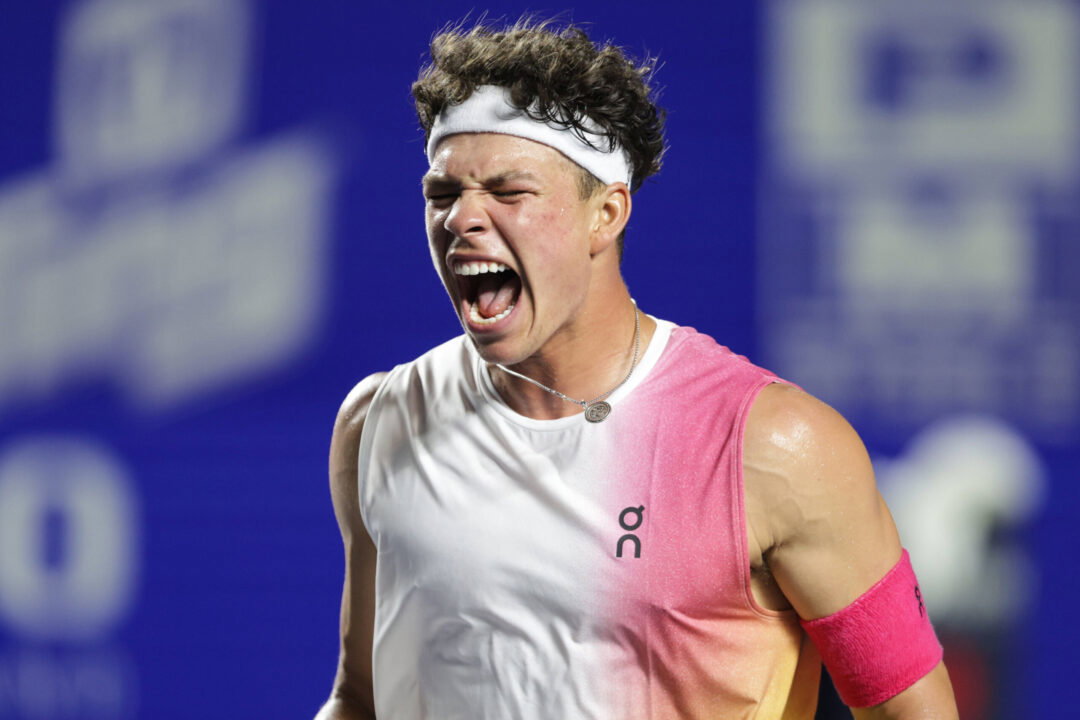
The fourth set produced the match’s tensest confrontation. With Shelton facing two break points in the opening game, Tiafoe raised his hand to stop play, but Shelton served anyway, believing the point was live. Tiafoe disputed the point, and after the chair umpire intervened, it was ordered to be replayed. Shelton was livid.
Imago
Sport Bilder des Tages Sport Bilder des Tages 250225 — ACAPULCO, Feb. 25, 2025 — Ben Shelton of the United States reacts during the men s singles round of 32 match against Flavio Cobolli of Italy at the 2025 ATP, Tennis Herren Mexican Open tennis tournament in Acapulco, Mexico, Feb. 24, 2025. Photo by /Xinhua SPMEXICO-ACAPULCO-TENNIS-ATP-MEXICAN OPEN FranciscoxCanedo PUBLICATIONxNOTxINxCHN
“Why did you not say something then?” he snapped. “You gotta say something immediately.”
The frustration was understandable in the context of the game: Shelton had already saved multiple break points, and the interruption came in the middle of a marathon opening game that ultimately lasted 10 minutes and 12 points. The replayed point went Shelton’s way when Tiafoe failed to convert the opportunity, and Shelton eventually held.
As he headed to the changeover, Shelton snarled toward his box and tossed a ball from his pocket.
4. An emotional aftermath
Frances Tiafoe could not hide his devastation once the match ended, walking off with a towel covering his face as he made his way down the hallway in tears. Meanwhile, Shelton spoke warmly of Tiafoe as a mentor figure.
“He’s like a big brother to me, to be honest,” he said in the post-match interview. “This is both our favorite tournament in the world, our favorite court in the world.”
The moment carried extra weight because this was not the first time the two friends had shared a major stage in New York. Shelton beat Tiafoe in the 2023 quarterfinals, while Tiafoe came back from two sets to one down to beat Shelton in the 2024 third round. Their semifinal meeting was the third time in four years they had faced each other at Flushing Meadows.
He then turned reflective, connecting the win to a family loss earlier in the year.
“My dad, my mom have sacrificed a lot for me to be in this position today,” he said. “My dad lost his mom earlier this year, and she’s the reason that he was able to play tennis. Without her, there’s no Ben Shelton standing here today. So this one is for her.”
Shelton also pointed to how much he has changed since his breakthrough run to the 2023 semifinals. “I think I’ve grown up,” he said. “I’m more mature, more focused. I know what my goal is, I know what my job is out here.”
He also paid tribute to the significance of the date itself, acknowledging the anniversary of September 11 before the crowd.
“And one more thing, it’s a difficult day to be out here playing. My thoughts and prayers go out to all the families who are impacted by 9-11,” he added. “This is one of the greatest, greatest cities in the world and one of the biggest tragedies, but yeah, thoughts and prayers to everyone involved and affected. Thank you guys”
The date had already been acknowledged inside Arthur Ashe Stadium before the match, with a ceremony, a moment of silence and the national anthem marking the 25th anniversary of September 11.
5. Records galore
Ben Shelton is the first Black American man to reach the U.S. Open final in 54 years, since Arthur Ashe himself in 1972, and the first Black American man to reach any Grand Slam singles final in 30 years, since MaliVai Washington at Wimbledon in 1996.
He is also the youngest American man to reach a US Open final since Andy Roddick, who was 21 when he reached, and won, the 2003 final. Shelton’s appearance ends a 23-year wait for an American man to reach the championship match in New York.
He is also the fourth left-handed player of the century to advance to a major final, after Goran Ivanisevic, Mariano Puerta and Rafael Nadal. Adding to that, he even became the youngest player – 23 years and 325 days – outside Europe to reach a Grand Slam final since Juan Martin del Potro in 2009 and the youngest American since Andy Roddick at Wimbledon 2005, per OptaAce.
Shelton had to weather through a tough draw to reach the finals. He only had one straight-sets win in the tournament, which came against former world No. 3 Stefanos Tsitsipas in the round of 16. That ranks him fourth in most games conceded with 105 games on the path to the final this century, trailing only Marat Safin, David Nalbandian, and Milos Raonic.
For Tiafoe, the loss caps what is still the best season of his career, as he joined Alexander Zverev and Jannik Sinner as one of the players to achieve 40 or more match wins in the season, with the Asian swing still to come, and climbed to a career-high ranking of world No. 8. He is still firmly in contention for his first ATP Finals appearance, as he is ranked sixth in the race.
Meanwhile, Shelton will face a daunting final, taking on the number one seed, Alexander Zverev. Both players have faced each other five times in their careers, with all the matches going the German’s way. In total, they have played 11 sets in those five matches, and the American has managed to win only one set. This will be their first Grand Slam meeting, and that too at the US Open.