
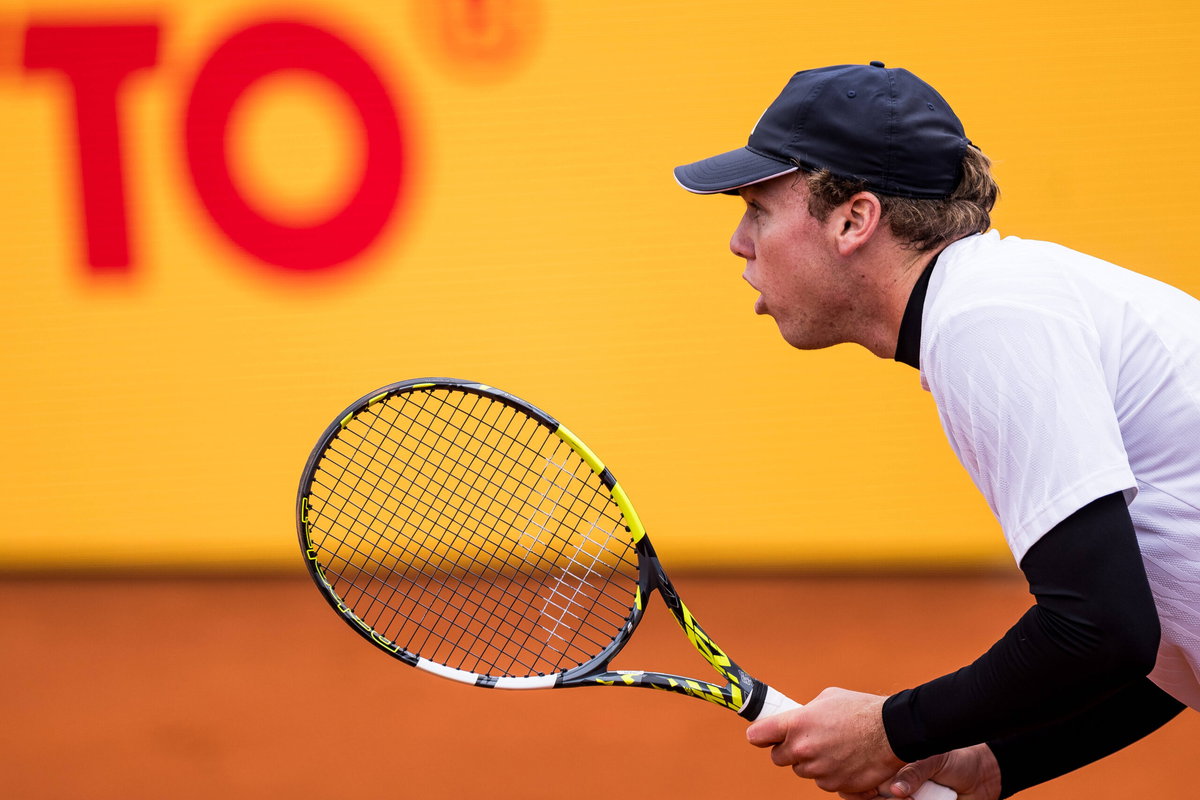
Last week in Nîmes during the UTS, Maxence Bertimon clinched a hard-fought win over Ugo Humbert. But his celebration, a spontaneous somersault, went slightly awry, as his racket slipped out of his hand and flew dangerously close to his opponent, turning it into a classic case of a celebration misfiring. A similar moment unfolded at the BMW Open, where Arthur Rinderknech’s celebration didn’t sit well with Alex Michelsen.
Watch What’s Trending Now!
At a crucial point, Rinderknech celebrated with a loud “come on” after Michelsen sent a returning ball straight into the net while he was positioned at the net. The reaction immediately changed the atmosphere, as the crowd fell silent, sensing the tension building between the two players.
Michelsen showed visible frustration, not only with his shot selection but also with the nature and timing of the celebration from the Frenchman. He quickly approached the chair umpire, clearly dissatisfied, as the moment escalated beyond just a lost point.
The intensity of the match, combined with Rinderknech’s behavior, lifted emotions on both sides and ignited wider debate among fans and observers. It once again brought into focus the thin line between passionate expression and respect, especially in a sport that traditionally values composure.

Kind of hard to be a Rinderknech fan when when he celebrates opponent errors like this Shows a complete lack of class and respect for the game / opponent 👎🏻
The incident did not overshadow the match entirely, but it undeniably became one of the defining talking points of the match. Despite the tension, Rinderknech maintained control on the scoreboard and secured a comfortable 6-3, 6-3 victory to move into the Round of 16.
His path now leads him to a challenging encounter against João Fonseca, setting up another intriguing battle. While this moment reignited debate, tennis has seen similar instances where celebrations after opponent errors have raised questions about sportsmanship.
One such example came last year through German teenager Diego Dedura-Palomero, who drew global attention even before establishing himself fully on the tour. The 17-year-old had initially failed to qualify for the BMW Open main draw after losing to Alexander Bublik in the qualifiers in 2025.
However, he entered the main draw as a lucky loser following the withdrawal of Gael Monfils, which gave him an unexpected opportunity. That opportunity quickly turned historic when he faced sixth seed Denis Shapovalov in the main draw.
Ranked No. 549 at the time, Dedura-Palomero stunned Shapovalov 7-6, 3-0, before the Canadian was forced to retire due to injury. It was a breakthrough moment that placed him firmly in the global spotlight, but the aftermath drew mixed reactions.
The teenager celebrated with visible and raw emotion, roaring loudly, throwing his headband onto the clay, marking a cross on the court, and lying flat on his back with arms and legs stretched out.
While some fans admired the passion and spontaneity, others strongly criticized the celebration, pointing out that it followed an opponent’s retirement due to injury.
The backlash centered on the perception that such an emotional display crossed the line of respect in that specific context. These moments highlight how easily celebrations can become controversial when they intersect with sensitive situations during matches.
And while the ATP circuit continues to deal with such debates, the WTA side has also witnessed similar tension this year.
A second-round Grand Slam match turned chaotic after a mid-match celebration, once again showing how emotional expression in tennis can quickly shift into a wider conversation about etiquette and fair play.
Naomi Osaka apologizes after outburst against Sorana Cirstea at AO
Naomi Osaka is rarely linked with on-court tension, but that narrative shifted after her Australian Open clash with Sorana Cirstea earlier this year. The match ended not just with a result, but with a noticeably frosty handshake and sharp exchanges that caught attention.
The key moment came late in the deciding set, when pressure was at its peak, and every point carried weight. Cirstea was serving at 2-4, 30-30 in the third set, a situation that demanded complete focus and composure.
At that moment, Osaka shouted “c’mon” to herself between Cirstea’s first and second serves, which immediately triggered a reaction. Cirstea felt the timing of the shout disrupted her concentration and broke her rhythm at a critical stage of the match.
She quickly raised the issue with the chair umpire, arguing that the celebration was distracting and interfered with fair play. However, the umpire did not uphold the complaint, allowing the match to continue without intervention.
After the final point, Osaka approached the net with a smile, ready for the customary post-match handshake despite the tension. Cirstea responded with a brief and cold handshake, and the two exchanged a few words near the umpire’s chair before walking away.
Later, during her press conference, Osaka addressed the situation when asked whether she wanted to revisit the confrontation or move forward.
“If I’m being honest, I’ve never been involved in something like this before. I don’t know if we’re supposed to leave it on the court and be like ‘Hey.. how you doing?’ I’m a little confused,” she said.
She then acknowledged the emotional intensity of the moment from her opponent’s perspective and reflected on her own actions. “But I get that emotions were very high for her. I also want to apologize. I think the first couple of things I said on the court were disrespectful. I don’t like disrespecting people. That’s not what I do.”
As similar situations continue to surface, including recent moments on clay in Munich, the broader question around fair play remains unsettled.
When players celebrate during opponent errors, it blurs the boundary between natural emotion and respect, keeping the debate alive across different surfaces and tournaments.