
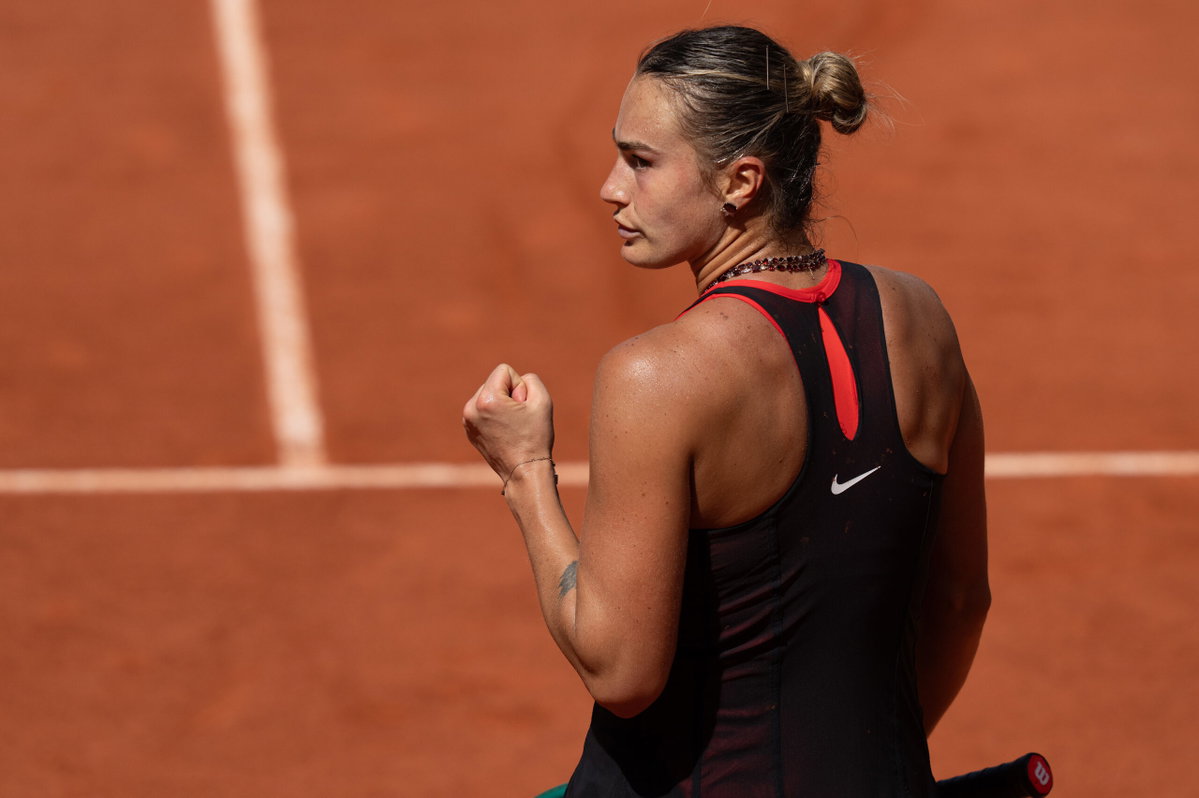
Aryna Sabalenka continued her impressive run at the French Open, cruising past Naomi Osaka 7-5, 6-3 in the fourth round. In doing so, the World No. 1 improved her record against the Japanese star this season to 3-0, once again getting the better of a familiar rival.
Watch What’s Trending Now!
The match also marked a historic moment at Roland Garros, becoming the first women’s singles match in three years to be featured in the night session on Court Philippe-Chatrier. Sabalenka knew exactly what that meant and didn’t hide her excitement, later admitting she was delighted to finally get the opportunity to play under the lights and soak in the unique atmosphere of a Parisian night session.
“I’m mostly happy with the way I served and that I was able to put all the pressure back on her. Happy with the win, it was a very tough one and wow, it’s amazing to play in the night session in front of you guys,” she said during her post-match interview.
Though Sabalenka clearly wants to play more matches during the night session, she knows that the decision is not up to her.
“Yeah, it was my first one and I really want to keep going but who knows, right? But thank you so much for bringing such an amazing atmosphere. You guys truly make this place special. Thank you,” she added.


😍 Aryna Sabalenka : "J'adore jouer en Night Session devant vous." #RolandGarros
The 28-year-old delivered yet another commanding performance against Osaka, continuing the rich vein of form that has defined her season. With the victory, Sabalenka improved her record to 31 wins in her last 34 matches and booked her place in a 16th Grand Slam quarterfinal.
The contest lasted just for an hour and 27 minutes, but the opening set was far more competitive than the final scoreline suggests. With both players locked at 5-5, a tiebreak seemed all but inevitable. However, Osaka blinked at the worst possible moment, dropping serve to hand Sabalenka a crucial break. The World No. 1 then stepped up and calmly served out the set, taking control of the match heading into the second.
The second set appeared to be evenly poised at 3-3. Though Osaka came close to breaking Sabalenka’s serve in the sixth game, the Belarusian managed to escape and level the set once again. Osaka would lose her composure following this game and would have her serve broken on the next two occasions as Sabalenka comfortably clinched the set and advanced to the last 8.
Notably, Sabalenka was also a part of the previous WTA match that had been held during the night session in Paris. She had faced Sloane Stephens in what was again a fourth-round clash at the Roland Garros. Since the one-match sessions had been introduced in 2021, only four out of a possible 60 night-session slots have been given to women. The rest of the slots were mainly dominated by the men’s singles draw.
Multiple WTA stars had come forward and criticized the French Open organizers over their decision to not schedule women’s matches at night. World No. 5, Jessica Pegula had said that it felt like she was “hitting her head against the wall” over the subject.
2017 French Open champion, Jelena Ostapenko had also been highly critical over the tournament’s approach and had questioned why they always prioritize ATP players over them.
“I wish women’s tennis could be shown more in those spots. The men always have the priority with the scheduling, they take the most popular slots, and on bigger courts. I like to play at night – especially when the stadiums are full. I’m the kind of player that really enjoys it when there are a lot of fans watching and I think that’s what we all play for,” she had told BBC Sport.
This sharp critcism against the French Open really begs the question as to why did the organizers take such a decision in the first place.
Why was no WTA match scheduled during the night session for 3 years?
The Roland Garros’ reasoning behind not scheduling any women’s singles match at the night is quite simple. The organizers believe that the audience wouldn’t get their money’s worth if they came to watch a best-of-three-set match. This is because such a match can get wrapped up within an hour if one player dominates over the other.
Unlike other Grand Slams, the French Open only has one standalone night-session match. While many have raised questions over this decision as well, tournament director Amelie Mauresmo had previously said that this was done in order to avoid late finishes. This rule has made it even harder for women’s matches to get a slot at night.
Additionally, the ticket prices for night-session matches are higher than the others and the organizers do not want the crowd to see short matches at such a late time.
While the Grand Slam wasn’t expected to schedule a WTA match at night this year either, they were likely left with no other choice after headline ATP players like Jannik Sinner and Novak Djokovic got knocked out within the first three rounds.
It remains to be seen if the French Open will continue scheduling more WTA matches during night sessions in the coming future.