
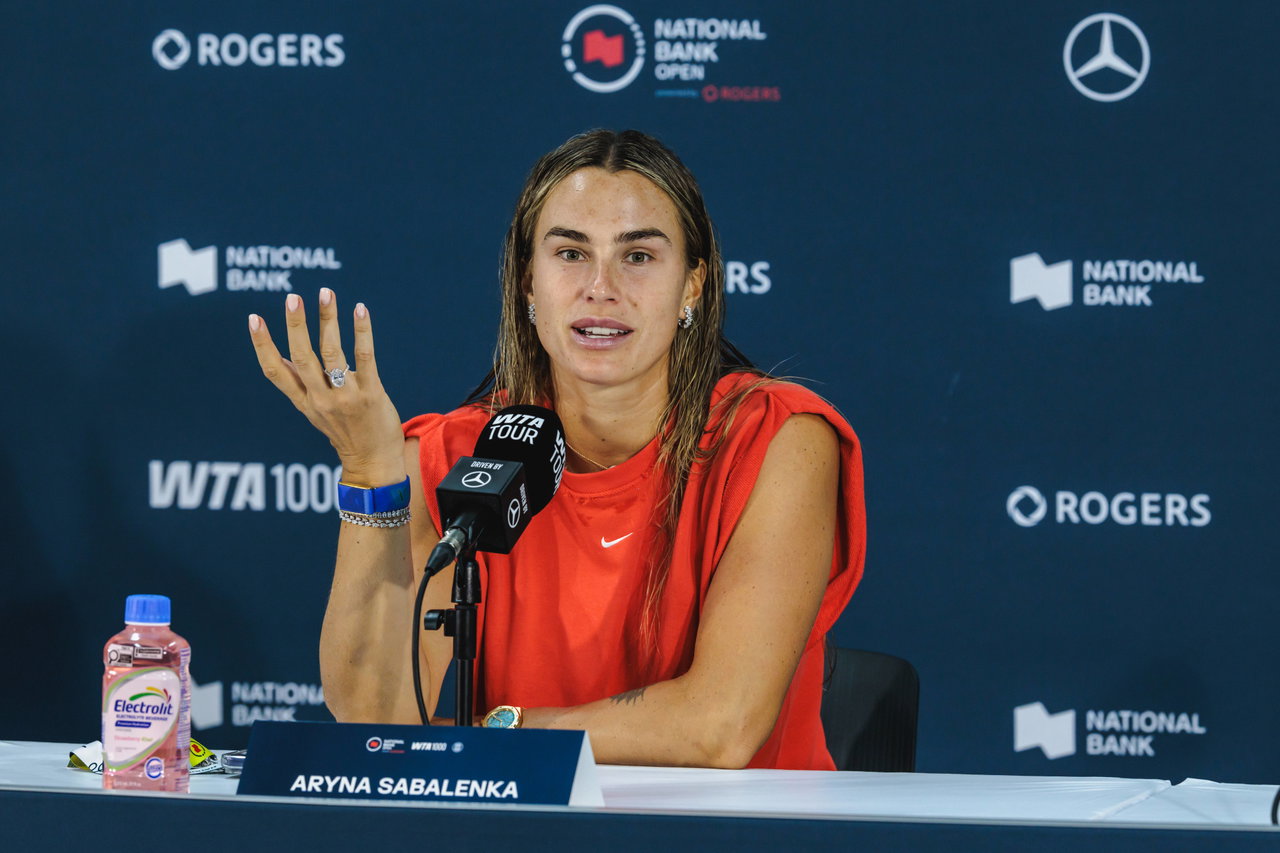
Tennis coach Rick Macci’s diagnosis of Aryna Sabalenka has been building over the season as the former World No. 1 has struggled to sustain her best level. After the French Open, where she led Diana Shnaider 6-3, 4-1 before losing the final 10 games, Sabalenka’s collapse became an early warning sign for Macci. After another 6-0 third-set loss to Jessica Pegula in Berlin, he called the pattern a “red flag.” He further questioned how she could fail to “scrape out a game” despite being “the better player on paper.”
Watch What’s Trending Now!
By the Cincinnati Open, he began pointing to an added factor. “Right now Sabalenka is competing against herself,” he wrote, arguing that her confidence was spinning. Even after her emotional US Open final loss to Elena Rybakina, Macci still said the answer was in her game, saying she could “beat any player any place face to face,” as long as the opponent was not “the one in the mirror.” Now, after the China Open, he seems to have reached a conclusion.
“Sabalenka needs to look in the mirror and she has the answer,” he wrote on X. “She has the game but mentally not the same. She can no doubt flip the switch if she still has the never say die dominate itch. There is a fine line in winning / losing and putting a new trophy on the shelf but the Belarus Bomber has to STOP COMPETING AGAINST HERSELF.”
Despite starting the tournament in Beijing on a high and defeating Renata Zarazua 6-1, 6-3, Sabalenka completely crumbled in the very next match. After being broken in the opening game, Sabalenka created five break-point chances in the sixth game of the opening set but converted none.
Sabalenka dropped the opening set 6-4 and needed a response, but Nikola Bartunkova tightened her grip. Bartunkova broke Sabalenka early again and moved 3-1 ahead, while the Belarusian failed to create a single break-point opportunity in the second set. Her frustration soon surfaced, too, with Sabalenka tossing her racquet after going a break down in the fourth game. Bartunkova, however, stayed composed and eventually broke again in the ninth game to close out a 6-4, 6-3 victory in one hour and 35 minutes for her first career Top-3 win.
Macci had earlier suggested that changes in Sabalenka’s tactical approach and a visible dip in confidence have emboldened the rest of the WTA field. Even for Bartunkova, having already had a close match with Sabalenka in Berlin, she knew she could compete with the former World No. 1, who had spent 99 consecutive weeks at the top of the rankings.
“It tells that I beat a No. 1 player, and she’s a Grand Slam champion,” Bartunkova said. “In Berlin, I had a very close match with her. I knew can play with [top players]. From Berlin, I knew I could do this.”
The China Open loss marked the sixth consecutive match Sabalenka has lost after dropping the first set. Interestingly, the last time she rallied to win after dropping the first set was also against Bartunkova in Berlin.
As for whether she is competing against herself, Sabalenka has spoken about spiraling before. During the French Open, Sabalenka went from being on the verge of a 14th Grand Slam semifinal appearance to suffering a 3-6, 7-5, 6-0 defeat. When she met reporters afterward, she had “no thoughts, no emotions,” before tracing the collapse to what was happening in her mind, while also giving Shnaider credit for making the most of her opponent’s growing volatility.
“I feel like I had very decent opportunities in the second set,” she said. “I screw[ed] up, and then she stepped in and she played great. I feel like mentally I couldn’t really recover after second set. That really … I think that was the biggest mistake from me.
“I don’t know when was the last time that happened to me that I lost 10 games in a row. I guess mentally I got into very deep, deep, dark hole over there, and I just couldn’t get back mentally on track.”
And after losing to Naomi Osaka at Wimbledon, she stepped away from tennis for about a month, went on vacation to Mykonos, and said the break helped her feel better both physically and mentally. When she returned, she said she had gone “back to basics” in practice: lots of crosscourt rallies, rebuilding confidence in her baseline game, and only then adding variety.
She was a lot more hopeful after that. At the US Open, after a strong second-round win, she explained that she was “moving away from trying to be perfect on court” and focusing on working with what she had that day. She also said she felt mentally and physically stronger than she had in the middle of the season. By the semifinals, after beating Jessica Pegula 7-5, 6-2, she added that she had been “super desperate” to turn her season around.
But then against Elena Rybakina, Sabalenka lost 6–4, 5–7, 6–2, ending her attempt at a third consecutive US Open title. During that match, she smashed a ball into the stands and received a warning, shouted at herself, smashed a racket against the ground, and later destroyed another racket in the locker room. Later on, she did say that the lessons from the season had already made her stronger and would motivate her going forward, but per Macci, all she needs is a mirror right now.